 |
 |
 |
 |
|
|
|
|
Issues Reviewed: #3, 5, 6
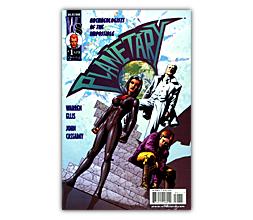
The premise is delicious: a team of super-hero archaeologists on a mission, not to fight crime or save the world, but to expose the secret dealings and hidden agendas that have shaped the world they live in. That's the idea that powers Planetary, the new epic undertaking by acclaimed comics writer Warren Ellis.
As with Ellis' other book for Wildstorm, The Authority, I was leery enough of the idea of reading stories set in the singularly unoriginal Wildstorm superhero universe that I held off on buying the first few issues. Much as I love his magnum opus, the beautifully perverse Transmetropolitan, I was afraid that Ellis was doing these books to pay the rent and wouldn't lavish as much detail on them as on his own work.
To an extent, this is the case. Certainly the Wildstorm books lack the jam-packed feel that makes Transmet so alternatingly exhilarating and exhausting. The dialogue and panel count have both been pared down. But the quality of the writing, plotting, and characterization has come across completely intact.
The book centers around three superpowered individuals who've been brought together by the utterly mysterious "Planetary" organization and its head, the "Fourth Man," to track down the sources of fantastic rumors and legends, and in the process lay bare the secret history of the world. Their search bears some interesting fruit: in one issue they find an incredible "quantum computer" somehow built in 1944; in another they encounter a fantastically advanced spaceship capable of sailing between parallel dimensions. At first these phenomena seem to be unrelated, but as the series progresses Planetary begins to realize that there are forces at work actively trying to stop them from getting at the truth (which seems to have something to do with the mysterious "snowflake effect" first seen in The Authority). I'd call Planetary a superheroic "X-Files", but the comparison would be unflattering to Planetary, which has clearly been thought-out in its entirety.
The other great thing about the book is the characterization. The main character, one Elijah Snow, possessor of vaguely-defined temperature altering powers, is one of Ellis' best creations in the genre. Snow--who, like Jenny Sparks and several other characters in the Planetary/The Authority milieu, was born on January 1, 1901--is quiet, circumspect, and convincingly conveys a vast intelligence. (Though John Cassaday's artwork is a major help in this regard.) He starts out with an almost voyeuristic detachment, but as the wonders and atrocities pile up, his hidden moral dudgeon begins to take over. There's an incredibly powerful scene where Snow breaks into the lair of a secret cabal of Cold War astronauts who were given superpowers after an accident in space (a clear reference to Fantastic Four) and marvels at the incredible collection of advanced technology. Discovered by one of "The Four", Snow kicks him in the balls and, towering over the squirming form of his foe, delivers a raging speech that could've come from the mouth of Transmet's Spider Jerusalem: "I know you've done your share of making the world mediocre...if I understand it right, the things here could save millions of lives a year. I have just one question...why?" The answer is chilling; if Ellis' heroes are often morally ambiguous, his villains are sheer evil.
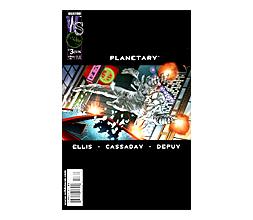
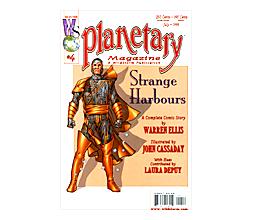
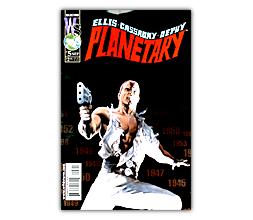
Special mention needs to be made of John Cassaday's art, which is nothing short of miraculous. It pulses with atmosphere and hidden, brooding power. Every character, whether major or minor, is flush with visual detail. Combined with Laura DePuy's excellent coloring (one of the few really good uses of computer coloring today) it makes Planetary a monthy visual feast.