


| Did
you ever wonder how astronauts scratch an itch? If you haven't, I
have. So if your curious and would like to know the answer to this
question, keep reading along.
If you think about it, an itch for an astronaut in space isn't too much of a problem. The majority of time an astronaut spends in space, he or she is inside the space shuttle wearing street type of clothes, which consists of comfortable pants or shorts and a t-shirt or polo shirt. So if an astronaut has an itch inside the space shuttle, he or she just scratches it. But what about when an astronaut is in his or her space suit? How does the astronaut scratch that itch? Pictured below: a group photo of those wild and crazy astronauts wearing their "street clothes" onboard the space shuttle. 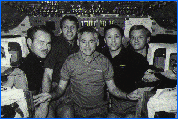  During the launch and reentry stages of a mission, astronauts wear a bright orange outfit known as the launch-and-entry suit (LES). This suit is very similar to the suits worn by jet fighter pilots and is designed to pressurize in the event the cabin has a sudden loss of pressure during launch or reenrty. The other important component of the LES is, of course, the helmet. The "big white suit", which makes the astronauts look like Pillsbury dough boys, is the EVA suit. This suit is much bulkier than the LES and is designed for the demands of outer space. If you seen a picture or a film of an astronaut during a space walk, a satellite repair or during a golf game on the moon, then you've seen them wearing the EVA suit. 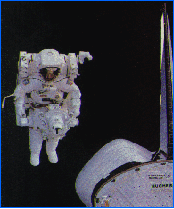  The helmets the astronauts use are locked to the neck clamp and do not move. When an astronaut decides to look at something, let's say to his left, the astronaut must move his whole body in that direction to get a look at it. Many people believe that the suits the astronauts use today are custom made for each astronaut, but this isn't true. The suits come in small, medium and large and have allowances for long and short limbs. Back in the days of Apollo, the suits the astronauts wore were custom made for each astronaut. To say that the LES suits are more comfortable than the EVA suits is a no brainer. But did you know that an astronaut is in this suit, before takeoff, for at least one and one-half hours before he or she is launched into space? And if there are delays, they may be stuck, without free movement, for up to four or five hours, which gives them sufficient time to think about the dreaded problem of ITCHINESS. Of course, once the shuttle is launched, it is in orbit within eight and one-half minutes (WOW!), the astronauts can change into street clothes. And once into street clothes, or while getting into street clothes, an astronaut can start scratchin' good ole Mr. Itch. So the question is: Is Mr. Itch a big problem among astonauts? Believe it or not, the biggest problem, according to astronauts, are with facial itches, especially on the nose. So now the question is: How does an astronaut scratch his nose when he has his helmet on? Let's find out. Pictured below: the astronaut William R. Pogue giving a demonstration to his fellow astronauts on how they should proceed in scratching their private areas in an EVA suit. 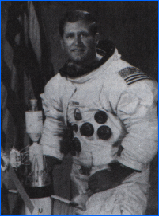  Inside the EVA helmet there is a V-shaped object known as the "Valsalva device", which is designed to relieve earaches created by pressure changes in the cabin. Normally, if an astronaut did not have his or her helmet on, they would simply hold their nose shut and blow through it to equalize the pressure in the middle ear and clear the Eustachian tubes. But when an astronaut has a helmet on, he or she must use the Valsalva device that is built into the side of the helmet. To use this device, the astronauts simply turn their heads and put their noses on it. Astronauts soon discovered that they rarely used the Valsalva device for ear problems but more and more for itching problems. Here's what ex-astronaut William R. Pogue had to say about the Valsalva device and itching: "Not only did my nose itch occasionally, but also my ears. Because a scratch is almost an involuntary reaction, I frequently reached up to scratch my nose and hit my helmet ----- which can make you feel real dumb. I scratched my nose by rubbing it on a little nose pincher device we used to clear our ears {the Valsalva device}. A facial itch is less of a problem for the astronauts when they are using the LES suit. Why? Because the visor on the helmet is flexible and the astronauts only close them for the first two minutes of each launch, until solid rocket booster separation occurs. Once that happens, the astronauts raise the visor and scratch that facial itch. Of course, if the orbiter lost pressurization, the astronauts would have to keep their visors down.   What about body itches in an EVA suit (the Pillsbury Doughboy suit)? According to the astronauts, the best thing you can do for a body itch in the EVA is to try and rub the itchy part against some part of the suit (EVA suits are very stiff and hard, which makes it impossible to scratch an itch through the outside of it). If you can't do that, you are simply out of luck. LES space suits are not as stiff as the EVA suits and it is possible to scratch an itch through the outside of the suit. Michael Wysmierski Special
thanks to Dallas
Brozik (Huntington,
West Virginia) for the information used in this article.
  |