 Discussions:Video Game Violence
Video Game Violence:
A Look at Violence in Video Games
Video game sales have been on the rise since the late 1990's and most game producers are pushing the envelope on realism and violence levels in the gaming industry. Does this increase in game violence mean that we are producing more violence in teens and adults than previous generations? No, rather the violence increase means that we need to make sure that our teens understand what kind of behavior we expect of them in society. While some research on video games has suggested a possible link in a player's aggressive behavior tendencies and the game's violence level, the real problem is a lack of parental guidance, personal accountability, and responsibility.
Before video games, children often engaged in shoot-'em up games such as “cops and robbers” that allowed them to act out their fantasies of shooting people or being a hero. Kids employed fake guns, sticks, or even empty hands to simulate weapons that would “kill” the other player for a short time. Nobody considered these activities dangerous as long as the children acted properly and did not get into a fight. No safety studies were conducted to determine the level of violence the participants in this horseplay activity displayed, or how it could cause some children to grow up to be bank robbers. At the time parental guidance, traditional values and morals, and personal accountability were enough to stop us from actually going out and recreating our fantasies.
Today, however, the psychology “experts” in society have a different point of view. They feel that we as people are unable to make decisions for ourselves, and that we are deeply influenced by what we see and hear, not what we have been taught. They feel that if we are exposed to massive violence as a youth, we are locked into a path of violence that we cannot stop. Thus, we are no longer to blame for our actions; instead, the “evil” video game makers, gun manufacturers, and movie producers are responsible. To support this they have launched numerous studies and fact-finding surveys to try to prove this theory.
In 2002, a video game study found that over seventy-nine percent of children in America play video games more than eight hours a week on average. Of these most are children between the ages seven and seventeen (Walsh, David). In 1998, a study found that over eighty percent of most adolescents preferred games they played to have violence in them (Walsh, David). However, few studies have attempted to link this violence to aggression. Some of the performed studies base their findings on the assumption that if television violence has a certain affect on people, video game violence will have a greater significance. They justify this belief in that television is passive in nature, but video games are active. If this is a true assumption then we can expect to see teens that played “army” as a child to then go out and perform violent acts against people more often then those that merely watched “GI JOE.” The fact that we do not see this kind of activity illustrates the truth that as we grow we learn that certain behavior is intolerable. For instance, I myself used to play with fake guns and swords with my sister all the time. I would never even consider going to school and attempting to harm a person with a real gun or sword because I was raised with the belief that I am accountable for my actions and it is wrong to try to hurt people.
Of the studies that have been done, the one most often used to support the claims that violent games increase aggression is a study conducted by C. A. Anderson & K. E. Dill. In this study, some students played non-violent games while a different group played violent games for a set period. They then completed a series of competitive tasks. On completion, the winning team was to make a controllable noxious blast of noise at the losing team. The study indicated that the players of violent games made their blasts last longer and that this indicated their level of aggression. However, a noxious noise blast is not the same as pulling out a gun and killing a person. This study could show us that people who play violent video games are more competitive than those that do not. This could be the reason they play the games: to act out their competitiveness in a positive manner. For instance, I often play violent video games. While sometimes I will play them to relieve stress, I also play them to engage my mind in a focused puzzle that forces me to think about how to solve it. This allows me to focus any competitive feelings I have towards the game. I remember hearing “do not hit people, but rather hit a wall if necessary.” This display of violence towards a wall could then allow a person to act out his anger in a socially proper fashion. The same should apply to video games. If a person is feeling violent tendencies, he can take his frustration out on a game and once he has calmed down rejoin society.
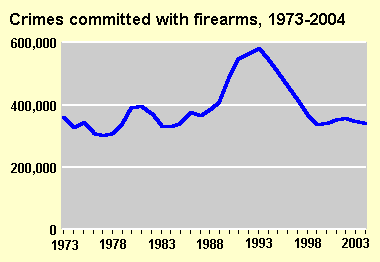
These studies fail to take into account one simple fact: while video game playing has expanded dramatically since 1994, violent crimes have declined in the same period. A study by the Bureau of Justice Statistics shows that violent crime is down and crimes committed with firearms are down as well. If we were producing a new generation of trained killers through video games, would we not see this in crime statistics? Alternatively, perhaps our “violent” teens are too busy killing realistically animated characters to be out committing crimes. Is this a bad thing?
How then can we stop teen and student violence? First, parents should start by taking active roles in their children's lives. By enforcing strict guidelines for children, they can limit the level of game playing and the amount of aggressive behavior. In addition, they should approve all games their children play. Allowing a five-year old to watch a violent, bloody video is ludicrous to most parents today, why is it different with games? For instance, I never even had video games until about the age of ten. Moreover, often my parents did not allow me to watch violent movies. My parents loved me enough to enforce strict guidelines and rules for me to follow.
On April 20, 1999, Dylan Klebold and an accomplice, Eric Harris shot several students at Columbine High school. Shortly after the media asked questions about what games they played and movies, they watched. No one asked why the parents did not know what their kids were doing. Later as information was gathered, the media revealed that both Klebold and Harris worked on bombs in a home garage. The parents never asked their kids what they were doing. In addition, Harris and Klebold both practiced target shooting. No one mentioned that we should ban target shooting. Finally, Harris and Klebold both maintained a web page that voiced their feelings towards the other students at Columbine. Neither parent nor teacher tried to help Harris and Klebold with their problems.
Second, we should teach our children to hold themselves accountable for their actions. Instead of looking for something to blame, we should look at the person who committed the crime. Personal responsibility is not new to our society, but rather it is something we have forgotten and need to reintegrate into our lives. For instance, if I kill a person, I am accountable for my actions. Often criminals today try to pass the blame onto other people, parents, movies, games, or even religious icons (i.e. “the devil made me do it”). While parents can share some responsibility for the way they raised their children, they are neither the primary focus of blame nor the final factor in a person's decisions. For instance, imagine a person whose life was a tragedy at home. His father regularly abused him for most of his life. Now if he went and attacked a stranger on the street would we blame this person's father or him? If this person regularly practiced martial arts, would we say that the martial arts programs in America were training killers? How is it any different with video games?
Thirdly, we as a society need to see that blaming different groups of organizations is not the answer to solving violence. The solution is helping our kids today. Talking to them and being a mentor for our children is more beneficial then blaming the gun and gaming industries. With blame, we are not addressing the problem, merely covering it up. Rallying against video game violence cannot help the child tormented every day by bullies. However, if we stop and listen to our kids about their problems and let them know that you are there for them, we can stop them from acting out their violence in the real world. I have always been able to talk to my mom and tell her how my day has been. She supports me and wants the best for me. Therefore, by listening to me (even if that is all she does) she has helped me a great deal more than if she did not.
In conclusion, video games currently have a powerful effect on the children of our generation. While they are also increasing in realism and in violent levels, with proper parental guidance and personal responsibility we can prevent school violence in the future. We need to hold ourselves accountable for any actions we perform. We are ultimately responsible for our own actions. We also should hold accountable parents who cannot control their children. They share the ultimate responsibility in regulating their child's behavior.
Works cited
1. Walsh, David. “Video Game Violence and Public Policy” National Institute on Media and the Family http://culturalpolicy.uchicago.edu/conf2001/papers/walsh.html
2. Walsh, D. (1998). "1998 Video and Computer Game Report Card: Video Game Violence: What Does the Research Say?" National Institute on Media and the Family. Retrieved Nov. 19, 1999 from the World Wide Web: http://www.mediaandthefamily.org/1998vgrc2.html
Reprinted in: Media Scope. “Video Game Violence” http://www.mediascope.org/pubs/ibriefs/vgv.htm
3. Anderson, C. A., & Dill, K. E. (2000). “Video Games and Aggressive Thoughts, Feelings, and Behavior in the Laboratory and Life.” Journal of Personality and Social Psychology, 78, 772-790. Reprinted in: Walsh, David. http://culturalpolicy.uchicago.edu/conf2001/papers/walsh.html
4. U.S. Department of Justice, Bureau of Justice Statistics “Key Crime & Justice Facts at a Glance” http://www.ojp.usdoj.gov/bjs/
[Home] [Starwars] [Star Trek] [Anime] [Games] [Discussions] [About Me] [Links]