Tube Amp Repairs
There are a lot of reasons why people still use tube amps but, the number one reason is their sound.
Vacuum tubes are far more linear devices then their solid state counterparts. Because of this,
they do not need nearly as sophisticated circuits to be able to faithfully reproduce an audio signal.
The less components in the signal path, the less chance there is of altering the signal. This is
an over simplification, but does tend to hold true,
The Dyna ST-70 is an amazingly good sounding amp. It is also a very simple, straight forward
design. It relies more on quality components then wild circuit engineering and a lot of
technological and electronic voodoo.
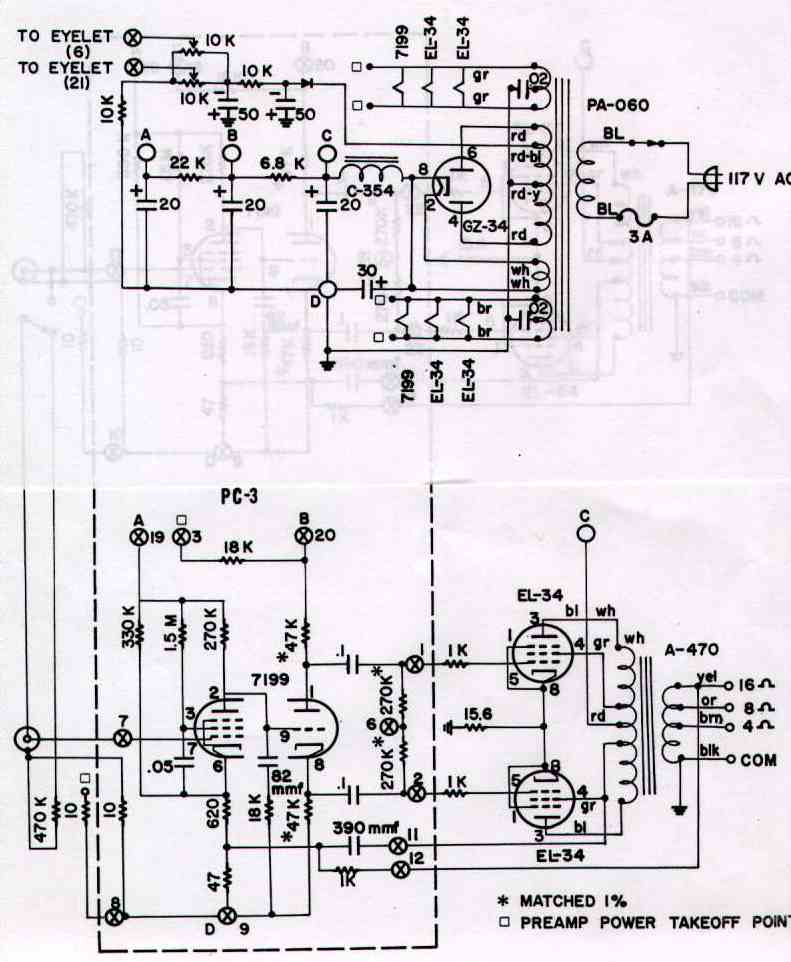
As you can see in the power amp section of the ST70's schematic, it utilizes a pentode amp,
a triode phase splitter and the classic dual pentode ultralinear push pull output stage.
This amp is very similar to the classic Mullard 520. The major difference is in the phase splitter where
the original Mullard uses both halves of a 12AX7 in a combination phasesplitter/driver stage and uses a
separate single pentode as the first amplification stage. The Dyna utilizes the 7199 pentode/triode to
do what the Mullard 520 does with a 12AX7 and an EF86.
Both amps use the ultralinear output design. This is also referred to as a distributed load design, and
is still used in tube amps today. For HiFi, I feel that this type of an output stage is
second to none. It offers low distortion, high power, and great stability. The only drawback is that
you need to find output transformers with the extra grid taps. The key to a good sounding amp
is in it's output transformer. You can use all the "wonder" components you like,
but if the output transformer is a piece of crap, the amp will sound lousy.
The A470 Dyna and Arco TO-300 are two of the most popular ultralinear output transformers.
The A470 is used in the Dyna ST70, and the TO-300 was commonly used in the Mullard 520.
Both transformers sound great!
The power supply in the ST70 is all but identical to the one I built for my Mullard 520. It
is very simple and is all tube. (with the exception of the bias circuit in the ST70. )
Since the Mullard 520 is a cathode bias, it does not have the bias circuit in it's power supply.
If you take a look at the schematic for the ST70's power supply, you will notice that it employs a classic
Pi filter arrangement of Capacitor-inductor-capacitor. This is a very effective circuit and Oh so simple.
Be careful of adding a lot of extra capacitance to the first filter stage (the 30UF capacitor that
is connected to pin 8 of the 5AR4). If you must go with a larger capacitor, put a 10 watt 10 ohm resistor
between the 5AR4's pin 8 and the first filter stage. If you put too large a capacitor where the
30uf capacitor connected to pin 8 of the 5AR4 is, you run a chance of causing the tube to arc
and possibly damage itself in the event of a power dropout. Also, if this capacitor is too large, and
you turn the amp off then back on, you will jump a huge arc inside the tube. This is NOT good
for the longevity of your 5AR4.
A lot of modifications are being made to and sold for the ST70. A lot do really enhance the sound
of this 30+ year old amp. A lot are really stupid and really detract from the sonic quality this amp
is capable of. If you are a tube lover as I am, and want a tube amp that sounds like a tube amp,
DO NOT REPLACE THE 5AR4 WITH A SOLID STATE RECTIFIER..PERIOD.
This will result in an amp that has a little more bass punch, but will lack that beautiful
imaging and warmth only a true all tube amp can produce. Believe me, the power supply
in a tube amp does have an audible impact on it's sound. If you have a PAS2, or 3 preamp
connected to a ST70, you have an all tube system. Both the preamp and power amp use tubes
in the power supply as well as for every amplification stage.
The mods that seem to have the greatest positive effect on the ST70 are the ones that
address the shortcomings of the driver/phasesplitter stage. Several companies offer
upgrades for the printed circuit board which not only hotrod the circuit but also
allow the use of tubes such as the 6U8 and 6AN8 in lieu of the hard to find and
expensive 7199. Personally, I prefer the 7199. It has been my experience that the 7199 is
far quieter then these other triode/pentode types.
Speaking of triodes, there are a lot of people "Triode" connecting the ST70. I heard one
that used the EL34's in 'triode mode', and about all it did was make a 35 watt per
channel amp into a 15 watt per channel amp. It didn't sound any better, and it had less then
half it's original power. If you must jump on the bandwagon, by all means, go for triode connecting
the best sounding pentode around. But, if you want a
great sounding amp that will drive real world speakers, let the EL34's run as they were
designed to. In pentode connected ultralinear mode. A. Hartley stated in the HiFi annual of
1957 that the EL34 was designed as a pentode and was intended to be used in an
ultralinear output stage. He later went on to vent his frustration at the misuse
of the EL34 as a triode. He called it essentially a waste of a great tube.
.
If you absolutely must go triode. The tube sockets will accommodate 6B4's.
These are essentially 2A3's with a 6 volt filament and an octal base. You will have to bias them by
connecting resistors from the filament winding's center tap to ground. Then you will have to remove
the "fixed bias" circuit. Again, I ask, why? Why make a great sounding 35 watt amp into
a weak 15 watt one? Anyway, for bias resistors, start with an 850 ohm 10 watt for each of the two
filament windings center tap connections. Connect one end to the center tap and the other to ground.
Turn on the amp and check the plate current making sure it doesn't exceed 40 ma. per tube.
If the current is too high, increase the value of the resistor. If the current is too low, lower the
value of the resistor.
The pinouts of the 6B4 are:
pin 1, not connected
pin 2, filament
pin 3, plate
pin 4, not connected
pin 5, grid
pin 6, not connected
pin 7, filament
pin 8, not connected
The sockets on the ST70 do not have to be rewired to accommodate the 6B4. Even if
you leave the ultralinear taps connected, it is not a problem since that pin on the 6B4 is not used.
Pin 8, the EL34's cathode is also not used by the 6B4. Anyway, what you do need to do is disconnect
the negative grid bias circuit.
The next don't" on my list is the increase the size of the coupling capacitor mod. The .1uf coupling
capacitor is more then sufficient given the power limitations of a duet of EL34's and the Dyna
output transformers. At 35 watts, you do not want to drop the low end of your bandwidth below 20hz.
Actually, there is very little actual "Music" much below around 35hz. In fact, H.H. Scott has
a cutoff filter in all their amps that essentially chops off all frequencies below 20hz, even though their
amps could produce frequencies below 20hz. The reasoning behind this is to conserve
all of the amp's power for the normal audio range. By chopping off the amp's response at
20hz and 20khz, you do not waste power trying to reproduce tones that are clearly out of the range
normal human hearing.
What follows is a list of what I would consider mandatory component replacements if
you want a reliable ST70.
1. The 4 coupling capacitors (.1uf @ 400v)
2. The bias rectifier (1amp or higher at at least 250 piv)
3 The power supply can capacitor (30x20x20x20uf @ 500v)
4 Both filter capacitors in the bias circuit (50 - 100uf @ 100 or more volts)
5. Make sure the amp is properly biased
By replacing these components, you greatly reduce any chance of catastrophic failure
of the amp. the only other thing I suggest is to check the value of all the carbon resistors
on the circuit board. Replace any that are over 5% off the stated value. If you do these things,
your ST70 should run reliably for year, and only need periodic tube changes.