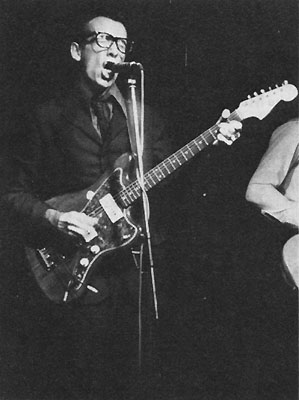
 ELVIS COSTELLO:
I fought the law!
By Dave Schulps
arely has mystery surrounded the arrival of a new rock performer the way it has Elvis Costello. Totally unknown a year ago, courtesy of Stiff Records Costello burst forth onto the British music scene. His debut album, My Aim Is True, quickly became the largest selling import of 1977 and led in short order to a contract with Columbia Records in America.
If Elvis's name alone wasn't enough to make you do a double-take, the album cover, featuring this unusually plain-looking bespectacled chap striking a knock-kneed Presleyesque pose, was certainly enough to garner a raised eyebrow and second glance from any dedicated rock 'n" roller. But it was the music inside that provided the most complicated mystery of all: 12 songs of revenge, guilt, jealousy, humiliation and rage written and sung by Elvis, who also supplied his own lead guitar work in tandem with an unnamed backing band, spartan arrangements, and minimum-frills production by Stiff stablemate Nick Lowe.
In fact, prior to the release of the album, Elvis was keeping such a low profile that many were sure that Lowe himself, recording under this strange pseudonym, had made the record and that our boy Elvis was just a figment of Lowe's and the inscrutable Jake Riviera's collective imagination. Gradually it came to be known that there was indeed a real live Elvis lurking about London and that he and band would soon be unleashed on an unsuspecting public, gigging around London in the near future.
By the time the reviews were in on My Aim Is True, Elvis was already hot property on his way to stardom. Not only was his single, "Less Than Zero," climbing up the British charts, but American FM stations were hooking onto the album almost as if it were an American release. The race to unscramble the Elvis mystery was on, but nobody was saying a whole lot, least of all Elvis, whose interviews were as oblique as most of the lyrics on the album.
It wasn't until Nick Kent of New Musical Express managed to get Elvis drunk and talkative (for him) that a picture began to emerge from the blankness. It turned out Elvis was really one Declan (D.P.) Costello hailing from Whitton, Middlesex, and was, as his lyrics strongly indicated, not just a little bit hung up on the idea of revenge and guilt, even going so far as to carry a little black book around with him containing a list of people to be dealt with when the propitious time arose (presumably after he had
achieved some degree of notoriety in the pop music world). Admission to the list seemed to be tied to rejection of Elvis in one way or another, and quite obviously, Elvis had known some rejection in his time.
Other interesting tidbits included Elvis's prior employment as a computer operator in an Elizabeth Arden plant ("Working all day in a vanity factory" is a line in "I'm Not Angry"); his annoyance at being compared to Graham Parker; the fact that he had recorded a demo for Dave Robinson (now director of Stiff) two years ago under a different name (rejected!) at the same time that Parker (accepted) and Willy DeVille (recording under his real name, William Borsay - also rejected) were doing the same; that he had once been a member of a bluegrass band called Flip City who had opened at the Marquee for awhile; and that he was married and had a child.
Aside from that and whatever could be gleaned from the seemingly autobiographical nature of his lyrics, the Elvis Costello story is strictly a game of fill in the blanks. And Elvis doesn't seem too keen on helping. The story was going around that a journalist from Sounds had been stuck into a corner of Dingwalls (a club in London where Elvis was appearing) by Jake Riviera, Elvis's manager, and told to wait there for Elvis to join him for an interview. Sometime over an hour later the writer was reportedly told that Elvis had left the building long ago.
Fortunately, Jake likes the Trouser Press, so when we asked him for a crack at Elvis, albeit over the phone from 3,000 miles away - hardly the proper circumstances for dragging anything out of a tough interviewee - we weren't left holding the phone. No, Elvis called at the appointed time (thanks!), but as expected proved a tough nut to crack. Not that he was hostile, or even particularly evasive, but he made it clear that he felt his past was for the most part irrelevant, that he wasn't too crazy about people analysing his songs and certainly wasn't going out of his way to help them. That didn't mean there was nothing to talk about, but it did limit things. Still, so much had happened to Elvis in the year since he had joined the Stiff stable of artistes that we were at least able to put Elvis's recent doings in some kind of perspective.
How long had he been writing songs and trying to find a label before coming to Stiff?
"I suppose I've been writing for seven or eight years now, since I learned to play lead guitar. I started writing soon after that, but it doesn't mean the songs were any good, You just start writing for a bit of fun and then you find it means something. I started taking my songs around about three or four years ago after I moved back to London from Liverpool, where I'd been living for two years. From then on I tried to get various things going without much success. About a year before I signed with Stiff I was actually taking tapes around to all the other labels and not getting very far with anybody. In fact, I wasn't getting anywhere. That's about it, really."
Why did he think they had passed him up then? Was it just too different from what was around at that time?
"I'd say it was down to lack of imagination on the part of the people at most of the other labels. They can't hear something unless it's put on a plate for them. I didn't think it was all that different; maybe they did. I think it was their ears that were at fault, not mine, and fortunately that's the way I kept thinking about it. I did sometimes wonder whether I wasn't mad and that maybe it wasn't any good, but I kept on thinking it was they who were wrong and not me. It turned out to be the best way to think about it."
For sure. But then Dave Robinson, who eventually was to sign Elvis at Stiff (at this time Elvis is no longer with Stiff, having been caught in the internal break-up there and choosing to stick with Riviera, who has left the company for undetermined points), was one of those who'd rejected Costello back then.
"Funny about that. He was quite surprised when I turned out to be the same person. When I submitted the tapes to Stiff, he didn't realize that it was the same person who'd done the earlier tape because I used another name then. It turned out he already had over an hour of me on tape and didn't know it. None of it's of great interest now except historically. It doesn't interest me in the slightest. Whether it'll ever get used is another matter."
An inquiry into the name Elvis used to record those earlier demos, however, brought out Elvis's defenses. That was digging too deep. "I'm not going to go into all that," he stated flatly, "because I don't like to dwell on the past. I don't see that as important now, that's gone. It's just a matter of irony, really, that they happen to have those tapes, but I don't want to talk about them that much."
Anyway, Elvis's reunion with Robinson took place because he answered an ad by a new record company who were looking for artists to submit tapes. "I believe it was one of the first they received," he recalled, "They just reacted to one of the songs and said, 'Yeah, we'll make a single,' which was the policy of Stiff in the early days. It just developed
from doing a single to doing an album as we cut more and more
tracks."
- p2 -
"The next album is going to be a lot crueler."
The album. It hit me right in the gut the first time
I heard it. The compact, straightforward delivery, the pure simplicity
of great rock 'n' roll songs, and the words. Songs for losers,
for anyone who's ever felt like they were being hurt or humiliated.
Maybe not each and every song, but the feeling pervades the LP.
Try these on for size: "I said, 'I'm so happy I could die'/She
said, 'Drop dead,' and left with another guy"; "And
I'm doing everything just to try and please her, even crawl around
on all fours/Well, I thought by now it was gonna be easy, but
she still seems to want for more"; "I know that she
has made a fool of him/Like girls have done so many nights before,
time and time again." Or, "You're upstairs with a boyfriend
while I'm left here to listen/I hear you calling his name, I hear
the stutter of ignition/I could hear you whisperin' as I crept
by your door/So you found some other joker who could please you
more... I'm not angry."
Not angry? Sounds positively furious to me. Why,
Elvis? Why so bitter?
"Because I'm an extraordinarily bitter person.
I don't like to sound as if I'm too obsessed and can't feel any
other way, but it just happens that those songs evince that kind
of feeling and, therefore, the album is like that. The next one
could be very, very different, although I don't think it's necessarily
going to be any kinder. In fact, if anything, the way I feel at
the moment, it's going to be a lot crueler.
"People have noticed that a lot of the album
is about being rejected, but I don't like the idea of getting
too analytical about it. It's just what the songs are about, I
don't think about them too hard. I think people will see the next
album as being a little different. I hope they do, anyway, because
I don't want it thought that I'm totally obsessed with one theme
because I'm not. Just like everyone else I have good days and
bad days. The things that mean the most to you or affect you most
you write songs about."
But Elvis, isn't that a reason to get analytical?
Precisely because the songs affect or move the listener, they'd
want to know more.
"I think that's maybe journalist's job, if they
choose, depending on the nature of the paper or magazine. Sometimes
it's on a very superficial level - asking me what I eat for breakfast
or something - other times they want to know what books of philosophy
I've read so they can determine something about my soul. It all
depends on the complexity of the analysis."
I protested that it wasn't as a journalist, but as
a listener who was moved by what the songs said or implied, that
I wanted to understand his motivations better. Personally, I didn't
feel it had anything to do with my job. I was touched by the songs,
identified with some of the feelings he was expressing.
"I suppose you try to make people think a little
bit," proffered Elvis. "You intend to have people identify with what you're writing. Not to be crass about it and say, 'How will I write a song which will
go to the heart of every kid in the land?' or, on the other hand,
be like Cat Stevens and write these terribly introspective songs
that only have meaning to yourself. That's it, really. I don't
really plan these things. I just write them and they come out
as they are."
Did he have any particularly favorite songwriters,
or people that he felt were influential on him?
"Yeah, but they change so rapidly that I tend
not to itemize them and say, 'My favorites are.... because they
change from day to day. Somebody asked me last week and looked
at me kind of surprised when I said Dusty Springfield was my favorite
singer. Right at that moment, she was. Right now, George Jones
is my favorite singer because I happen to be listening to his
album a lot. The same thing happens with songwriters, they just float in and out of my
head. I'm not particularly obsessed with anyone who would bear
down on me in any way."
Elvis has put together a backing band since he started
doing concerts. They're called the Attractions and consist of
ex-Chilli Willi drummer Pete Thomas, ex-Quiver/Moonrider bassist
Bruce Thomas, and Steve Young on keyboards. Elvis says the band
is meant to be permanent, "or until it goes wrong,"
but adds that he's not thinking about anything going wrong. "We're
thinking about it going right," he adds for emphasis.
Questions about the band members' past history, however,
meet with the same response as questions about his own.
"They're not particularly interested in talking
about the past, either. We don't like to dwell on the past in
general. They're the Attractions now and I'm Elvis Costello and
we're not bothered whether people talk about the past or not.
We just generally encourage them not to, because I don't feel
it's very interesting and they feel the same way.
We think it's polite of people if they don't talk
about it, and we usually think a little less of them if they dwell
on it too heavily."
I wondered if that was a subtle warning. Anyway,
when did he start calling himself Elvis?
"A while ago."
Why?
"Why not?"
So much for motivation. But didn't he think that
people just hearing about him now might get the wrong idea and
think he was jumping on the Elvis bandwagon? Did he feel Elvis's
death hurt him?
"We did lose a bit of press, but it's not any
big deal, it's just a name. It wasn't meant as an insult to Elvis
Presley and it's unfortunate if anybody thinks we're having a
go at him in any way. I don't really comment on it at all, usually
- it's really irrelevant. It's just because it's such an unusual
name that anyone would even bother asking me about it. If John
Lennon died tomorrow, people wouldn't ask John Miles about it."
Come on, Elvis, that's ridiculous. If Elvis was your
given name, I could understand, but you did take it on.
"Yeah. It's rather like wearing a crown, because
people expect something of you. I don't mind that, I'm prepared
to give them all I can. I don't think any feelings on it are relevant,
though. I'm not prepared to be quoted about it."
One very amusing incident made headlines in the British
music papers recently. It involves Elvis's getting arrested for
playing music in the street without a permit, an incident which
took place in front of London's Hilton hotel in ritzy Park Lane
where, inside, CBS Records was holding its annual international
convention. Jake and Elvis thought it would be a laugh if Elvis
went outside and played for the company staffers when they went
outside on their lunch break.
"We were playing a gig at Dingwall's that night
and we went down to let them know that the gig was on," Elvis
explained. "We had guys walking around with placards advertising
the gig and I was playing through a battery-powered amplifier.
They came out on the pavement and quite a big crowd gathered very
quickly, including quite a few of the big guys at CBS. All these
guys were actually standing there and applauding, but the Hilton
didn't see the humor in the situation and called the police.
The police didn't see the humor in the situation and arrested
me. It wasn't a big deal. It was just a crazy stunt." Elvis
is now signed to CBS in America.
Getting back to My Aim Is True, there were
two songs I felt Elvis might be willing to shed some light on
(not analytically, of course), because their subject matter stood
out from the other songs. One is "Waiting for the End of
the World," the album closer which seemed to be some kind
of fantasy story, with Dylanesque images ("The legendary
hitchhiker says that he knows where it's at/Now he'd like to go
to Spain or somewhere like that/With his tombstone bible and
his funny cigarettes/His suntan lotion and his castanets...");
the other is "Less than Zero," which also appeared on
Bunch of Stiffs, and refers to British Nazi spokesman Oswald Mosley
in its lyrics.
" 'Waiting' was just the result of a particular
feeling I had. At the time I wrote it I was working a day job.
It was written on a train where several incidents had occurred
to spark off this frame of mind. It's rather the way I feel, more
resigned than angry. The whole album is pretty much that way because
I feel that, particularly in England, people don't go shooting
each other in the streets - if they get fed up with their neighbor
they don't go and kill him. It's probably just that we can't buy
guns so easily as you can in America. We read a lot about people
getting shot over trivial things there just because there's a
gun handy when somebody gets angry, but it's different here. It's
not that we're any better because we don't actually kill people
- the feelings are still there - it's just under the surface,
very close to the surface, and it breaks out quite easily. It's
just that we don't have these tools at hand.
"Some of the songs are about those kind of feelings,
but I don't like to put it in grand terms. I just like to put
it in the way I feel about it myself, maybe from one person to
another. That's why some of the songs have got violence in them
or elements of violence. Those things are very close."
It seems a repressed violence, though, quite masochistic.
"I'm not sure I'd like to get so analytical
about it. I tend to shy away from words like that come out, because
I'm not sure of the implications of using those kind of words,
but you could look at it that way, I agree.
"Briefly, 'Less than Zero' is about Mosley's
being allowed on TV during the evenings. I really don't feel like
itemizing these things though, because there's no point writing
songs if I have to explain them.
"Uh, listen, I gotta go, my wife's on the other
line."
A face for '78? Definitely. The album should've already
been released here by the time you read this, and Elvis says there
are plans for some US dates before the end of the year. Whether
or not he plays here, get the record; listen to Elvis. The guy
has something to say, and his record has touched me like no other
album this year. Make Elvis king once again.
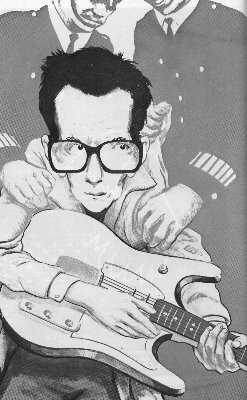 ELVIS COSTELLO: