|
|
During the blizzard of 1977, we were huddled in an all-electric apartment in Ohio wrapped in blankets to stay warm (the power had been off for nearly 8 hours), when I looked at Jean and said, "You know, we don't really have to live this far from the equator."
Within a month, I had landed a job with ITT in Cape Canaveral, Florida, and we were off for our first adventure into the world of big bizness! I started with the training group working on projects with NATO, which gave me the opportunity to travel to Belgium. Later, as Program Manager for a domestic switching project, I spent a lot of time traveling in the Caribbean -- Trinidad, Honduras, and Guatemala.
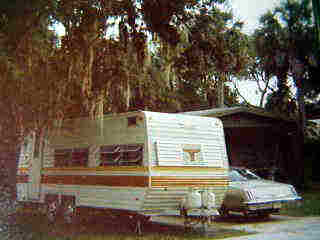
Here's the camping trailer we pulled down with our old dilapidated Oldsmobile parked outside our home in Cocoa. We loved the Spanish moss in the trees. |
|
After ITT, I went to work for United Telephone (now Sprint). I worked in the central office engineering group, upgrading switches to the new digital technology. During this time, I was tapped to design and install the first PC LAN in the company. When a vice president from our Florida company saw it, he drafted me to go back South and take charge of their office automation system. On the right is a view of the lovely central courtyard at the UTF headquarters building in Apopka, Florida. |

|
In 1988 I was invited by vps Ron LeMay (now Sprint president) and Dick Brown (now chairman of EDS) to come to corporate headquarters in Kansas City to help bring the corporate center executive staff into the world of computing. What an exciting and challenging task! I can still remember my prophetic words during the preliminary meeting in the View Room when, after ceaseless argument about this technology and that, I remarked that the real issues to be resolved would be behavioral ones, not technological ones. I think sharing this insight with the senior executives around the table helped to clinch the job for me.
Managing the introduction of personal computing among senior staff was a formidable process, but a thrilling one as well. There was a period of many years when I literally could not wait to get into the office in the morning. I recall one incident when chairman Bill Esrey dialed my number to leave me a voice message at 3:30 am and caught me at my desk drinking my first morning cup of coffee.
It was the era of the Intel 286 personal computer -- as embodied by the IBM PC-AT. People were buying desktop devices willy-nilly, and there was no centralized control or planning. Nor was there any way to centrally manage the resource. It was all "shoe leather" support. For this reason, we elected to provide an office productivity solution based upon a highly reliable minicomputer, delivering the screens to the executive desks via easy-to-use Macintosh computer interfaces. (This was the era of DOS, don't forget, and windows were just openings in the wall of Bill Gates' office.) I argued that broad deployment of PCs at that time did not make good economic sense because of their support requirements, cost, and the fact that they were used for such a small fraction of time. A shared resource computer, on the other hand, could be kept busy all day at high levels of utilization and, in the evening, could run batch jobs such as payroll and accounting functions. In support of this position, I developed a measurement that I called "Cost per Utilized MIPS-Hour" and proved that midrange computers afforded the best investment when compared to mainframe data centers and desktop computing. Desktop computing (PCs) in fact turned out to be the high cost alternative, coming in much higher than the second place data center model.
It was uncanny, the resistance we met from the data "establishment." One of the many criticisms was that our system did not comply with the corporate IBM 3270 architecture. In response to these complaints, I often tried to make the point that interoperability was the issue, not the architecture of a single system. "After you have solved all of your customers' business problems," I would say, "you go up on the roof and look down, and what you see is your architecture." Needless to say, this comment never brought a smile to the face of the computer priesthood. I guess a man's best friend is his dogma.
In the end, PC deployment ran way ahead of anyone's ability to control it. The Information Systems staff was pretty much forced to accept the rapid introduction of the machines by the business segment, and finally gave up on any attempt to slow down the rate of expenditure on PC technology. As one sagacious data guy was heard to say, "It's a lot easier to ride a horse in the direction it's going." Rapid deployment of PCs was occurring not just at Sprint, but in all American corporations. (One notable exception was Pioneer Hybrid Seed Corn in Iowa who was carefully managing the introduction of the technology at a reasonable pace.) Costs were sky-rocketing, but the machines were not being used to good purpose. We know this because the mean time to repair a PC during those early years was nearly a week. Business units would never have stood still for this if the machines had truly been vital to the unit's effectiveness. Much later, when I participated in a ground-breaking study of end user computing sponsored by the consulting firm of Nolan and Norton, we would learn that across all major corporations, the typical user was devoting 20% of his time assisting others in his work group with their PCs. That means for every five PCs we brought through the door, we had to hire one full time equivalent person to take care of them! We knew the hidden support cost was large, but we had no idea it was of this magnitude.
So how do we know if our investment in technology is paying off? There's a very easy measure to employ which can be bench marked across an industry group. The measure is simply the ratio of the gross billable revenue of the firm to the total expenditure on information technology (IT). The proof is as follows:
- The chief purpose of technology is to leverage human endeavor… to improve the efficiency and effectiveness of the labor input. Computers do nothing that cannot be done manually. They only do it faster.
- A good way to measure the contribution of an employee is to look at the fraction of gross billable revenue that the average employee supports -- i.e. GBR/total employees
- IT investment to support the employee can also be found by dividing the total IT investment by the total number of employees -- i.e. IT Costs/total employees.
- Now look at the ratio of contribution to IT cost per employee (GBR/total employees)/(IT Costs/total employees) and note that the total employee factors out of the expression, leaving
Gross Billable Revenues/Total IT Expense
When we benchmarked this number, we found that Sprint compared quite favorably to the industry, and it gave us a way to monitor our effectiveness as IT service providers. I was a member of the senior management team that successfully used metrics such as this to manage nearly 40 percent of the costs out of Sprint's IT structure while improving service levels several-fold. Yes, life was good!
I look back on my years at Sprint with fondness.