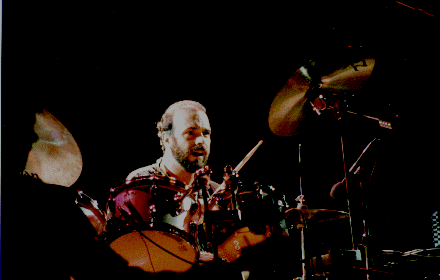
DM: Do you still play regularly?
DS: I'm starting to play a lot more these days, I've been playing
gigs with the two artists on my production company: Lyric and Jason Perrin,
it really feels good to play again, I've missed it more than I realized.
DM: Would you play in another band and tour if given the
opportunity?
DS: I suppose if the right opportunity came along, a tour with Billy
Joel, Elton, Sting or better yet a real Chicago reunion, meaning Peter and
I with the band, then I would consider touring. If one of my artists takes
off I would probably do their first few tours to show them the ropes.
DM: Are there any solo works in the making? do you still write?
DS: I'd like to do a real big band album some day but I'd have to
do some real wood shedding before I do, right now I'm really focusing on
my production company and getting my artists careers going.
DM: Who were your greatest influences earlier in your life and who
has the greatest impact on you now?
DS: Gene Krupa was the single biggest influence when I first started
playing, then I got into Buddy Rich who had a tremendous influence on me
also, I then I got into guys like Elvin Jones, Max Roach, Tony William�s
and Grady Tate and I had the honor and privilege of studying under the legendary
Jo Jones. As far as rock drummers Mitch Mitchell (Jimi Hendrix), Ginger Baker
(Cream), Ringo, Hal Blaine, Steve Gadd, Jeff Porcaro, Bernard Purdy and John
Robinson. (Their really isn't anyone that I'm into right now).
DM: What exactly is Street Sense Records?
DS: Street Sense Records is my record company. I'm using� it
as an alternate way to get� my artists to the market place, when the
major record companies pass (don't sign) one of my artists then I release
their music on my company. I still believe in their music even though the
majors don't. As far as I'm concerned they're too interested in chasing trends
then manufacturing and promoting quality music. Proof of that is the lack
of excitement in the market place today. They don't establish long term careers
anymore; they're just interested in fastest hit record and they're really
missing the boat as far as I'm concerned.
DM: Name some of the acts that you work with.
DS: Jason Perrin, Lyric and Wakeup Call.
DM: Why did you go into producing as opposed to session or solo
work?
DS: I always felt that making records was the ultimate in creativity
and I really enjoy the role of producer, I feel I'm good at it and have a
lot to offer my artists. I�ve had the honor of working with some of the great
masters of making records and I've learned from everyone of them. (Phil Ramone,
David Foster, Jim Guercio, Tom Dowd) to name a few. As far as being a solo
artist, it just doesn't interest me right now and I've never been a session
player, I love playing in the studio but you have to be in the loop and I
have never been in it.
DM: How did you feel about drumming as Chicago moved more and more
towards using drum machines?
DS: In the beginning drum machines really intimidated most drummers
at first (rightfully so). Here was this machine that played in perfect time
and didn't talk back, at least that's what we were told by producers, song
writers etc., So there was a resistance by us to embrace them so we simple
wrote them off as a fad. We'll they put a lot of drummers out of work, at
the time as far as I was concerned they were a scourge. When I realized they
were here to stay I went out and bought a E-MU R-8 and learned it inside
and out, (I was sick of hearing these records with drum parts programmed
by a keyboard player or worse yet a non musician) and believe me they sounded
like it. I programmed all of Chicago 18 (Foster) was really hung up on drum
machines, so it worked out well. The programming sounded like a drummer and
David was happy because he had perfect time. To me the bad side of the drum
machine is that its deprived a lot young drummers of all kinds of work,
experience i.e. demos, cocktail bars etc. For that reason alone sometimes
I curse Roger Linn (just kidding) but they've also become a staple and a
great song writing tool, but at what cost, I'm still not sure its worth the
gain� (excuse my soapbox.) Fortunately drum machines have found their
place and live music is back, both seem to be coexisting today.
DM: In the early part of your career, you were an excellent drummer,
but in the eighties your drumming seemed to get less intense. Was this due
to the type of material Chicago was playing at that point or was it just
a reflection of your feelings about touring and where Chicago was going in
general?
DS: That's a good point and believe me I had a lot of problems with
that and it was a source of constant irritation between myself and the
songwriters. Around the fifth album there was a conscious change in the direction
by the band (song writers) and Jimmy Guercio. They came to the conclusion
that they had to start writing more commercial songs meaning less time changes,
shorter solo's more basic grooves, etc. Consequently we became a hit machine
instead of a band that took its music to the limits. Now I'm not saying that
they were wrong but it was the end of the Chicago that so many people loved
and respected, consequently from then on we lived and died by our next hit
record. It was a double edged sword in my opinion and we lost many loyal
fans at that point, but we gained legions of (not as loyal fans) also. I
was constantly trying to put my jazz licks into these commercial compositions
(Just You And Me, Old Days, etc.) I guess what I�m trying to say is my role
greatly changed in the band and it took me a long time to adjust, but eventually
I gave in to what the song writers wanted me to play as opposed to what I
thought should be played. It was a tough transition for me, and a sacrifice
of my musical integrity in a sense, but I think it was worth it in the long
run, I really believe that you have to compliment whatever is going on around
you no matter how simple or complicated the music is, that is the essence
of a true musician.
DM: How did you get started in drumming?
DS: My uncle is a drummer, he used to play at family functions, weddings,
anniversaries, etc. and I would stand on the side of the stage and watch
him play, I was fascinated by it and started banging on pots and pans. I
expressed a deep interest in learning to play the drums and the rest is history
so to speak, I was nine years old at the time. (I was always an intense
individual, so playing drums was a natural for me.)
DM: I've always respected your desire to constantly improve. I remember
reading an interview from around the time Chicago VII came out where you
mentioned studying brush technique with Jo Jones. What was that like for
you?
DS: Studying under Jo Jones was a incredible experience. He was very
intense and at times pretty tough to work with but he taught me many things
about playing, attitudes and discipline as well as his incredible brush technique
which I used on Chicago 7 "Devil Sweet." To this day I feel I�m a good brush
player and a better drummer because of Jo, he was an great man with intense
pride. He always stressed that I sit up straight when I play and look at
the audience in the eye when I�m playing, I�m grateful I had the opportunity
to study under him, when he came to see me play at Carnegie Hall and liked
what he saw and heard, we�ll it made me very proud.
DM: How do you feel about Chicago not getting nominated to get inducted
into the Rock and Roll Hall of Fame?
DS: Of course Chicago deserves a place in Rock N Roll history and
I�ll tell you why. Never before or since has their been a band with such
exceptional talent (musicianship, vocal ability, song writing) to attain
such a high level of commercial success. It was almost a fluke. Can you name
me one band that has or had as much talent in so many areas as Chicago (Police,
Blood, Sweat & Tears, Yes) and none of those bands lasted nearly as long
as Chicago or sold as many records. Chicago has lost some of its luster as
of late but the band still very much deserves to be inducted. That would
make me very happy.
DM: Have you kept in touch with Laudir de Oliviera at all?
DS: No unfortunately I haven�t, he is a really nice person. I hear
that he is back in Brazil teaching percussion and doing very well. I�d like
to see him someday he is a fun person with a happy spirit.
DM: I've noticed that magazines such as Rolling Stone and Entertainment
Weekly (they give everyone bad reviews though) have consistently given Chicago
bad reviews, do you think Chicago will ever get a good review from Rolling
Stone?
DS: Rap and Alternative has forced many of the really talented artists
to look else where for exposure. Anyway I imagine its been really tough for
those quality artists to sustain their careers, but necessity is the mother
of invention. So there�s been some good for these artists careers, that they
otherwise wouldn�t have accomplished, they�ve established strong followings
in those marketplaces that they probably wouldn�t have gone after. My feeling
is that quality music is going to make�a comeback, the major record
companies have been chasing trends and ignoring quality artists for too long
and its taken its toll on the industry. (sales and excitement level are at
an all time low)
DM: In years of late some of the most talented music groups and musicians
(such as Toto, Richard Page, and Bobby Caldwell) have been overlooked in
the United States yet in Europe and/or Japan they play to sold out crowds.
Do you think Chicago was received better by Japanese and European audiences
than it was by American audiences? Do you think their musical tastes are
more mature than that of the Americans?
DS: Chicago was a major success first in Europe and Japan but that
changed when we released Chicago II. Its funny when we became commercially
successful over here then our popularity began to fall off over there. Let
me say that Europeans have always embraced/appreciated�American Jazz
artists long before we started to realize what a wonderful art we have in
this country. It's only recently that their has been an awareness in this
country (thank god).
DM: Where do you think Chicago would be today if David Foster hadn't
come around?
DS: Who knows where Chicago would be today if I hadn�t brought David
Foster onto the scene. (Please don�t take that the wrong way I�m not blowing
my horn here, its just the facts) my friend Bobby Colomby urged me to consider
having David produce the band so he deserves allot of the credit. I tried
to get the band to have David produce Chicago 15 (thumb print album) but
I�was out voted by the band and record company, consequently when that
record stiffed people were ready to listen. I knew we needed a strong presence
in the studio, someone that we couldn�t intimidate with our numbers and
musicianship, someone that would co-write and bring new lifeblood to our
material, it had become stale we were too incestuous, the band was at an
all time low and David injected new life. Chicago was also David�s first
major success, so it was a two way street.
DM: In hindsight do you believe Peter's departure was good for both
he and Chicago?
DS: No Peter�s leaving served no one. Chicago was at a all time high
and Peter was at the center of it, its unfortunate because Peter could/should
have done what Phil Collins did but at the time he was getting some bad advice
and we were being stubborn. Peter went on to have a successful debut but
that was it and we struggled on Chicago 18 but we eventually prevailed on
Chicago 19 with three top five songs, but neither of us ever attained the
kind of success that we had on Chicago 17. I�d like to see Peter go back
with Chicago and do a reunion record and tour, I�d love to be a part of it
but none the less Peter is a great artist and he deserves finish his career
on top, it hurts me to see him struggling, he�s too good for that. I also
think it would help put Chicago back in the history books, where we very
much deserve to be.
DM: Donnie Dacus seemed to have dropped off the face of the Earth
when Chicago fired him. Do you know what ever happened to him?
DS: Your right Donnie Dacus did disappear from the face of the earth.
He was let go because he really didn�t fit into the band, never did, it was
a mistake in the first place. It wasn�t his fault either, he was a good guy,
he just didn�t fit in with the mix. I know it really hurt him to be let go
like that, believe me now I know how that feels.
DM: Although hindsight is 20/20, is there anything you would have
done different in your career?
DS: I have so much to be thankful for so having regrets is a little
like saying I�d wish I had been with the Beatles. I guess my only regret
is the way my tenure with the band ended, it kinda left me in limbo, it should
of ended differently, a farewell tour, long good-bye�s you know what I mean.
But like I said having regrets after accomplishing so much and experiencing
such incredible highs is like tempting the gods to bring the sky down on
you, so I think I�ll just be glad for what I accomplished and did with the
band and get on with my life, I have a lot of music and living left in me.
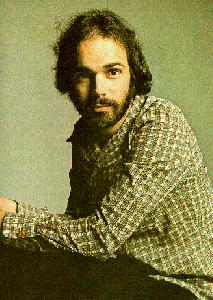
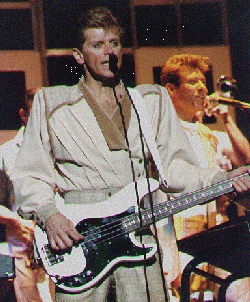
(NOTE: Every attempt was made to acquire the original photos used in this interview. One of them, at the very top, has been found and restored. The other photos were not available, so where possible, a representative photo was used in accordance with that part of the interview. Larry Launstein, Jr.)