

Music is similar to spoken language in many, many ways. In language, the end of a sentence is marked by a period, and the end of clauses and phrases is marked by a comma. In music, these endings are brought about by a musical punctuation called a cadence. Cadences bring the end of musical statements, some end the sentence for good, others simply end the idea and continue with a new one. In most western music, the types of cadences will usually fall under one of four categories: Perfect Authentic, Imperfect Authentic, Half, or Deceptive. A perfect authentic cadence is used to bring a very "finished" feeling into a piece, it is usually put at the end of a major section in the piece. The perfect authentic cadence consists of a two chord progression, V-I. What makes this cadence perfect is that both the V chord and the I chord must be in root position (not inverted). If the progression goes V-I, but the chords are inverted, then it is an imperfect authentic cadence. This type of cadence is not as strong as a perfect authentic cadence, but it still has a very "finished" feeling to it. A half cadence is used to leave things "up in the air". It usually falls in the middle of a two-phrase statement, or at the end of any passage that is followed by a continuation of the theme. This cadence is a also a two chord progression, but instead of going V-I, as in the authentic cadences, it goes I-V, leaving a very "unfinished" feeling. A deceptive cadence is basically any cadence that starts on the V, but moves to any other chord besides the I. These cadences are there to trick your ear, they make you think that V will resolve down to I, but instead it stays on the five, and then moves to some other chord and starts another phrase. These cadences are found mostly in sections where a single theme is being presented, for they do not provide any kind of closure to the statement.
There are other kinds of cadences, one of which is a Plagal cadence. Mostly, this cadence is IV-I, and brings a somewhat weak end to a phrase or statement. There are also Plagal Half cadences, which go I-IV, but they are used infrequently because it doesn't seem to end things at all.
By now, you should have a firm understanding of harmonic tones (tones which are part of a chord or key.) The next step is to learn about nonharmonic tones. Nonharmonic tones will usually be found stuck in between two chord tones (ex. {C maj chord} C-D-E.) Often, these nonharmonic tones will be on the upbeat, or unaccented, to avoid dissonance. There are several types of nonharmonic tones: Passing tones (ascending and descending), neighbor tones (upper and lower), escape tones, appoggiaturas, suspensions, retardations, and anticipations. See the chart below, the nonharmonic tone is circled.
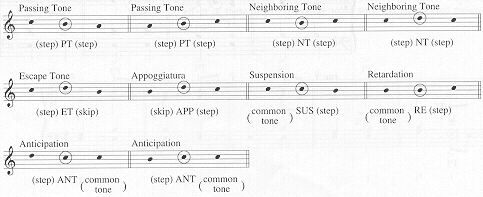
A passing tone is simply an ascending or descending stepwise motion, with the nonharmonic note in between two chord tones. A neighboring tone goes from a chord tone up or down (upper or lower) to a nonharmonic tone, then back to the original chord tone. An escape tone moves from a chord tone, up (or down) to a nonharmonic tone, then skips back in the direction of the original chord tone, but bypasses it for the next chord tone above that. The escape tone will usually fall over a two chord progression, with the first note being a chord tone of chord 1, the second note being the escape tone, and the third note being a chord tone in chord 2. The same goes for the next few nonharmonic tones. The appoggiatura is like a backwards escape tone. Instead of going step-skip, it goes skip-step. The chord tone is hit, then it skips to the appoggiatura, then moves stepwise to another chord tone. A suspension simply lingers on a note after the chord is hit, then resolves. It starts on a chord tone of chord 1, then when chord 2 is struck, it re-articulates the same note (which was a chord tone with chord 1, but is not with chord 2) before finally resolving to a chord tone of chord 2. A retardation is simply a suspension that resolves up, all suspensions resolve down, a retardation resolves up. An anticipation is the opposite of the suspension and retardation. This time, a chord tone is struck with chord 1, then before chord 2 is hit, the anticipation sounds (a chord tone of chord 2, but a nonharmonic tone with chord 1), and is re-articulated when chord two is sounded.
Beat placement and accents are very important with nonharmonic tones. The effect of a nonharmonic tone is greatly altered if that tone is sounded on the beat. It can be done, and it is not against any kind of rule to place them on the beat, it is done quite frequently, but the effect is all together different.
