Savage Garden Concert Reviews
July 11, 1998: Las Vegas, Nevada: The Joint
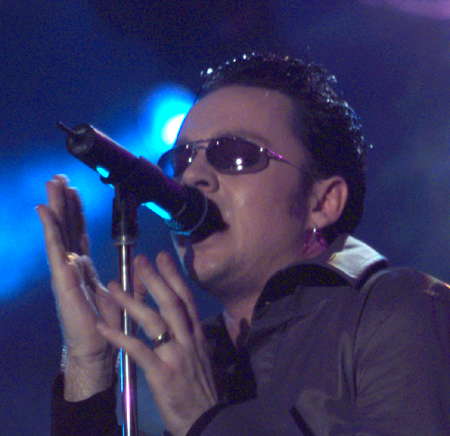 From: Battle of the Bands: Pearl Jam fills more
seats, but Savage Garden tops charts
By Mike Weatherford, The Las Vegas Review-Journal
Two concerts going off a few blocks away from each other Saturday night
may surprise some people with what they suggest about the current state
of pop music.
First: Pearl Jam, one of the few '90s bands that concert promoters hoped
would become stadium attractions, will instead settle for the Thomas &
Mack Center. Saturday's concert, originally announced for Sam Boyd Stadium,
was moved when ticket sales did not merit the extra overhead of the outdoor
date.
The move "isn't because of poor ticket sales," Thomas
& Mack director Pat Christenson stresses. The show sold better in Las
Vegas than in many markets, and likely will have people sitting behind
the arena stage, he said. Promoters "took a shot and thought, `If it becomes
a regional event vs. a local event we want it to be out there (at the stadium),"
Christenson says. Instead, Pearl Jam played enough concerts elsewhere that
promoters are happy with local sales of 16,500 and a probable sellout by
show time.
But a second development is perhaps even more surprising:
Pearl Jam is not the Saturday attraction that sold 4 million copies of
its latest album.
That honor goes to Savage Garden, a comparatively
obscure Australian pop band playing across the street at the Hard Rock
Hotel. When it comes to concert drawing power, "I think Pearl Jam is going
to beat us at the moment," says Daniel Jones with a cheery laugh. The multi-instrumentalist
shares the Savage Garden partnership with singer Darren Hayes.
But when it comes to what music buyers are taking
home, it's Savage Garden that has the Seattle band beat. The duo's self-named
debut album holds steady at No. 20 on Billboard's album chart after more
than a year in release, while Pearl Jam's million-selling "Yield" hovers
around the No. 1 spot after just five months on the chart.
At face value, the comparison could be seen as evidence
of what trend-spotters have been saying for months: Grunge is dead and
pop is back. Kids have traded their flannel for dance shoes, their guitars
for synthesizers.
Of course, Pearl Jam is not a fair example of a band
that furthers its career in calculated moves. Perhaps to its credit, the
band was distracted in recent years by its news-making battles against
the Ticketmaster agency and its social activism. Less productively, the
quintet also seemed musically divided when lead singer Eddie Vedder trailed
off to follow a Middle Eastern muse.
The Pearl Jam of today is not -- and by all accounts,
doesn't want to be-- the Pearl Jam that virtually defined grunge with its
10 million-plus seller "Ten" in 1992.
Even when the band played the Aladdin for two nights
in December 1993, the modest staging made Pearl Jam seem more like club
rockers than the biggest band in the country.
Pearl Jam already lowered commercial expectations
with 1996's slower-selling "No Code." The new album is following the same
downscaled commercial path, though it's getting more airplay. It's less
pretentious, and alternates between being more consistently tuneful or
garage-rocking in its simplicity.
"Everyone feels good about selling a million records
compared to selling 8 or 9 million, guitarist Stone Gossard told the Dallas
Morning News. "It's made our lives a lot saner, and besides, the fans who
really like us still go out and buy the records."
Pearl Jam's diminished following, however loyal,
doesn't dispute the theory that hard rock has retreated to a niche, while
pop is back as the mass-market common denominator.
Savage Garden's annoyingly catchy "I Want You" not
only resonates "chic-a-cherry cola" from poolside radios, but from "The
Rosie O'Donnell Show." "Truly Madly Deeply" was not only a No. 1 pop hit,
but doubles as the theme song to TV's teen hit "Dawson's Creek."
What's missing in this equation is the actual face
of Savage Garden. The wisest move the band may have made, in the face of
forced compliance to "Godzilla" and the Spice Girls, was to lay low and
let the music speak for itself.
"We were sort of held back, I suppose, from the press
or from hype or any sort of media," Jones says. "Basically, our record
company in Australia said it might be a good idea just to grow into yourselves
a bit before you start hitting the media with your image or whatnot."
The duo agreed. "You have to adapt to a situation
and figure out what you're gonna say before you open your mouth," Jones
says. Besides, the
music -- especially when it's
pop music easily roasted by critics -- carries
more validity if it's not laid
on with the hard sell.
"We've had quite a lot of success considering so many people don't
know who we are," Jones says.
"I take that as a bit of a compliment in that
the songs, something we put our
heart and soul into, have stood up fairly
well on their own."
Both in their mid-20s, Hayes and Jones grew up in Brisbane, Australia.
Jones describes it as "a really
big country town" about the size of Las
Vegas, with a fast-growing population.
Yet because Australia is still fairly
isolated, the two followed their
own path instead of anticipating trends.
Jones agrees his band's old-fashioned love songs are a counterpoint to
grunge, in which "everyone felt
they had to be angry." The two were
working separately in bar bands
when grunge came to Australia.
"It was really cool just to go see a local grunge band. If Savage
Garden started within that time,
it just wouldn't have worked. We would
have not got out of the pubs alive,"
he says.
That indirectly explains why Savage Garden was launched as a studio
project, tapping everything from
'80s Europop ("I Want You") to the Alan
Parsons-level of orchestration
in "To the Moon and Back." "We hadn't
played (the album) in those pubs
before. If we had, we probably would
have had scars all over our faces,"
Jones says with a laugh.
But freedom from rowdy bar crowds also allowed the duo to "make
every song different from the
next on purpose. It's more interesting, and also
allows you to be more versatile."
Jones and Hayes looked at Australian pop-rockers INXS as a role
model, but are now faced with
the frightening realization that their first
album's sales rival that of the
seventh INXS album, "Kick."
"That's kind of scary," Jones says, "because when you peak that early
you never quite know what's ahead.
The only solution we've got is to try to
do better again. Going into the
studio and writing better songs. If the (next)
album was released with great
songs in our mind, and that didn't work
because of (the novelty), then
I wouldn't want to be in the music industry
anyway. ... Then it's not about
music anymore."
No doubt Pearl Jam can relate.
And perhaps the Seattle band will. Jones reveals that Savage Garden's
tour employs some former Pearl
Jam crew members, so it may be that
when both Saturday shows are done,
"we'll end up at a bar drinking at
night."
Click here to return to Crystal
Minds and Magenta Feelings
From: Battle of the Bands: Pearl Jam fills more
seats, but Savage Garden tops charts
By Mike Weatherford, The Las Vegas Review-Journal
Two concerts going off a few blocks away from each other Saturday night
may surprise some people with what they suggest about the current state
of pop music.
First: Pearl Jam, one of the few '90s bands that concert promoters hoped
would become stadium attractions, will instead settle for the Thomas &
Mack Center. Saturday's concert, originally announced for Sam Boyd Stadium,
was moved when ticket sales did not merit the extra overhead of the outdoor
date.
The move "isn't because of poor ticket sales," Thomas
& Mack director Pat Christenson stresses. The show sold better in Las
Vegas than in many markets, and likely will have people sitting behind
the arena stage, he said. Promoters "took a shot and thought, `If it becomes
a regional event vs. a local event we want it to be out there (at the stadium),"
Christenson says. Instead, Pearl Jam played enough concerts elsewhere that
promoters are happy with local sales of 16,500 and a probable sellout by
show time.
But a second development is perhaps even more surprising:
Pearl Jam is not the Saturday attraction that sold 4 million copies of
its latest album.
That honor goes to Savage Garden, a comparatively
obscure Australian pop band playing across the street at the Hard Rock
Hotel. When it comes to concert drawing power, "I think Pearl Jam is going
to beat us at the moment," says Daniel Jones with a cheery laugh. The multi-instrumentalist
shares the Savage Garden partnership with singer Darren Hayes.
But when it comes to what music buyers are taking
home, it's Savage Garden that has the Seattle band beat. The duo's self-named
debut album holds steady at No. 20 on Billboard's album chart after more
than a year in release, while Pearl Jam's million-selling "Yield" hovers
around the No. 1 spot after just five months on the chart.
At face value, the comparison could be seen as evidence
of what trend-spotters have been saying for months: Grunge is dead and
pop is back. Kids have traded their flannel for dance shoes, their guitars
for synthesizers.
Of course, Pearl Jam is not a fair example of a band
that furthers its career in calculated moves. Perhaps to its credit, the
band was distracted in recent years by its news-making battles against
the Ticketmaster agency and its social activism. Less productively, the
quintet also seemed musically divided when lead singer Eddie Vedder trailed
off to follow a Middle Eastern muse.
The Pearl Jam of today is not -- and by all accounts,
doesn't want to be-- the Pearl Jam that virtually defined grunge with its
10 million-plus seller "Ten" in 1992.
Even when the band played the Aladdin for two nights
in December 1993, the modest staging made Pearl Jam seem more like club
rockers than the biggest band in the country.
Pearl Jam already lowered commercial expectations
with 1996's slower-selling "No Code." The new album is following the same
downscaled commercial path, though it's getting more airplay. It's less
pretentious, and alternates between being more consistently tuneful or
garage-rocking in its simplicity.
"Everyone feels good about selling a million records
compared to selling 8 or 9 million, guitarist Stone Gossard told the Dallas
Morning News. "It's made our lives a lot saner, and besides, the fans who
really like us still go out and buy the records."
Pearl Jam's diminished following, however loyal,
doesn't dispute the theory that hard rock has retreated to a niche, while
pop is back as the mass-market common denominator.
Savage Garden's annoyingly catchy "I Want You" not
only resonates "chic-a-cherry cola" from poolside radios, but from "The
Rosie O'Donnell Show." "Truly Madly Deeply" was not only a No. 1 pop hit,
but doubles as the theme song to TV's teen hit "Dawson's Creek."
What's missing in this equation is the actual face
of Savage Garden. The wisest move the band may have made, in the face of
forced compliance to "Godzilla" and the Spice Girls, was to lay low and
let the music speak for itself.
"We were sort of held back, I suppose, from the press
or from hype or any sort of media," Jones says. "Basically, our record
company in Australia said it might be a good idea just to grow into yourselves
a bit before you start hitting the media with your image or whatnot."
The duo agreed. "You have to adapt to a situation
and figure out what you're gonna say before you open your mouth," Jones
says. Besides, the
music -- especially when it's
pop music easily roasted by critics -- carries
more validity if it's not laid
on with the hard sell.
"We've had quite a lot of success considering so many people don't
know who we are," Jones says.
"I take that as a bit of a compliment in that
the songs, something we put our
heart and soul into, have stood up fairly
well on their own."
Both in their mid-20s, Hayes and Jones grew up in Brisbane, Australia.
Jones describes it as "a really
big country town" about the size of Las
Vegas, with a fast-growing population.
Yet because Australia is still fairly
isolated, the two followed their
own path instead of anticipating trends.
Jones agrees his band's old-fashioned love songs are a counterpoint to
grunge, in which "everyone felt
they had to be angry." The two were
working separately in bar bands
when grunge came to Australia.
"It was really cool just to go see a local grunge band. If Savage
Garden started within that time,
it just wouldn't have worked. We would
have not got out of the pubs alive,"
he says.
That indirectly explains why Savage Garden was launched as a studio
project, tapping everything from
'80s Europop ("I Want You") to the Alan
Parsons-level of orchestration
in "To the Moon and Back." "We hadn't
played (the album) in those pubs
before. If we had, we probably would
have had scars all over our faces,"
Jones says with a laugh.
But freedom from rowdy bar crowds also allowed the duo to "make
every song different from the
next on purpose. It's more interesting, and also
allows you to be more versatile."
Jones and Hayes looked at Australian pop-rockers INXS as a role
model, but are now faced with
the frightening realization that their first
album's sales rival that of the
seventh INXS album, "Kick."
"That's kind of scary," Jones says, "because when you peak that early
you never quite know what's ahead.
The only solution we've got is to try to
do better again. Going into the
studio and writing better songs. If the (next)
album was released with great
songs in our mind, and that didn't work
because of (the novelty), then
I wouldn't want to be in the music industry
anyway. ... Then it's not about
music anymore."
No doubt Pearl Jam can relate.
And perhaps the Seattle band will. Jones reveals that Savage Garden's
tour employs some former Pearl
Jam crew members, so it may be that
when both Saturday shows are done,
"we'll end up at a bar drinking at
night."
Click here to return to Crystal
Minds and Magenta Feelings