Just Within Reach Newsletter
Kevin's Flight over Kentucky Mountaintop Coal Mines

Date: August 2, 2001
Source: Just Within Reach
With Permission from: [email protected]

On June 19, while at home in Kentucky, I got to do one of my favorite things in the world - fly. And even though I'd actually flown a plane several times before, this flight was different because I didn't just see clear sky and the Earth below. Instead I saw how a part of my home state has been turned into a bit of a wasteland.

My flight was sponsored by Southwings, a group of volunteer pilots who donate their planes and time to take lawmakers, celebrities and the media up to get a bird's-eye view of environmentally damaged areas of the South. We also had a coal expert from the Kentuckians for the Commonwealth with us to explain what we were seeing. Unfortunately, I wasn't quite prepared to see just how damaged the eastern part of Kentucky is.

We had perfect weather and it was nice to look down and see what I call "home." As we left Lexington, we passed over horse ranches and farms and neighborhoods with fields where kids were playing. We traveled farther east and saw the awesome forests of the Daniel Boone National Forest where I grew up and the Kentucky River as it wound around the hills.

Our pilot said I could take over and go where I wanted, so I took control and flew us over my old high school. That's where the first sad sight hit me. There, in an otherwise beautiful area was Estill County High School, football field and all, flanked by what we think might have been a coal sludge pond on one side and a huge landfill on the other. A coal sludge pond is where they store all the junk and dirty water after they rinse off coal to get rid of impurities. And a landfill is basically a garbage dump where they dump your trash and then cover it up with layers of dirt and grass. It was disappointing to see my football field, where I'd made lots of memories, basically sitting between two environmental eyesores!

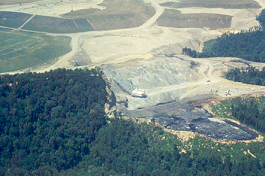
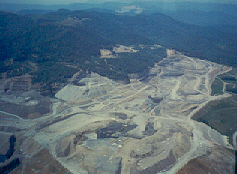
We flew further east and south, "chasing clouds," as our pilot put it, until we reached the part of the state where they mine for coal. I figured once we got over there we'd see a mine site here and there and another one maybe a few miles away. I had no idea they would be everywhere I looked. EVERYWHERE I looked. It was depressing to see that in every direction, horizon to horizon, you could see where the tops of mountains had been blasted off. They looked like flat, gray, gravel parking lots. And you can't even see this stuff or know it's going on unless you're on top of the mountain or in the air.

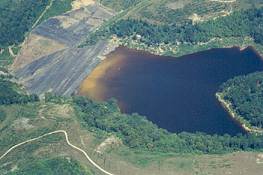
Basically, in mountaintop mining, they use dynamite to blow off the top of the mountain, then take the leftover Earth, which they call, "overburden" and push it over the side of the mountain, filling in the natural valleys below. Then, because the streams and waterways get all choked and clogged, they have to make these fake, concrete streambeds to allow the water to drain from the top of the mountain. They scoop the coal out of the mountain and wash it, which makes a watery soup of coal dust, chemicals and heavy metals called "slurry." They dig out big holes near the mine site and put the slurry in the holes. They call them slurry ponds, but they're more like slurry lakes. And last year one of them broke through and spilled 250 million gallons of contaminated muck down several of Kentucky's waterways.

Once the coal is extracted, the companies pulling the coal out are supposed to restore the mountain's contour to 90% of its original shape, which doesn't always happen. They plant grass and shrubs and maybe some trees on the tops of these mountains, but they will never ever be the same again. And that's what makes me feel so bad.

I know we need resources for energy and I know that coal will always be a vital resource to our country, but there just has to be a way to have energy while also protecting our environment. There has to be a safer, cleaner, better way of doing this. The land houses coal but at the same time it houses animals, people, waterways and vegetation.

During the flight, our pilot said, "I've taken a lot of people up and everyone has a strong reaction to what they see. I've seen people weep at the sight of these mountains." Well, nobody in our plane teared up, but I tell you, we were all pretty quiet as we looked around and saw mountaintop after mountaintop taken and changed forever. It was an eye-opener for us all.

It's always my hope that you'll get involved with preserving and protecting our environment, but mostly I just wanted to share my story to let you know that coal doesn't just magically appear. Many homes across America are powered by coal that is being pulled from what were once lush, thriving and forested mountains. And so if you keep your lights and computer and CD player on when you're not using them, ask yourself, "Is it worth that? Or is there a better way of doing things? Are there other sources of energy we should be looking into?" Just start thinking in terms of where electricity and energy comes from and start asking questions. Thanks for hearing me out about my flight. You'll be able to see photos of it when the JWR Web site is up, which will be soon.

Peace,
Kev

*~*~* Just Within Reach *~*~* Just Within Reach *~*~* Just Within Reach *~*~*

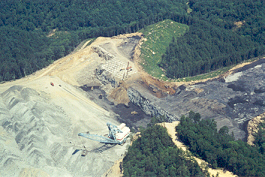
View of mountaintop The dragline
View of mountaintop removal
mine operation.
The machine you see is called a dragline
and it is a HUGE piece of equipment.
The black areas are coal.
reclaimed 
area sludge pond
The grassy area at the top left side of the
photo is a "reclaimed" area which means
it's being restored after the mining.
This is a coal sludge pond. It holds water
with coal dust, acids, toxic heavy metals
and minerals. Note the yellowish-orange
area of the water. We're not sure what's in
there but we think it might be a concentra-
tion of some sort of element or mineral.

*~*~* Just Within Reach *~*~* Just Within Reach *~*~* Just Within Reach *~*~*

Kevin's Charity Page

Charity Page

Main Page

Brian Thomas Littrell ~ The Golden Voiced Backstreet Boy
- Established Jan 1999 -