 KEVIN RICHARDSON, who at 32 is the oldest member of the Backstreet Boys,
took delivery last week of his 2004 GMC Yukon sport utility vehicle. He
raves about its "F.B.I. look" - all black and chromeless, with lacquered
wheel rims - and the 5.3-liter V-8 engine that puts close to 300 horsepower
under the hood.
And he dreams of ordering a customized license plate for this, his perfect
Hollywood ride. It would read "CLEAN."
That may sound as contradictory as Mr. Richardson himself - an avowed
environmentalist with an ungreen hankering for big, powerful cars - but, in
fact, he is spending more than $10,000 to convert the Yukon to run on
compressed natural gas, a domestically produced fuel that is less polluting
than gasoline. The conversion will include the installation in his garage of
a refueling system, which will let him fill up the Yukon by using the same
gas line that supplies his house.
To do the conversion, he has hired Evo Transportation, a company started by
two former entertainment industry executives, David Young and Seth Seaberg.
The two men, who had virtually no automotive experience but a lot of
Hollywood connections, have built a bustling business in Los Angeles by
offering environmentally friendly but cool rides. Their Evo boutique limo
service features three black S.U.V.'s much like Mr. Richardson's. The
vehicles also have Game Boy consoles and minibars stocked with organic
goodies like soy-based vodkas and soft drinks made from green tea.
Celebrities like Cameron Diaz and Woody Harrelson are regular customers.
"We figured, 'Why should people compromise?' " said Mr. Seaberg, who before
founding Evo with Mr. Young was chief executive of Ray Gun Publishing, which
publishes the magazine Bikini. (Mr. Young ran Bliss Artist Management, which
managed rock bands.)
Unlike cars powered by electricity, a vehicle fueled by natural gas has the
same power and performance - and can carry the same weight - as an identical
vehicle fueled by gasoline. "You actually can get all the luxury of a big
S.U.V. with none of the guilt," Mr. Seaberg said.
Now Evo is ramping up its next and potentially far bigger business:
converting S.U.V.'s for Hollywood's elite - and anyone else with $10,000 or
more to spend -as well as converting smaller vehicles like General Motors'
new Chevrolet Colorado pickup for corporate and municipal fleets. Their
municipal customers already include the City of Santa Monica and Los Angeles
County.
As traditional automakers continue bickering over the future of hybrids and
hydrogen, Evo is offering consumers alternate-fuel versions of the vehicles
they want to drive right now.
The limo service will expand, but its founders say it was just a start
toward creating a company based on the idea of alternative fuels. "The limo
business was a scaleable business and got us good cash flows pretty
quickly," Mr. Young said. The service started in April 2003 and became
profitable in the first quarter of 2004, and the two men say they expect to
have $2 million in revenue this year.
A ride in an Evo limos costs $75 an hour, with a two-hour minimum. The
company said it logged 2,000 hours of service last year, 60 percent of them
for hauling celebrities to events like the Academy Awards or Emmy Awards
ceremonies. More important, Mr. Young said, the limo service brought the
vehicles to the attention of the very customers who were likely to buy an
S.U.V. conversion.
Evo has received $500,000 in venture capital to expand its limo fleet into
other California cities. And more celebrities are expressing interest in
conversions. Brad Pitt requested a proposal for a conversion after he rode
in an Evo limo to a pre-Oscars party.
As for Mr. Richardson, he said he saw his first Evo S.U.V. in May 2003, when
he showed up at a forum for the Natural Resources Defense Council featuring
Arianna Huffington, the syndicated columnist, who has been pressing Detroit
automakers to make more fuel-efficient cars. The topic that day was
"Breaking the Chain of Oil Dependency." Mr. Richardson showed up in a
gas-guzzling Mercedes CL500 sports car that gets about 16 miles to the
gallon.
"I was looking for some place to hide my ride when I saw this S.U.V.," Mr.
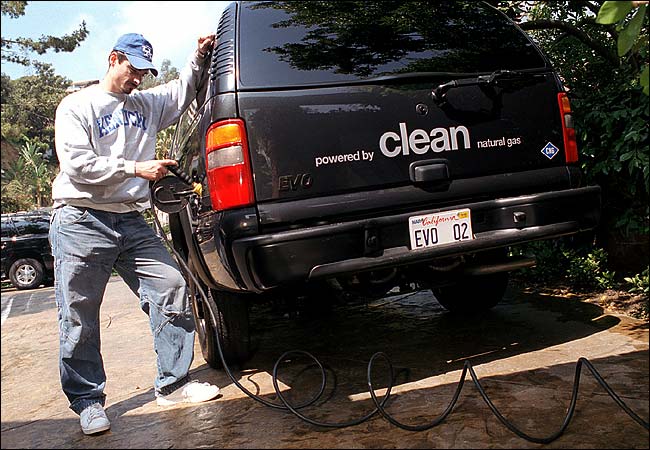
Richardson said. The converted Evo S.U.V.'s have labels saying, "powered by
clean natural gas."
"I didn't want to be a hypocrite anymore," said Mr. Richardson, who operates
an environmental foundation called Just Within Reach. "I want to walk the
walk if I'm going to talk the talk." He sought out the S.U.V.'s owners, and
Mr. Seaberg let him take the vehicle for a drive after the meeting.
In addition to spreading the word at environmental events, the Evo founders
have hired several drivers with M.B.A.'s who serve as business development
employees when they are not on the road.
In effect, the drivers are missionaries for the Evo brand. Jacob Ryan, who
drives for Evo and holds an M.B.A. from Schiller International University in
Madrid, can reel off a host of facts and figures about Evo-mobiles. They
have a range of about 175 miles on a fill-up. The gas is stored in several
high-pressure tanks under the rear of the vehicle. It takes about the same
time to refill the high-pressure tanks with compressed natural gas as it
does to fill up a conventional tank at a gas station.
And natural gas is cheaper than gasoline. "It's $1.39 per equivalent gallon
at a lot of stations, but if you go the airport it's 30 cents cheaper and
there's no line," in contrast to the usual queue at regular gas stations,
Mr. Ryan said. That compares with more than $2 a gallon for regular gasoline
throughout much of California. "And it has 90 percent less emissions than
regular gasoline engines," he added.
Despite its recent successes, Evo, like other alternative-fuel companies,
faces formidable challenges. Most notable is the continued emphasis of the
auto industry and the federal government on hydrogen as the fuel of the
future. Compressed natural gas, which has been used most extensively in
corporate and municipal fleets, including thousands of buses around the
country, has become a stepsister to what experts envision as a far more
exciting transportation economy based on hydrogen fuel cells.
NATURAL gas has been pumped from underground reservoirs for decades to heat
homes and businesses. In the 1980's, the gas was commercialized as a
transportation fuel by compressing it so it could be stored in portable
tanks. Hydrogen fuel, by contrast, is made by the complex process of
breaking apart molecules that contain hydrogen atoms. That is one reason
experts say that compressed natural gas still has a future.
"We're driving down this hydrogen highway and that's hurting compressed
natural gas," said Rebecca J. Royer, president of the Baytech Corporation, a
manufacturer based in Los Altos, Calif., that provides Evo with conversion
parts and does conversions for big corporate clients like United Parcel
Service. "Everybody is saying it's better to just wait for the hydrogen
economy."
Evo also has to contend with the rapidly expanding popularity of the hybrid
gas-electric vehicles, like the Prius. Evo said it planned to add a few
Priuses to its limo fleet. Even S.U.V.'s will soon be available as hybrids,
as Ford Motor and Toyota add them to their lineups this year.
It is also true that many gasoline-powered vehicles produce far lower
emissions than they did in the 1980's, reducing one of the benefits of
natural gas. "The inherent advantages of natural gas have diminished in the
past three or four years as superclean gasoline and diesels have come on the
market because of tighter emissions regulations," said Tom Cackette, chief
deputy executive director of the California Air Resources Board, which
regulates emissions in the state. "It's hard for natural gas to compete."
Still, Evo's founders appear undaunted. To the idea of a future fueled by
hydrogen, they argue that compressed natural gas can be a helpful
steppingstone. "Right now, you have consumers who think hydrogen in a tank
in their car is like riding with a bomb," Mr. Seaberg said. "But storage of
hydrogen and natural gas aren't that different. So if you get comfortable
with one, you'll feel comfortable with the other one."
Mr. Richardson of the Backstreet Boys does not seem especially worried about
fueling up next to his home. In fact, he says he is happy to have such a
convenient refueling station, allowing him to get natural gas at a price
equivalent to 80 cents a gallon of gasoline. The fuel system in his garage
is "the size of a small water cooler," he said, and the cost of the fuel he
uses is added to his home gas bill.
Hybrids, meanwhile, still use gasoline, albeit in smaller quantities than a
regular S.U.V. does. If gasoline becomes more and more expensive, even
hybrid S.U.V.'s might be regarded as guzzlers.
Mr. Ryan, the Evo driver, said such issues could change the minds of even
Hollywood's most vocal environmentalists. "Now Arianna can finally ride in
an S.U.V.," he joked as he waited to hear the name of his first celebrity
passenger of the day. Alas, it was not Ms. Huffington.
KEVIN RICHARDSON, who at 32 is the oldest member of the Backstreet Boys,
took delivery last week of his 2004 GMC Yukon sport utility vehicle. He
raves about its "F.B.I. look" - all black and chromeless, with lacquered
wheel rims - and the 5.3-liter V-8 engine that puts close to 300 horsepower
under the hood.
And he dreams of ordering a customized license plate for this, his perfect
Hollywood ride. It would read "CLEAN."
That may sound as contradictory as Mr. Richardson himself - an avowed
environmentalist with an ungreen hankering for big, powerful cars - but, in
fact, he is spending more than $10,000 to convert the Yukon to run on
compressed natural gas, a domestically produced fuel that is less polluting
than gasoline. The conversion will include the installation in his garage of
a refueling system, which will let him fill up the Yukon by using the same
gas line that supplies his house.
To do the conversion, he has hired Evo Transportation, a company started by
two former entertainment industry executives, David Young and Seth Seaberg.
The two men, who had virtually no automotive experience but a lot of
Hollywood connections, have built a bustling business in Los Angeles by
offering environmentally friendly but cool rides. Their Evo boutique limo
service features three black S.U.V.'s much like Mr. Richardson's. The
vehicles also have Game Boy consoles and minibars stocked with organic
goodies like soy-based vodkas and soft drinks made from green tea.
Celebrities like Cameron Diaz and Woody Harrelson are regular customers.
"We figured, 'Why should people compromise?' " said Mr. Seaberg, who before
founding Evo with Mr. Young was chief executive of Ray Gun Publishing, which
publishes the magazine Bikini. (Mr. Young ran Bliss Artist Management, which
managed rock bands.)
Unlike cars powered by electricity, a vehicle fueled by natural gas has the
same power and performance - and can carry the same weight - as an identical
vehicle fueled by gasoline. "You actually can get all the luxury of a big
S.U.V. with none of the guilt," Mr. Seaberg said.
Now Evo is ramping up its next and potentially far bigger business:
converting S.U.V.'s for Hollywood's elite - and anyone else with $10,000 or
more to spend -as well as converting smaller vehicles like General Motors'
new Chevrolet Colorado pickup for corporate and municipal fleets. Their
municipal customers already include the City of Santa Monica and Los Angeles
County.
As traditional automakers continue bickering over the future of hybrids and
hydrogen, Evo is offering consumers alternate-fuel versions of the vehicles
they want to drive right now.
The limo service will expand, but its founders say it was just a start
toward creating a company based on the idea of alternative fuels. "The limo
business was a scaleable business and got us good cash flows pretty
quickly," Mr. Young said. The service started in April 2003 and became
profitable in the first quarter of 2004, and the two men say they expect to
have $2 million in revenue this year.
A ride in an Evo limos costs $75 an hour, with a two-hour minimum. The
company said it logged 2,000 hours of service last year, 60 percent of them
for hauling celebrities to events like the Academy Awards or Emmy Awards
ceremonies. More important, Mr. Young said, the limo service brought the
vehicles to the attention of the very customers who were likely to buy an
S.U.V. conversion.
Evo has received $500,000 in venture capital to expand its limo fleet into
other California cities. And more celebrities are expressing interest in
conversions. Brad Pitt requested a proposal for a conversion after he rode
in an Evo limo to a pre-Oscars party.
As for Mr. Richardson, he said he saw his first Evo S.U.V. in May 2003, when
he showed up at a forum for the Natural Resources Defense Council featuring
Arianna Huffington, the syndicated columnist, who has been pressing Detroit
automakers to make more fuel-efficient cars. The topic that day was
"Breaking the Chain of Oil Dependency." Mr. Richardson showed up in a
gas-guzzling Mercedes CL500 sports car that gets about 16 miles to the
gallon.
"I was looking for some place to hide my ride when I saw this S.U.V.," Mr.
Richardson said. The converted Evo S.U.V.'s have labels saying, "powered by
clean natural gas."
"I didn't want to be a hypocrite anymore," said Mr. Richardson, who operates
an environmental foundation called Just Within Reach. "I want to walk the
walk if I'm going to talk the talk." He sought out the S.U.V.'s owners, and
Mr. Seaberg let him take the vehicle for a drive after the meeting.
In addition to spreading the word at environmental events, the Evo founders
have hired several drivers with M.B.A.'s who serve as business development
employees when they are not on the road.
In effect, the drivers are missionaries for the Evo brand. Jacob Ryan, who
drives for Evo and holds an M.B.A. from Schiller International University in
Madrid, can reel off a host of facts and figures about Evo-mobiles. They
have a range of about 175 miles on a fill-up. The gas is stored in several
high-pressure tanks under the rear of the vehicle. It takes about the same
time to refill the high-pressure tanks with compressed natural gas as it
does to fill up a conventional tank at a gas station.
And natural gas is cheaper than gasoline. "It's $1.39 per equivalent gallon
at a lot of stations, but if you go the airport it's 30 cents cheaper and
there's no line," in contrast to the usual queue at regular gas stations,
Mr. Ryan said. That compares with more than $2 a gallon for regular gasoline
throughout much of California. "And it has 90 percent less emissions than
regular gasoline engines," he added.
Despite its recent successes, Evo, like other alternative-fuel companies,
faces formidable challenges. Most notable is the continued emphasis of the
auto industry and the federal government on hydrogen as the fuel of the
future. Compressed natural gas, which has been used most extensively in
corporate and municipal fleets, including thousands of buses around the
country, has become a stepsister to what experts envision as a far more
exciting transportation economy based on hydrogen fuel cells.
NATURAL gas has been pumped from underground reservoirs for decades to heat
homes and businesses. In the 1980's, the gas was commercialized as a
transportation fuel by compressing it so it could be stored in portable
tanks. Hydrogen fuel, by contrast, is made by the complex process of
breaking apart molecules that contain hydrogen atoms. That is one reason
experts say that compressed natural gas still has a future.
"We're driving down this hydrogen highway and that's hurting compressed
natural gas," said Rebecca J. Royer, president of the Baytech Corporation, a
manufacturer based in Los Altos, Calif., that provides Evo with conversion
parts and does conversions for big corporate clients like United Parcel
Service. "Everybody is saying it's better to just wait for the hydrogen
economy."
Evo also has to contend with the rapidly expanding popularity of the hybrid
gas-electric vehicles, like the Prius. Evo said it planned to add a few
Priuses to its limo fleet. Even S.U.V.'s will soon be available as hybrids,
as Ford Motor and Toyota add them to their lineups this year.
It is also true that many gasoline-powered vehicles produce far lower
emissions than they did in the 1980's, reducing one of the benefits of
natural gas. "The inherent advantages of natural gas have diminished in the
past three or four years as superclean gasoline and diesels have come on the
market because of tighter emissions regulations," said Tom Cackette, chief
deputy executive director of the California Air Resources Board, which
regulates emissions in the state. "It's hard for natural gas to compete."
Still, Evo's founders appear undaunted. To the idea of a future fueled by
hydrogen, they argue that compressed natural gas can be a helpful
steppingstone. "Right now, you have consumers who think hydrogen in a tank
in their car is like riding with a bomb," Mr. Seaberg said. "But storage of
hydrogen and natural gas aren't that different. So if you get comfortable
with one, you'll feel comfortable with the other one."
Mr. Richardson of the Backstreet Boys does not seem especially worried about
fueling up next to his home. In fact, he says he is happy to have such a
convenient refueling station, allowing him to get natural gas at a price
equivalent to 80 cents a gallon of gasoline. The fuel system in his garage
is "the size of a small water cooler," he said, and the cost of the fuel he
uses is added to his home gas bill.
Hybrids, meanwhile, still use gasoline, albeit in smaller quantities than a
regular S.U.V. does. If gasoline becomes more and more expensive, even
hybrid S.U.V.'s might be regarded as guzzlers.
Mr. Ryan, the Evo driver, said such issues could change the minds of even
Hollywood's most vocal environmentalists. "Now Arianna can finally ride in
an S.U.V.," he joked as he waited to hear the name of his first celebrity
passenger of the day. Alas, it was not Ms. Huffington.
Brian Thomas Littrell ~ The Golden Voiced Backstreet Boy
- Established Jan 1999 -