Aide de camp for the Warlord in need of tactics
The
castle The Oblique line The Wedge
Encirclement Mongolian
harassment The trap
Here I'll try to describe some of the tactics I know of that can
be used on the field of battle. They are grand tactics and doesn't try to tell you exactly
what unit to use and which items to equip them with since the variants possible is almost
infinite.

The castle
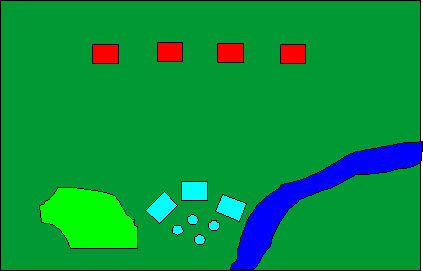
The castle has a very simple idea behind it, namely defense. This
tactic is built upon the use of warmachines in a keep guarded by a wall of infantryunits.
The keep is ideally on top of a hill so that the warmachines get a clear line of sight
over the most of the battlefield. The wall will enegage the enemy hindering them from
reaching the keep and the keep will bombard the enemy units all the way. This tactic means
that you will sit still and wait for the enemy to plod over the field to get to you while
you blast him to pieces with concentrated bombardments. The longer time the enemy takes to
get to you the more time you have to hurt him so that when he arrives to the wall he will
be defeated by the infantryblocks there. To increase the efficiency of this tactic a moat
is often used. The purpose of the moat is to move out and move within 8 inches of the
enemy and thus negating him to make marchmoves. This slows him down and the moat can also
charge units to slow them down further or even destroying them. It also gives you the
opportunity to strike back and not just sit there and wait. As for the placement of the
castle my advice is to place it on a hill and anchor the flanks with impassable terrain or
with troops with great stayingpower or fightingprowess alternatively a huge monster or
mean warmachine. This keeps the enemy from outflanking you and destroying your castle.
For the choice of troops the keep should consist of the most devious warmachines you
can muster preferrably with a descent range. The wall should be built from large blocks of
infantry with a high stayingpower which can be boosted further with the use of proper
magical items such as The crown of command, Sword of fortitude, Talisman of Obsidian etc.
The moat is ideally built from units of cavalry with high movement. Light cavalry or
missilecavalry is ideally suited to the mission of delaying the enemy while heavy cavalry
is better suited for breaking the enemy and/or counterattacking. One variation or
complement is to use flying creatures which can both
serve as delayers or to create havoc among the enemys midst. Using flying
creatures is also a defence against one of the castles weaknesses, the vulnerability
against flyers. Your efforts to protect your warmachines is worthless if the enemy just
after flying high rips them to pieces. Other tactics against flyers that works well is to
place a unit nearby the warmachines with the Scarecrow banner or the Talisman of
Ravensdark and charge or scare the flyers. Even without any items a large unit is
threatening to flyers and can dissuade them from attacking. The sky arrow of Naloer can
also be used to great effect in the hands of a suitable character.
One other weakness is if the enemy closes too fast. Look out from fastmoving units like
cavalry and try to delay or even destroy them before they can upset your tactics too much.
The two other weaknesses that springs to mind is magic and other warmachines. As for magic
your best defense is either items such as the Talisman of Obsidian or the Banner of arcane
warding etc. or to load up on magical users yourself. Kill the other wizards or try to
negate their powers by using drain magic from the High magic or use protective spells on
your castle. Flyers and outflanking troops can hunt for magicians with great effect.
Especially watch out for magicians with spells from gray magic or Waagh which can move
units real fast araound the battlefield. As for warmachines there's only one medicin,
destroy them. Either by charging them with flying/fastmoving units or by targeting them
with your own warmachines. This is risky because it draws power from your real targets,
the enemys mainunits, so use your weapons with consideration. Target one unit with all
your artillery instead of spreading your fire since it's better to destroy one unit
utterly instead of damaging many. One special mentioning of the one of the most effective
warmachines when the castke is used, The Earthshaker cannon. This devious Chaos Dwarf
invention serves equally well for as against the castle. If it's in your keep it does not
only blasts the enemy it also has the possibilty to slow them down or negating their
warmachines to counterfire. As the enemys weapon it can blow up your warmachines but also
silencing them for turn after turn so try to knock them out as fast as possible. That was
my thoughts on the Castle and it can be used by virtually every race except maybe Skaven
or Chaos which lacks warmachines. They can however take allies that can provide the
necessary equipment of war.
Top of the page
The oblique line
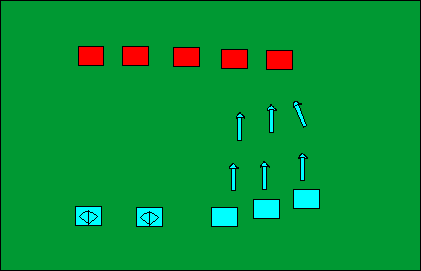
The Oblique line is based on the principle of regional
superiority. The idea is to attack with your strongest units on the flank where your enemy
has his weakest units. In the same time you should try negating your enemy of making
contact with your own weak units. This way you'll break his weak troops and later on gang
up on his stronger ones and gain the superiority you want. This tactic also builds on the
assumption that your opponent will place his strongest units in the middle ie the wedge
formation, see later entry. If he doesn't you may be in trouble but you should anyway be
able to gang up on his flanks and outmatch them by numbers and by charging them in the
side or rear. The Oblique line will if executed perfectly roll up the enemys flank and
destroy his units one at the time. At the same time you refuse your own flank by not
advancing and ideally peppering him with missilefire. Speed is of essence since you'll
need to be faster than your opponent so that he doesn't bring up enforcements on your
flank or has the time to outflank you. If he outflanks you it will be a race and that's a
kind of scissormaneuver that can spell doom for you as much as for your opponent and luck
will have a great impact on the outcome.
The ideal choice of troops is of missiletroops in the refused flank and of hard hitting
and fast units on the attacking flank. The refused flank can be composed from move or fire
units since they're not supposed to move around anyway. With this in mind crossbowmen or
musketarmed troops are excellent choices. A alternative is to use warmachines in this role
which is quite a effective option but you better make sure that your opponent doesn't
reach your artillery. On the attacking flank the ideal troops are fast and are able to
break the enemy with one charge. They can be augmented with the Battlebanner or by being
able to cause fear. Heavy cavalry are always a good choice. Look out for nonbreakable
units like Troll Slayers and the like and units with a high survivability from armour or
really high leadership/Crown of command or sword of fortitude. Fast units of the
opposition should be considered too since they can aid the troops on the flank you are
attacking. Magic and warmachines can also wreck havoc in your plans (nothing like a
wellplaced organgun to wipe out a cavalrycharge). Use magic of your own to augment your
troops and if possible slow his down. If you keep up the pressure on the flank and is able
to keep your regional superiority you should be able to beat your opponent with the
Oblique line.
Top of the page
The Wedge
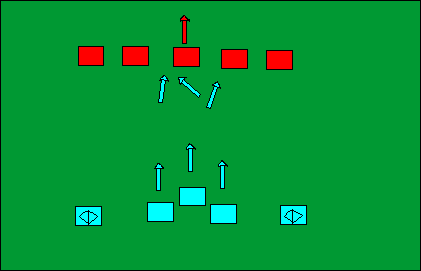
The wedge is probably the most common formation on the
battlefield but most people don't even know they are using it. The setup for the wedge is
to place your most powerful unit(s) in the center of the battlefield and flank it with
supporting units. This way they'll be in the center of the battle and probably see most of
the action. This is not the whole story though because with a bit of consideration it can
serve you well and divide and destroy your enemy. The main plan is to punch trough the
centre of the opposing army and divide it in two parts which are separated from each
other. If your opponent has placed his toughest unit in the middle and you concentrate all
your centerunits to that one instead of attacking along the entire line you'll have
crippled him severly by taking it out. When his toughest unit goes down you have divided
his army in two and can charge his other units in the flanks. Be careful not to get
charged in the back if you concentrate on just one half of his army. The element of panic
in the heart of your opponent is of great importance since this may cause him to make
fatal errors which you can exploit. If you manage to punch through his center you can
either continue by attacking at both sides as shown in the picture or you can attack at
only one of the sides preferrably the weakest. Attacking one side works fine if your
opponent mainly fields slow units which will have a hard time catching up with your
exploitation of your breaktrough. So against Dwarves for instance it's often a good idea
to mop up one flank at the time since they're generally to slow to stop you. It's often
hard to strike through a determined Dwarf line of defence but if you succeed you'll have a
field day.
The strength of this tactic is that you don't need very many
units if you choose your points of attack carefully with the right trooops and it's
potentially a real battlewinner. The downside is that if you get stuck it's you're very
vulnerable to counterattacks. Special care is to be taken if your opponent uses the
Oblique line or The Cannae tactic and is able to execute it before you or if he planned on
you using the wedge. The units which are most suitable to this tactic is with the baddest
units you can find in the middle who should be able to break the enemy in one turn. On the
flanks troops which will deter from flanking your centre unit or augment it's attack is
preferable. Heavy cavalry in the middle and light or missilecavalry on the flanks is a
very good setup. This is a fast formation with a strong punch and quick response time to
changes in the situation. If you can afford it go with more than one centreunit and/or
further troops on the flanks, optimally troops which will stop your opponents flanks from
charging your centre. Artillery and/or bowmen in the furthest ends work wonderfully in
this role. To augment your tactic use magical items which makes your centre unit even
harder or weakens alternatively slows down your enemy. The battlebanner,warbanner
Dreadbanner etc all enables you to break the enemy much faster and the Orb of Thunder,
pipes of Doom etc can stop or hinder your opponets counterattack.
A special mention must go to the use of psychology. By proper utilization of fear you
can break units much faster and if you land something nasty which causes terror nearby
some low Ld units you may be not even have to fight them at all to send them running. With
the new edition of Warhammer you have to take a Ld-test when your general dies so
seriously consider going for the General in your charge. If you kill him you have another
chance of routing enemy units. If you combine killing the general, causing fear/terror
tests and causing panictests for breaking nearbt units you will have a very strong grip on
the battle. So punch hard and relentless and you'll be victorious.
Top of the page
Encirclement
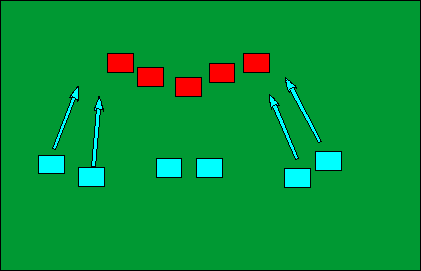
The encirclement or pincher manuever is a classic battlefield
tactic that aims to to strike the opponent in the flanks while holding fast in the centre.
Correctly executed with the right troops this tactic is devastating since it leaves the
enemy no routes of escape and he'll probably be annihalated if he can't break out of the
pinchers. The key to the encirclement is to fool your opponent to attack your centre. If
he uses the Wedge maneuver he'll be in trouble if you can manage to keep him occupied in
the centre. When your opponent clashes with your centre formations you move the flanks
(the pinchers) to engage his forces on both sides. To lure him in, place something tasty
but not too dangerous in the middle and keep the centre a bit closer to him than the
flanks so that he thinks that you are using the Wedge. Alternatively place the units so
that he only can get to the centre since the flanks are out of reach. Second to getting
your opponent to hit you in the right place is the speed of the pinchers. If they are too
slow your centre may crumble and you'll be in trouble for sure. So a high movement goes a
long way in executing the encirclement but isn't strictly necessary if you place the
flanks close to the centre. Threats to this maneuver are the regular ones that affects
movement and general troublemakers ie magic, warmachines and flying monsters. Look out for
fasat cavalry that stops you from marchmoving and from wellguarded flanks. Enhance your
flanking troops by adding banners that increase speed and hittingpower, banner of might,
war banner, Jaguar banner etc, and survivability for the centre, Banner of defiance,
Banner of Shielding, War banner etc. The Oblique line tactic can be quite troublesome when
using the Ecirclement since he'll probably be stronger on the flank he chooses so look out
for a strong and hardhitting flank with a second refused flank.
Top of the page
Mongolian harassment
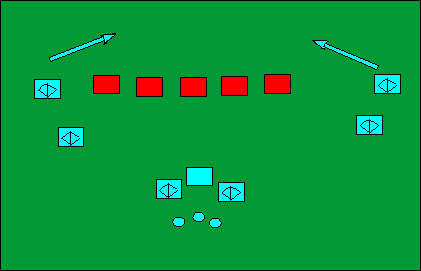
Mongolian harassment is a tactic that can be hard to execute but
very rewarding when you succeed and annoying to your opponent. The idea is to slow your
enemy down while you rain arrows and charges him in the back and on the flanks. The goal
is to stay away from your opponents main fighting blocks and to constantly make his troops
whittle away. The extreme varaint is having just fast cavalry with bows and maybe spears.
Some armies may even employ flyers like this like for instance the Wood Elves. This way
you will be very hard to catch while you can maneuver to your enemys flanks and deliver a
charge at the right moment and against a unit that you can break easily. Since such a army
would be very small for it's points and in practicality vey hard to succeed with due to
that most gaimg table isn't big enough a more conservative approach often works better.
That kind of army and it's deployment is what is shown on the illustration above. In the
middle anchoring your army you have a big blcok of something tough and resilent who can
dish out some damage if charged. Slightly behind this you could place either large blocks
of missile troops andperhaps some smaller units who can jump into the fray and help the
anchor out and at the same time be protected from harm by its presence. Behind this,
optimally on a hill, you can place any warmachines you have included in your army. This
way they'll be protected and can fire away without danger. On the extreme flanks you place
something fast and maneuverable, ideally with bows too, to harass the enemy and slow him
down. The flanks can also join combat by charging weaker targets in the rear and flanks,
especially if the anchor gets engaged in combat. If you have infiltrators they will help
immensly by being placed in the way of the enemys advance and slow down by being within 8
inches and ultimately force your opponent to deal with them. So fire away with your
warmachines, wizards and missiletroops while slowing him down by being within 8 inches.
The biggest threat to this tactic is fast and maneuverable units fielded by the opponent
who can capture and destroy or tie down your flanks and leave his main units free to march
against your rather weak centre. Especially flyers should be dealt with by bringing Bolt
throwers and/or magical items like the Orb of Thunder, Skyarrow of Naloer, Hail of Doom
arrow, Talisman of Ravensdark, Scarecrow Banner and some flyers of your own. Troops with
very high resilence against missilifire can also be troublesome but warmachines and magic
should sort them out nicely. Opposing warmachines and magic can also wipe out your flanks
so bring antimagical items, wizards of your own, infiltrators and flyers to take out these
threats.
Top of the page
The trap
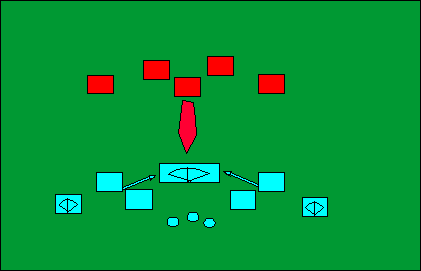
The Trap or the Diamond, called so because of the shape of the
setup, is a variant of the encirclement and has the same aim. The goal is to be able to
attack your enemys main formation(s) from the flanks to gain a favorable combat resolution
and to pin him in place. The setup is very similar to the encirclement but here you rely
completely on a bait in the centre. First place a juicy target in the centre like in the
illustration where the warmachines are bait. Suitable baits are forinstance the mentioned
warmachines, Wizards, your general in a weak unit or even alone, a objective like a
battlestandar that must be captured, a pricey but weak unit etc. To make it less obvious
and to protect your bait from immediate harm place a small unit that appears weak but may
include items like the Sword of Fortitude, Crown of Command, Banner of Defiance, Valorous
banner etc to make sure it stays in position whatever the casualties. Try to maintain a
balance between making it too big and dangerous and too weak so that it gets wiped out by
the first volley of arrows or are scared away very easily. Skirmishers work very well in
this role. They'll get wiped out for sure by the charge but that is secondary to their
ability to avoid getting killed by missilefire. Just remember to place them so far away
from the bait so that the enemys pursuit doesn't bring him into contact with your bait.
+12 inches is about right since you will be safe from infantry and likely to avoid cavalry
but if possible keep the distance longer if you know your facing cavalry in the centre.
Against enemy units that are frenzied it's even easier to lure you opponent in since they
have to charge your bait anyway so Savage Orc Boar Boys, Chaos Knights with the Banner of
Rage and Witch Elves are easy prey for the trap. Slightly behind this and flanking it you
place your rock hard units. Speed is of less importnce than strength since you wait for
your opponents to come to you. To anchor your setup place something that deters from
flanking your rock hard units like Hellblaster Volleyguns, Organ Guns, Chariots that can
countercharge, Night Goblins with possible fanatics, Skirmishers, Swarms, terrain, large
monsters or anything that can bog you down or is outright dangerous to get near. When your
enemy charges your bait you spring the trap and wheel to charge him in the flanks. If you
succeed wth this you will most likely cripple his army severly. Be careful with wise
opponents who ignores your trap and goes for the flanks or probes the trap with a
expendable unit to take away your screen to get to the juicy bait. The main problem with
the Trap is to lure your enemy into taking the bait. The best thing is if you can fool him
into believing he has outsmarted you but this is rare and demands a very well balanced and
finetuned trap and only works against a agressive player. More easily acheived is to
present your setup in such a way that the flanks look like a bad point to attack while
wiping out your center will win the game through taking out the juicy bait and to split
your army into two. A interesting variant is to use Night Goblins with Fanatics as the
rock units. If you let loose Fanatics from four units into your enemys sides he will
recieve immense damage from the 16 Fanatics that are suddenly in his lap.
Top of the page
Hans
Lundgren©
Updated : 1997-10-06
Back