Naval Battle Rules for Fantasy Gaming
By Adam Clark & Jason Russell
http://www.technoskill.com/forms/ships
Contents
Introduction
Order of Play
Ships
Crews
Other
| The Turn Sequence The turn is divided into 5 phases:
|
 |
All movement in these rules is simultaneous. Figures may be used to represent crew but are only necessary in the case of Specialists, described in the crew section later.
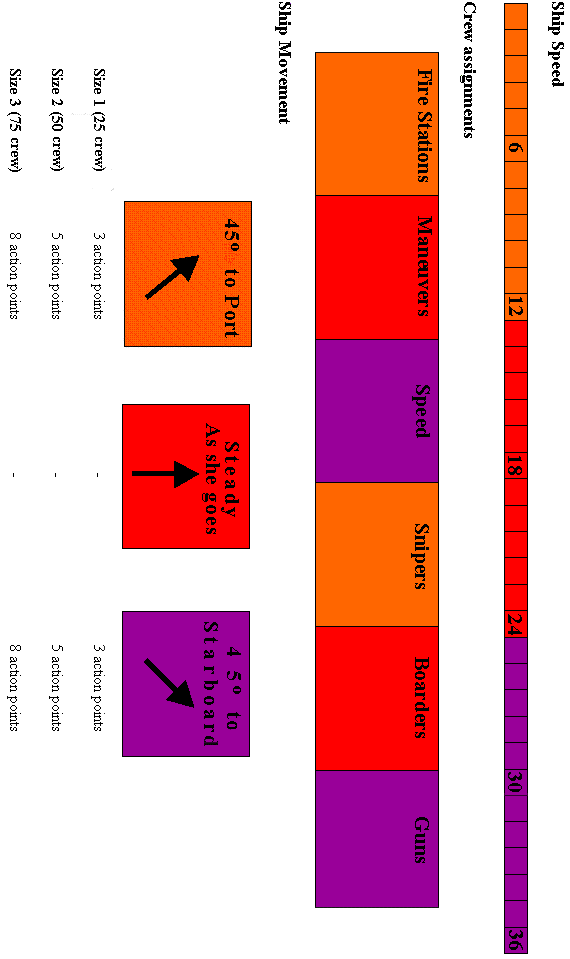
| To allow simultaneous movement, each player gives orders at the start of the turn by placing counters on the play sheet. A larger version of this play sheet is included at the end of these rules. You will also need a number of counters as described below. | 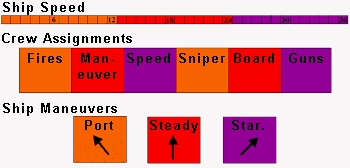 |
The counters you will need are:
The Orders Phase
At the beginning of the turn is the orders phase. There are two things you will need to do to place orders.
Crew Assignments
Crew assignments are allocated by placing poker chits in the Crew Assignments section of the play sheet. For the remainder of the turn these chits will represent the number of crew available to perform a given action and are therefore called Action Points.
There are 6 different actions your crew can be assigned to. These are:
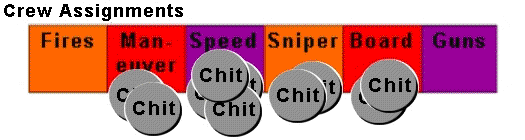
In this example a ship with 10 crew has assigned 2 crew to maneuvers, 4 to speed, 2 to snipers and 2 to boarders. Each action will be described in detail later.
Ordering Maneuvers
Each captain begins the game with a number of maneuver tokens equal to the ships maneuver value. These tokens are numbered consecutively (1, 2, 3, etc.) up to the ships maneuver value. Ships maneuver values vary as described later in the section on ships.
Each turn, when you place your orders, you must place these counters on the Ship Maneuvers boxes. This indicates both the maneuvers you intend to make and the order in which you will make them.
There are three types of maneuvers; a turn to port, steady as she goes and a turn to starboard. Steady as she goes is a free maneuver while the turns cost action points. Each turn costs a number of action points equal to 10% of the ships original action point total. This is indicated on the play sheet for the three most common ship sizes.
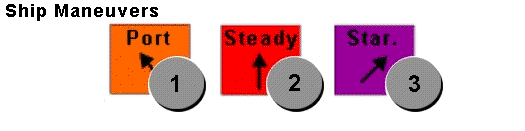
In this example the player has ordered 1. a turn to port 2. Steady as she goes, and 3 a turn to starboard. In the next section we will combine the orders and maneuver examples to see what the ship will do.
The Movement Phase
Two things determine a ships movement:
Speed
The speed value for your ship, described in the ships section, is an indication of the ships maximum speed. Each point represents 12" of movement. For example, a ship with speed 2 will have a maximum speed of 24"/turn.
All ships begin the game traveling at 1/2 of their maximum speed (12"/turn for a ship with speed 2).
A ships current speed is indicated by a marker on the Ship Speed track at the top of the play sheet.
Changing speed
Allocate the number of action points you wish to expend on changing speed by placing poker chits in the speed box of the crew assignments section of the play sheet.
2 action points to speed up by 1"/turn.
1 action point to slow down by 1"/turn.
At the start of your turn, move the counter along the speed track to the new value. Speed change is instantaneous so your ship will begin the turn traveling at the new speed.

Note: At the beginning of the turn, before revealing orders, each captain must declare whether his ship is increasing or decreasing speed. Which your ship will do will be obvious to the other captains as your crew adds or removes sails.
Maneuvering
The different races in Warhammer build ships to different specifications. While the Elven ships are fleet and maneuverable, a Dwarven juggernaut is heavily armoured and stacked with guns. To represent this each ship has its own maneuver value.
Each captain begins the game with a number of maneuver tokens equal to the ships maneuver value. These tokens are numbered consecutively (1, 2, 3, etc.) up to the ships maneuver value.
Each turn, as described in the orders phase, you must place these counters on the Ship Movement boxes. This indicates both the maneuvers you intend to make and the order in which you will make them.
To move your ship you divide your speed by the number of maneuvers, each maneuver taking place in the partitioned distance. Note traveling straight ahead counts as a maneuver so you will need to allocate maneuver counters to this as well.
If you order turns but do not don't have the action points assigned to perform the turns, these turns revert to steady as she goes.
Example:
This ship has maneuver 3 and is traveling at 10"/turn. There are 10 crew assigned
as follows: 2 crew to maneuvers, 4 to speed, 2 to snipers and 2 to boarders. Maneuver
counter 1 has been placed on "Port", maneuver counter 2 on "steady as she
goes" and maneuver counter 3 on "Starboard".
The ship will increase its speed to 12" per turn (4 action points will increase speed by 2 inches). Dividing the speed by the number of maneuvers (12 divided by 3), will result in each maneuver taking place in the partitioned distance of 4 inches. Each turn costs 10% of the ships action points (in this case 1 action point). Two turns have been ordered and the necessary two chits were assigned to maneuvers.
The following diagram illustrates the ships movement:
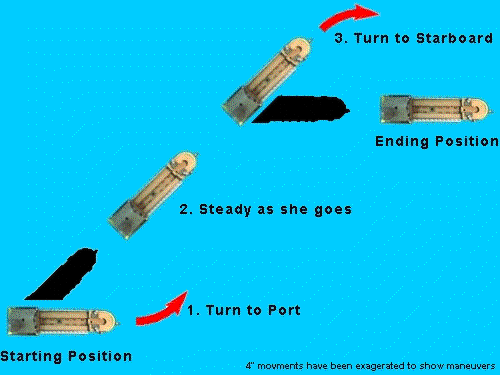
The first maneuver is a turn to port. The ship is turned 45 degrees to the left and moved 4" forward on its new heading. The second maneuver is "steady as she goes". The ship travels straight ahead for another 4". The third maneuver is a turn to starboard. Again the ship turns 45 degrees, this time to the right and moves 4" on the new heading.
Collisions
When two ships collide they both take damage. The amount of damage is equal to the combined speed of the ships divided by 6 plus the roll of a dice. Each player rolls for the opponents ship. If a 6 is rolled, add 6, and roll again, add the second roll. If this roll is a 6, add 6, and roll again. Keep rolling until a 1-5 is rolled.
Ships hit in the side or rear take full damage. Ships hit in the front (doing the hitting)take half damage.
Armour saves apply in both cases.
Boarding the enemy ship
If either ship has poker chits in the Boarding box of the play sheet, that player may elect to bind the ships together, this can not be stopped, and only after winning a round of combat can a captain elect to cut his ship loose and move away. Once two ships are bound crew at boarding stations will fight in the Boarding Phase
.
| Shooting There are two types of shooting in Naval Battles:
|
 |
Snipers
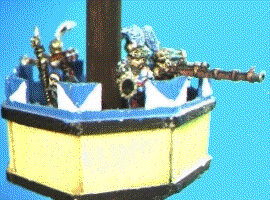
Snipers represent all the small arms fire in Warhammer. This includes Bows, Hand Guns, Pistols, Javelins, Crossbows and the rest.
Each action point you have on Snipers represents a crew member taking up one of these weapons and trying to plug crew from another ship.
*
Sniper Fire* |
|
Range |
To hit |
0-18" |
5 |
18-30" |
6 |
The target ship must make an armour save for each hit and a poker chit is removed for each failed save. Keep track of the damage you do as it is used for victory points * Snipers vary depending on the racial abilities and weapon of the sniper. Consult the Crew Chart for these abilities.
Armour
Some races in Warhammer put on more armour when they go to sea or are just naturally more resistant to attacks. Likewise each race builds their ships to different standards of durability. While a ship and its crew share the same armour value this value varies between the races. Consult the Ship Type chart for these differences.
Unless otherwise stated, a player rolls against their ship's armour value to save each point of damage taken.
Example: a ship with armor 5 takes six hits from sniper fire. The player rolls a dice for each point of damage, rolling 2,2,3,4,5 and a 6. The 5 and 6 save and the ship takes damage from the remaining 4 shots. 4 poker chits are removed.
.
Removing casualties
A player removes poker chits for each point of damage taken. You are free to remove chits from any of the Crew Assignments boxes and it is usual to take them from speed and maneuvers first as these crew have already "acted" this turn.
Ship's guns
In addition to sniper fire, your crew are able to smash the opponent with the ship's main guns. The term Guns refers to any model classed as a War Machine in the WFB army books (cannons, bolt throwers, Skaven Jezzails, etc.) Each poker chit in the Guns box of the Play Sheet represents one action point available to fire the ship's guns.
You are free to assign these action points to any gun that has line of sight on an enemy ship.
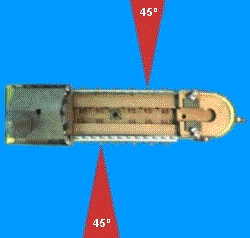 |
A Gun has line of sight if the target lies within a 45 degree
fire arc (22.5 degrees to each side of the gun's barrel). Note that this is less than in
the standard Warhammer rules and that ship's guns do not freely turn to face their target.
The exceptions to this rule are:
|
| Guns are fired as described in the chart below. Cannons and stone throwers act in much the same way as they do in WFB while weird weapons like Warp Fire and Hellblasters have been modified to keep the game quick. Also, one chart has been used for all missfire roles. |
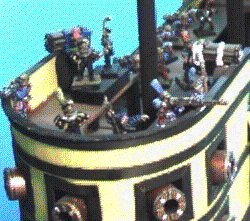 |
Some quick notes:
*
Guns |
||||
Type |
Action points |
Range |
Damage |
Special |
Bombards |
6 |
36" + artillery dice |
D6* |
6's on damage roll cause Fire |
Great Cannon |
5 |
48" + artillery dice |
D6 |
6's on damage roll cause Fire |
Cannon |
4 |
48" + artillery dice |
D4 |
4's on damage roll have a 50% chance of causing a fire (4+ on D6) |
Bolt Thrower |
2 |
48" |
D4 |
BS as crew, no misfire |
Jezzail |
2 |
48" |
D3 |
BS as crew, no misfire |
Swivel gun |
2 |
12" |
D6* |
Automatic hits, 1 = misfire |
Hellblaster |
3 |
12" |
D6** |
Automatic hits, 1 = misfire |
Flame Cannon and Warp fire thrower |
3 |
12" |
D6** |
Automatic Hits, D3 Automatic Fires, 1-2 = misfire |
Heavy Catapults |
5 |
12"- 48" + artillery and scatter dice |
D6 |
5-6 causes fire |
Catapults and Mortars |
4 |
12"- 48" + artillery and scatter dice |
D4 |
4's on damage roll cause Fire |
Rockets |
2 |
36" + artillery and scatter dice |
D4 |
4's on damage roll cause Fire |
Doom Divers |
2 |
unlimited + artillery and scatter dice |
D6*** |
Can correct deviation as described in rule book |
*
| * | Reroll 6's and add |
| ** | Reroll 5&6's and add |
| *** | Lose 1 Goblin crew (represents the Goblin you just fired) |
Misfires
*
Misfire Chart* |
|
Dice roll |
Effect |
1-2 |
Explosion: war engine explodes doing no damage to the enemy and killing its own crew. Lose one poker chip per action point of the weapon. |
3-4 |
Fires: war engine does no damage this turn but powder spills and a fire starts for every 3 action points the gun used rounding up. (For example, 4 action points = 2 fires) |
5-6 |
Weapon Jam: war engine does no damage this turn |
*Some crews are more prone to spectacular misfires. Consult the Crew Chart for race specific modifiers.
| The Boarding Phase Each poker chip in the Boarding box of the play sheet represents one action point to be used in a boarding action. For each action point you roll a dice. Your crew counts as winning if you did more damage than your opponent in the previous round. If more than two ships are engaged, everyone counts as winning as boarding parties take advantage of the confusion to slay helpless cabin boys and gun crews. |
 |
||
*Boarding Actions* |
|||
| To hit | Save Modifier | ||
Winning |
4 |
-2 |
|
Even or losing |
5 |
-1 |
|
* Boarding skills vary depending on the racial abilities of your crew. Consult the Crew Chart for race specific modifiers. Rules for Armour saves and Casualties removal is identical to those for sniper and gun fire.
The End Phase
Fires
In the end phase you need to calculate how well your crew at fire stations have done at reducing fire damage. Each poker chip in the Fire Stations box of the play sheet counts as an action point.
Each action point represents a 1 in 6 chance of putting out a fire. Your crew can team up (increasing your odds) or can go it alone (possibility of putting out more fires).
*
Action Points |
Die roll necessary to |
1 |
6 |
2 |
5+ |
3 |
4+ |
4 |
3+ |
5 |
2+ |
6+ |
1+ |
Note some races will need to team up because they are such poor fire fighters or their ships are so delicate/combustible that they suffer penalties when fire fighting. Consult the Crew Chart for race specific modifiers.
Fire Damage
Each fire remaining after the Fire Stations dice have been rolled immediately causes 1 point of damage. There are no armour saves for damage done by fires and the fires continue to burn next turn.
Magic and Morale
In this phase we can add Magic and Morale. We would rather add these later though, after we have done some heavy play testing of the existing rules.
Ship Types
*
Ships |
||||
Type |
Speed |
Maneuverability |
Armour |
Special |
Orc |
2 |
2 |
5 |
|
Dark Elf |
2 |
3 |
6 |
Creatures |
Elf |
3 |
3 |
6 |
|
Dwarf |
1 |
2 |
4 |
|
Skaven |
2 |
2 |
5 |
|
Human |
2 |
2 |
5 |
|
Lizard |
1 |
1 |
4 |
Creatures |
Chaos |
2 |
2 |
5 |
|
Each ship is allowed to take one modification. This modification can be chosen from the list below. The cost associated with each modification is also noted:
Modifications (1 per ship)
Creatures
Dark elves and Lizards may use creatures to pull their vessels. 50% of a creature ship’s action points/chits are automatically assigned to the creature. The creature/ship will be either a ship pulled by a creature or a howdah mounted on a creature. The creature has speed, maneuverability and armor equal to that of a normal ship of that race. In combat, the attacker allocates hits between the ship or howdah and the creature. Because creatures do not catch fire all fires are applied to the ship/howdah regardless of who took the damage.
Unlike ships, the creature can have up to 2 modifications of each type, which are applied to the creature independently of the ship/howdah. If there is a cost associated with the modifications, this is worked out as a percentage of the creatures action points. The ship/howdah’s speed and maneuver are reduced to 1 and the armour cannot be modified. The ship/howdah therefore has the armour value of a normal ship of that race.
The creatures remaining action points are used for movement (speed and maneuver). In the shooting phase, a creature may use a ranged attack. This has a range equal to the creatures total remaining action points action points (including those used for speed and maneuvers). For each 6 creature action points, the damage is 1D6 with 6's causing fires. In a ram the creature can rip and tear an enemy ship to pieces. To represent this a creature does ram damage equal to D6 plus it's total remaining action points. Again, a 6 on the D6 will cause a fire on the defending ship.
If the creature is killed the remaining ship/howdah will flounder with a speed and maneuver equal to 1. If all crew in the ship/howdah are killed, the creature will continue with its last orders until it leaves the field of play. It will shoot each turn at the nearest ship, friend or foe, and will attempt to destroy any ship it collides with.
Example creature ship
A size 50 (50 action points/chits) dark elf ship is pulled by a sea dragon. The dragon replaces 25 action points. To upgrade the dragons armor twice and speed once, the elf player pays 3 action points per upgrade (10% of 25 rounded up) resulting in a 3 3 4 creature pulling a 2 3 5 ship. The remaining 16 action points can be used to move. In combat the dragon can shoot 16" for 2D6 damage, with 6's causing fires, or ram for D6 + 16 damage, again with 6's causing fires. The ship the dragon pulls has 25 remaining action points which it can use for snipers, guns, to fight boarding engagements, or put out fires.
| Ship's Crews Each race has it's own unique abilities. These are listed in the chart below. You can use mixed crews if you want but these must be allies in the Army Books and you will need a distinct set of poker chits for each crew type. |
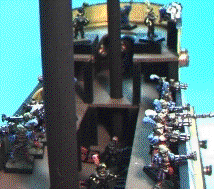 |
Note: in order to use Goblin doom divers (who kick ass in these rules) you will need either a mixed crew (Orc/Goblin) or an entirely Goblin crew.
*
Crews |
|
Race |
Abilities |
Orc |
-1 to put out fires, +1 in boarding actions |
Goblin |
-1 in boarding |
Dark Elf |
-1 to put out fires, +1 in shooting |
Elf |
-1 to put out fires, +1 in shooting |
Dwarf |
-1 in boarding actions, +1 to armour saves resulting from boarding actions |
Skaven |
-1 on misfire chart, luck (one reroll per turn) |
Human |
none |
Lizard |
primitive weapons (18" maximum in shooting), +1 in shooting |
Chaos |
-1 shooting, +1 in boarding actions |
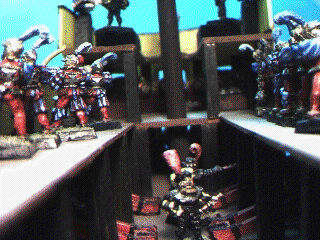
| Specialists Until now all crew have been able to perform any of the tasks on a ship. There is a second crew category called specialists. These are crew who have specialized in one of the 5 crew functions (fire stations, maneuvers, changing speed, snipers, boarding, or ships guns). |
 |
There are both benefits and drawbacks to using specialists. The marine for example, is a specialist at boarding actions. A marine will therefore roll 2 dice in combat instead of 1. The down side is that he will not perform any other action on your ship. A captain using specialists will have many advantages but must be very careful managing his crew, especially when removing casualties. Marines will only be of value if other crew are alive to bring the ship into a melee situation.
To include specialists, a player must trade crew chits for specialists at one chit per specialist. To represent these specialist crew, specialists must be represented on the ship with appropriate miniatures.
The following table lists the 5 different specialists that can be used:
*
Specialist |
||
Specialist |
Function |
Abilities |
Marine |
Boarding |
Marines are well trained shock troups or large creatures such as Ogres and Minotaurs. Each marine rolls two dice in a boarding action. |
Sharp Shooter |
Snipers |
Sharp shooters can pick out enemy in the rigging or exposed on deck Enemy crew hit by snipers do not get an armour save. |
Sailor |
Speed & Maneuvers |
Sailors automatically count as being on fire stations in addition to their speed or maneuver function. |
Cabin Boy |
Fire Stations |
Cabin boys run about the ship with buckets of water. Each cabin boy counts as two regular crew when putting out fires. |
Master Gunner |
Ships Guns |
Guns crewed entirely by Master Gunners may reroll the first
misfire in each turn. Additionally, in order to use megga-weapons, these weapons must be crewed by Master Gunners. |
Victory Points
The average ship is size 50 (50 action points/crew). Each point of damage this ship does is worth on victory point. You can use bigger or smaller ships though, and the victory points are just multiplied at the end by this formula:
| Victory points |
= Damage done x |
50 your ship's size |
So if your ship is size 100 and you do 20 damage on me it will count as 10 victory points. However a dingy with 10 crew doing the same 20 damage will amount 100 victory points. Each captain can calculate his damage to victory point ratio by dividing 50 by his ship size, 1:1 for an average size 50 ship, 1:1/5 for the 100 crew ship, 1:5 for the 10 crew dingy.