The goal of a campaign is to survive. You are out of the game if your Home Castle is taken. These rules are intended for 3.000 - 4.000 points worth of Warhammer troops for each player. You can play with less or more, but some parts of these rules might need to be adjusted accordingly. Before starting a campaign you should gather together and make sure everybody knows any special rules you intend to use. As the movement system requires all players to be present it should be pretty easy to handle any problematic situations by negotiation/voting/die-roll. One possibility is to have a Game Master who makes all decissions and comes up with other interesting things, for example makes new random events. A Game Master could also lead 'minor-powers', that is if you have around models for more armies than you have players such an army (armies) could be a passive 'minor-power', only defending it's homelands. This way the GM also have a chance to fight some battles.
TURN SEQUENCE
1)BEGIN TURN, declare alliances
2)MOVEMENT PHASES 1-8
3)BATTLES:
- Fight battle
- Check losses
- Withdraw or new battle
4)CHECK SUPPLY
5)END TURN
As you will notice reading these rules most is written about situations that will rise very seldom. The reference sheet in the end handles most common situations.
Forget about Army Book restrictions on who may ally with who. Players may ally with anyone. You should use for 'non-alliable' alliances the Dwarfs Elf-Grudge rules found in the Dwarf Army Book.
1.0 UNITS
Your troops are divided into 'units'. Each unit has a maximum limit of troops it can have, and a minimum leader.
| UNIT | MAX POINTS | LEADER |
| Corps | 500 | Champion or 2nd level Wizard |
| Army | 1000 | Hero or 3rd level Wizard |
| Grand Army | 2000 | General |
Note: Some players take the habit to have ONLY corps units. This is perfectly legal. The
General leads one corps and in battle he leads all the forces present.
The Army Book limits are for all your troops, so if you have 4.000 points worth of troops you can have up to 1.000 points of warmachines, up to 2.000 points of characters, a minimum of 1.000 points of rank and file and so on. This means you could have for example an all-character corps, an artillery-army etc.
If the number of regiments is limited (for example Dwarfs can have 0-1 regiments of Miners) it is the limit for all your units. I.e. a Dwarf player could have one regiment of Miners in ONE of his units.
You may divide the troops as you wish into units, but note that since you can have only one General you can have only one Grand Army. You may freely exchange the contents of your units if two units are stacked in the same place, but always remember the unit limits and minimum leader.
Units start on or around the Home Castle hex. If there are secondary cities you may place unit(s) in them too.
If for some reason you don't have the necessary minimum leader available (i.e. he is probably dead) you have to split the unit into smaller units OR the whole unit stays put until a replacement leader arrives. The unit can fight defensively, but you have to deploy all your troops first, before the enemy deploys any of his units.
Note that the unit leader doesn't act as a general, only the general has the generals abilities. Also note that you can only have one battlestandard.
2.0 THE MAP AND STACKING
The area where the campaign is happening should be a hexagon map. Depending how
big/complex campaign you wish to have the amount of hexes varies. If you want a pretty
small campaign there should be around 10-20 hexes per player. The map should have
different territory, some roads connecting the Home Castles (and other castles/cities if
you have them). It is advisable to use common sense when placing the Home Castles (and
other cities/castles), so that WoodElves are in forest, Dwarfs in hills or mountains and
so on.
Each hex can stack 3.000 points worth of one players troops. At NO TIME may this stacking limit exceeded. If it is impossible to move elsewhere (i.e. withdrawing from a battle) you have to eliminate troops in excess of 3.000 points. The player may choose which troops are eliminated.
This 3.000 point limit represent a logistic maximum: more troops could easily fit into the hex, but they cannot be supplied or given commands. Eliminating the excess troops represent troops getting lost, nobody knows wether they have starved, died from wounds, simply went home or what.
More than one player can have troops in the same hex. Each player has the 3.000 point
limit, so if six players have troops in the same hex there could be a whopping 18.000
points of troops in the same hex...
All units have 4 Movement Points. Exception: If the unit is totally composed of light
cavalry and/or troops with movement of 9 or more it has 8 Movement Points (these units are
later called LC units for convinience).
3.1 MOVEMENT COSTS
| TERRAIN | MP | NOTES |
| Clear | 1 | - |
| Road | - | Halves movement cost, but only if entered from a connected road |
| Forest | 2 | Doubled for LC, halved for WoodElves and Forest Goblins |
| Hill | 2 | Doubled for LC, halved for Dwarfs, Chaos Dwarfs, Night Goblins, Skaven |
| Mountain | 4 | Doubled for LC, halved for Dwarfs, Chaos Dwarfs, Night Goblins,Skaven |
| Swamp | 3 | Doubled for LC, halved for Lizardmen and Skaven |
| Stream | - | Doubles cost to enter hex on other side, except for Lizardmen. Via bridge normal road cost. |
| River | - | Impassable except via bridge. Lizardmen may cross. |
3.2 MOVEMENT PROCEDURE

The movement is done in 8 phases. Players move their units in a random order (roll 2d6, highest goes first, 2nd highest then etc).
1. Phase: The first player moves one unit for 1 MP. This might be enough to move the unit 1, 2 or no hexes. If able to move 1 or 2 hexes, then place the unit in the new hex. If not able, then the unit is said to be 'commited' to the move. Now the second player in order move one of his units for 1 MP.Then the third and so on. When all have moved 1 unit the first player moves a second unit for 1 MP, and so on. When all players all units have moved 1 MP go to phase 2.
2. Phase: The first player moves one unit for 1 MP (the units second MP). If the unit was committed to move it may now be able to finish the move, if not it is still commited. All units move 1 MP, some units may be committed to new hexes. When all units have moved their second MP go to phase 3.
3. Phase: Now the first player moves a unit for it's 3rd MP, and then every player in turn move one unit a time until all units have moved.
4. Phase: Repeat the procedure.
Phases 5-8 are for LC units ONLY. Repeat the procedure for them.
A 'commited move' may last from turn to turn, if the unit is not attacked meanwhile. You may break a commited move by using 1 MP.
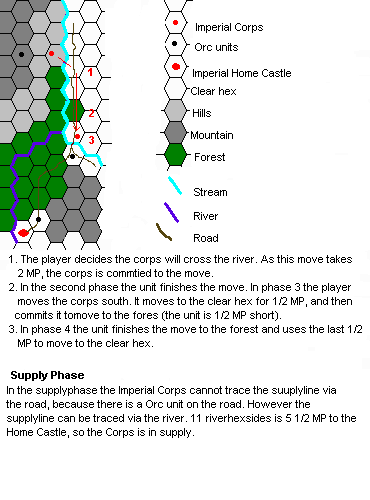
Example of moving: An Empire Corps is on the east side of a stream, and a huge Orc army
is closing in from east. The player wisely decides to move the corps onto the west side of
the stream to get away. In the first phase the corps is commited to move to the west side,
where there is a clear hex. The move takes 2 MP, so at the end of the 2nd phase the corps
have crossed the stream. In phase 3 the player decides to use the road in this hex and the
corps moves south via the road. The first hex is clear but the second is forest, that
would be 1 1/2 MP together, so the corps is commited to move to the forest from the 'new'
clear hex. In phase 4 the corps have moved entirely to the forest hex via the road, so it
can use the remaining 1/2 MP to move to a clear hex via the road.
3.3 HEXSIDE CONTROL
If a unit enters a hex with enemy units it is important to determine the control of hexsides. The 'newcomer' now has the control of the hexside it entered from, the 'original' hex-owner controls all the other hexsides. Hexside control reverts to the player whose units last entered via it. If at some point only friendly units are in a hex they now control all hexsides and is judged to be now the original owner of the hex.
You may not enter a hex with hostile troops AND leave the hex from ANOTHER hexside. Exception: If an adjacent hex-side is/becomes friendly you may leave via it (NOTE only adjacent hexside).
LC units can't leave hexes with enemy units in phases 5-8.
3.4 BUILDING TEMPORARY DEFENSIVE WORKSREMEMBER if you don't have a leader for the unit, the unit can only stand around doing nothing.
3.5 NOTE ON ALLIES
You can declare with an other player at the beginning of the turn that you are allied.
Allied troops don't prevent you from moving through them or building temporary defensive
works. Allied control of hexsides are regarded as friendly. Allied cities/castles are
regarded as friendly.
4.0 COMBAT
There will be one ore more battles if two or more hostile to each other stacks are in the same hex after all movement is complete. Each battle is said to take a day. Count how many battles (days) you have fought, this may be important for withdrawal.
You should try to get the 'feeling' of the hex to the board. If the battle takes place in a forest you should take as much woods as possible, if in a swamp-hex some small rivers and wet ground should be present and so on.
4.1 WHICH BATTLE TO FIGHT?
The usual situation is when there are two sides, each side composing of one or more
players units. Deploy for a meeting engagement and fight the battle.
If there are three or more to each other hostile sides present, things get a bit more problematic. Follow the the next procedure to determine what/how you will have battle:
1) The players now must secretly write down wether they withdraw their units, or prepare for battle. If there are only two hostile sides left after this they deploy for a meeting engagement. If there is only one or no sides left after withdrawal there obviously are no battles.
2) If there still are more than two sides present the players now have the chance to make temporal alliances. Their troops fight together in the coming battle. However no troops benefit from any bonuses from the other army (armies), for example generals LD, battlestandard and so on. All troops within 12" of a temporal ally have LD-1. Temporal allies may not charge into a combat where their temporal allies are involved (if temporal allies decide to charge same target, then both/all must hold back).
-if temporal allies win the battle, then they must IMMEDIATLY fight a battle between them (again, if there are more than two sides you first make temporal alliances). Deploy for a suprise attack. The attacker is the side who collected more Victory Points in the previous attack.
3) If after forming temporal alliances (or maybe none were made) there still is more than two sides left, you have to fight a "King of the Hill" -battle. In this scenario deploy the two weakest (in points) sides on the short edges. Then deploy the rest as follows: -if a third side exists it deploys at the center of the table in a 12" x 12" to 24" x 24" area depending on how big table you have -if a third and a fourth side is present let them deploy then they deploy on the long sides in 12" x 24" areas In his battle the turn sequence have to be changed a bit. Determine iniative for each turn with a 1d6. The first player moves one regiment or one independent character (you may decide that an independent character stays in a regiment for the turn). Then the second player moves a regiment/character and so on. You may not advance into contact with an enemy. After all movement there is a charge-phase. Each player secretly writes down who will charge who (for example "Dwarf Miners charge the Bloodthirster"). Note that in this version you may always 'stand and shoot' (it would be darned difficult to check who came from where). As for the charges there will certainly be difficult situations rising. Use common sense, or if that is not available use a Game Master. Then each player takes turns shooting with their units, then there is close combat. In the magic phase roll as many dice as there are sides for winds of magic. Distribute the cards evenly and any odd cards are returned to the deck. (I suggest considering to take the Total Power -card from the deck for this battle, as chances are high it will be otherwise used every turn.)
4.2 LOSSES
 After every battle check losses. Each
model removed as a casualty has a die rolled for. Note that models fleeing off the table
or moving off the table all get back. In fact, it is even advisable to retreat off the
table if everything goes wrong to save your soldiers. 1-3 The model was only scratched, it
is still available. 4-6 The model is dead, seriously wounded, prisoner or missing in
action. In other words it's not available anymore. Change the rosters up to date.
After every battle check losses. Each
model removed as a casualty has a die rolled for. Note that models fleeing off the table
or moving off the table all get back. In fact, it is even advisable to retreat off the
table if everything goes wrong to save your soldiers. 1-3 The model was only scratched, it
is still available. 4-6 The model is dead, seriously wounded, prisoner or missing in
action. In other words it's not available anymore. Change the rosters up to date. 4.2.1 WARMACHINE LOSSES
If there are no friendly troops on the table at the end of the battle, any Warmachines left on the board are eliminated for good. Use the casualty table for any broken/blown-up/destroyed warmachines (it still might be possible to do a quick repair). Note: You may crew warmachines with troops who have same profile as the original crew. 'Extra' crewmen (from destroyed warmachines) may hang around in a unit, they take no part in combats, put they can replace killed crew-members.
Example 1: 24 Goblins and their Boss were hacked down to last Gobbo. Seeing their destruction 10 Spiderriders took the better part of valour and ran off the table. After the battle the player rolls for casualties; 11 gobos and the boss are dead or missing, 13 gobbos surived with only minor scratches. The Spiderriders all return to camp. "Err, we got lost, boss!" they explain. The units roster is changed, where there used to be 24+1 gobbos there now are only 13.
Example 2: Imperial Great Cannon blew up taking it's crew as casualties. Rolling for losses the Cannon can be repaired, but two crew-members are killed. The Imperial players remove two spearmen in the same corps from their roster, and from now on they act as crew-members for the Great Cannon.
4.3 WITHDRAWAL
After checking for losses each player should write down secretly wether they want to fight an other battle or if they want to withdraw. NOTE: A player who had no troops on the table when the battle ended MUST withdraw. If he has nowhere to withdraw his troops are eliminated instead. If the enemy has 5-times more worth of troops in points left after checking for losses you must also withdraw.
The same rules are in effect for withdrawal as for leaving an enemy-occupied hex (discussed in the Movement section), i.e you may only withdraw via friendly hexsides.
You may not withdraw to a hex with enemy forces. However if there is an unsolved battle yet to be fought the hex may become free of enemy troops. If the hex becomes free of enemy troops on the same day (or earlier) as the battle you are withdrawing from you CAN withdraw the units there.
4.4 NEW BATTLE?
If there are more than one side present after withdrawal has been done start again with determing what kind of battle you'll have to fight.
4.5 QUICK BATTLE4.6 DEFENDING THE HOME CASTLE
 If more than two hostile sides are in a
Home Castle hex, the others have to first fight it out between themselves who get the
right to attack the Home Castle. The winner then can attack the garrison. A Home Castle
(or a city) may garrison at most 1.000 points worth of troops. If more are available the
defending player may choose to fight a normal battle or leave the excess troops outside
(who then must fight a normal battle). If the defender decides to fight outside the Home
Castle he may later withdraw into it, but any excess troops above 1.000 points are
eliminated.
If more than two hostile sides are in a
Home Castle hex, the others have to first fight it out between themselves who get the
right to attack the Home Castle. The winner then can attack the garrison. A Home Castle
(or a city) may garrison at most 1.000 points worth of troops. If more are available the
defending player may choose to fight a normal battle or leave the excess troops outside
(who then must fight a normal battle). If the defender decides to fight outside the Home
Castle he may later withdraw into it, but any excess troops above 1.000 points are
eliminated.
The defender of a city or Home Castle sets up the territory. It could be appropriate to limit the scenery to maybe 4-6 pieces. The first piece is buildings (no need to roll on the table). In addition to any other scenery the defender may use up to 24" of walls.
A Home Castle (only original Home Castle) garrison have an unmodified LD 10.
The Home Castle will act as a supplysource for the new occupants. If occupied by a sole players unit(s) that player may now garrison the Castle. If two or more allies occupy none of them controls the Castle unless the players reach an unanimous decission on who gets it, but they still can count it as a supplysource. If the former allies are later at war with each other they have to fight for it's control.
5.0 SUPPLY
After all battles are fought you'll have to check supply for all units. You have to trace supplyline free of enemy-units back to your Home Castle, captured enemy Home Castle, allied home castle or (if you are using a map with other cities) to any other friendly city.
The supplyline may not be longer than 10 Movement Points.
You can also draw the supplyline via rivers or streams (and lakes or sea). The river or stream may not pass adjacent to enemy units. Each river hex-side (note! hex-side, not hex) has a cost of 1/2 Movement Point, each stream-hexside 1 Movement Point. Lake/sea hexes cost 1 MP.
If a unit can't trace a supplyline, it is considered 'Disrupted'. Check for ALL units simultanously. Models in a Disrupted unit have LD-2. If a unit is already Disrupted it is elimininated. A unit that is already Disrupted cannot cut supplylines.
6.0 END OF TURN
If a players Home Castle is lost all his troops are eliminated. If a player doesn't have any troops left he is out of the game.
If only one player has troops left he/she is regarded as the winner. Two or more players may declare Joint Victory if there are no other players left.
It might be possible that because of casualties the Army Book limitations are now violated. If this happens you must eliminate any excess violating troops.
Example 1: The Bretonnian player realizes 80 % of his troops are characters. He now must eliminate troops from his units to get it back to the hefty Bretonnian 75 % limit. He does this by eliminating (or "Releasing" as the Bretonnian player insist) a Pegasus mount.
Example 2: The war for the Dwarf player is going totally down the toilet. He now has a IronBreaker Regiment and a Hammerer Regiment plus four Slayer regiments left from his proud Armies. The Dwarf Army Book states that a Dwarf player may not have more slayer regiments than it has other regiments. Fortunately the Dwarf player is able to combine two slayer-regiments (they are in the same hex), but he has to eliminate one regiment. Insult on injury! The slayers probably found a troll-city in a cave and charged in.
If the game is not over start a new campaign turn.
7.0 A BRIEF GUIDE TO A SUCCESFULL CAMPAIGN
Very soon every player understands the value of roads and the value of river-network. The player that controls the road-system is only a step from victory, because they can hit anywhere with no fear of supplylines breaking.
Use LC units to cut withdrawal routes (either by occupying possible withdrawal hexes or entering the battle hex via enemy-controlled hexsides). LC units are also useful when cutting supplylines.
It is advisable to have a unit or two behind your Main Army. They act as rearguard and they also provide fast replacements to depleted units in the Main Army.
Try to make allies. If the other players are smart they'll soon notice if you like to sit back at your Home Castle and watch others hack each other to pieces. Usually the loners are taken out first.
Restricting the use of magic-items might be a good idea. For example 1 magic item up to 150 points, 5 items up to 50 points and 5 items up to 25 points for each player in a 3.500 point campaign.
It's a good idea to have basic troops in a unit with war-machines, so that crew losses can be replaced.
It's also a good idea to have secondary leader(s) in a unit in case it's leader is slain. Oh, and do protect your General! For one shot games it might be a good idea to gear up your General and make him ride a Dragon (the so called 'power-gaming'), but in Campaigns that usually don't pay off. Imagine what happens if in your third battle this horrifying General or the Dragon (or both) is slain... With what are you going to replace that loss?
When planning a Campaign you get a longer campaign by giving players secondary cities. With the basic rules you can't make a never ending story, simply because players will sooner or later run out of troops.
8.0 DESIGNERS' NOTES
When feeling comfortable with these rules you might wish to use other rules from the Advanced section. Please note that altough the Advanced rules add many new and interesting things they also make the Campaign more complex. Things like weather or reinforcing an on-going battle add some flavour, but also some extra work and book-keeping. A Game Master is a must if you intend to use ALL of the Advanced rules.
I have tried to make these Basic Campaign rules as simple as possible so that a campaign can be played smoothly and without too much pain. For some reason the most obvious things seem to take the most words to explain!
If you find any glutches in these rules I would like to hear of them. I would like to hear any comments about these rules, especially how things could be said in a more clear manner.
I can also help setting up a campaign-map for you. Just tell me what armies will take part and how long Campaign you wish to have.
The easiest way to contact me is by e-mail. My e-mail address is:
I'd like to thank Mr. Simo J. Voutilainen and Mr. Jari Penttinen (man behind html coding and graphics) for ideas and comments. These rules would be different without them.
Jarkko Suvinen in 1998 Kuopio, Finland