|
Like most games that successfully navigated the
ever-treacherous straits of the gaming industry, Doom
left in its wake a tangled legacy, revolutionizing
multiplayer gaming -- for what it's really worth -- and
setting new standards for customizability and immersion
in entertainment software. But Doom's success also
enticed many designers to ignore that which made the
classics of yore, well, classics -- characterization, story,
plotting, and multi-faceted, open-ended play. Taken to
extremes, this has meant the propagation of violence in
lieu of creativity, as seen in a series of games awash in
blood but drowning in repetition, like Rise of the Triad
and Blood.
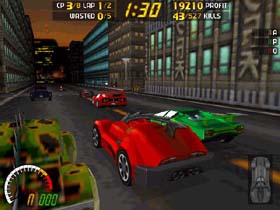
At a glance, Carmageddon would appear to be in the
high-risk group for violence over gameplay. Not so --
though extremely violent, Carmageddon offers some of
the more technologically sound arcade racing around and
manages to keep the gore from overshadowing the fun.
All in all, it's good. Good enough, in fact, to make one
wish it were better.
Engines, V-8 and 3D
Carmageddon seems pretty
simple: you drive your car around
a progressively difficult series of
tracks, making checkpoints,
battling the clock and a group of
motorized sociopaths whose
primary goal is to make your life
miserable, with the ultimate goal
of earning credits to improve your ranking (you start
ranked 99th on a phony ladder) and upgrade your engine,
weapons and armor. Races are won in one of three ways:
running over all the pedestrians on the track (extremely
difficult, since many tracks have 500+), pummeling your
opponents into scrap (usually easy) or by actually
following the course to its finish.
Carmageddon is perhaps the most unapologetically
violent game around right now, and truth be told, is
damn satisfying in its bloodshed. Sure, you gain infusions
of cash and time by trashing your opponents' cars and
splattering those unfortunate souls who chose alternative
transportation -- and the scoring system is terrific, giving
you extra bonuses for plowing through groups of people,
running them over in reverse, landing on them after a
jump or squishing them against buildings and guardrails
(
|
Tomb Raider II Part 1
Created by Core Design
Published by Eidos Interactive
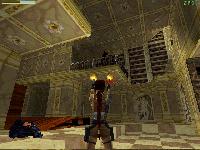
The undisputed Queen of action gaming is back. Having
spun her hair in a flowing pony tail, learned a few new
acrobatic moves and picked up some more powerful
weapons, Lara Croft returns after a year off. This time
around her sequel activities mirror her first venture into
computer gaming � investigate ancient ruins, gather
priceless treasure and kick some tail. The original Tomb
Raider took a lot of people by surprise. Its release
occurred during the blossoming of the 3D acceleration era
and gamers all over waxed poetically about how
incredible the game looked on their 3Dfx or Rendition
card. In fact, all that talk is what convinced me to jump
head first into the 3D era. By year's end, Tomb Raider
was a solid hit, Lara Croft was the new gaming icon and
OGR awarded Tomb Raider Best Game of the Year.
The game wasn't without its
critics though; some found the
exploration gameplay tedious
with not nearly enough action.
Others complained that Lara
shot far too many bullets into
wolves, bears and tigers � the
computer gaming animal
activists were up in arms. And
while the graphics were stunning in 3D accelerated mode,
many complained about bad texture alignment and
clipping problems. With these criticisms planted firmly in
mind, designer Core Design sought to improve on the
original game in virtually every way � more detailed and
outdoor environments, more human enemies, more
weapons, cleaner graphics, and hey, even more outfits for
Lara.
The Lara Factor
Has there ever been a gaming character as recognizable
as Lara Croft? She's everywhere and on everything.
During the past year, Lara has popped up at U2 concerts,
in fashion magazine layouts and even on this year's
Presidential greeting cards. OK, so I'm kidding about that
last one, but the point is, Eidos Interactive has
effectively marketed this character into more than just,
well, a computer-generated babe. And, as we stated in
our reasons for awarding Tomb Raider Best Game of
1996, this sort of appeal gave Lara life and made players
more interested in what she was doing -- thus, more
interested in the game. Another
factor that puts Lara out of the
computer screen and into your
face is the fact that Tomb
Raider is third-person. Every
keyboard action you perform,
you see immediate results on
the screen. Do a ALT-BACK
ARROW, and you instantly see
Lara perform a back flip. Can you imagine if Tomb Raider
had just been another first-person shooter? Would Lara
Croft be as popular?
Make no mistake about it, one of Tomb Raider and Tomb
Raider II's biggest selling points is the inclusion of one
Lara Croft. Eidos knows this; in their catalog of upcoming
releases, they listed
|