
Railroad Tycoon II

It's hard
to run a railroad--and I'm not talking about the competition from airfreight,
seaboard shipping, trucking or even localized infrastructure where raw
materials are used to produce finished products and consumer goods within
a close region. Nor am I talking about the high-maintenance costs, the
crazy situation on the stock market or pressure from labor unions including
the Teamsters. No I'm talking about running a virtual, simulated railroad,
where most of those factors don't even come into play. Still it is hard
to run a railroad in Railroad Tycoon II, as a lot has been greatly
improved and adapted since PopTop's early preview beta. Of course, RRT2
is vastly different from the original game that was created by Sid Meier
almost ten years ago.
Most improved since the beta made its rounds is that the AI, which
is represented as the robber barons and other "get really rich quick" kings
of the 1800s, has gotten a whole lot smarter. This isn't to say that the
game has really gotten harder, though in some ways it has, but rather the
game is even that much more true to the era that it represents. It has
become more challenging and consistent. For those who didn't get a chance
to check out the early demos (some were available online) or read the previews,
the AI made some strange decisions and often the computer's companies ended
up filing for bankruptcy. In the final code, the computer players usually
can stick it out while facing the bears and they'll also know when to run
with bulls.
It has taken a while for Railroad Tycoon II to arrive in station,
but it has been well worth the delays. The final game is solid, and it
has enough for fans of the original and those who are looking for a unique
sim. There are 59 trains from around the world, including locomotives that
date back to the earliest days of the rail industry, and as the game progresses,
new and improved ones become available. Maintaining these trains now becomes
more necessary, with gamers needing to supply water and make sure that
trains aren't overused. Of course, like in real life, trains can be pushed
to their limits when it comes to safety, but faster than you can say "Amtrak,"
be prepared for a disaster.
While it isn't good idea to try to pinch pennies in terms of maintenance,
the same goes for trying to save a few dollars by buying a cheaper train
or laying a single length of track instead of a double. In RRT2 you get
what you pay for. It's all part of a very sophisticated economic system
that is actually pretty easy to use, but does take a little patience to
get used to and is a bit of a departure from Sid Meier's original game.
Essentially the game uses the basic formula of running a railroad, and
that requires laying track, building stations, purchasing train engines
and finally moving products. Supply and demand is crucial if there is any
chance of making a profit from running a railroad. Where a line goes should
be determined before track is laid, so that stations that supply goods
or materials are connected to stations that can use those goods. Eventually
a whole network is created, and if planned well, every trip should be making
some sort of income, even if not entirely profitable. The basic strategy
is to add cars supplying goods and to take them to cities that need those
goods, where those cars are removed and new cars carrying new goods for
a later destination are added.
While making sure that the right shipments are going to the right place
might take a little bit of tweaking, gamers won't have to worry about trains
colliding in RRT2. Designer Phil Steinmeyer explains that the president
and CEO of a railroad company would never worry about such things on a
day- to-day basis. However, as mentioned, trains do require maintenance
and water to keep running. Trains won't crash into each other in this game
if switching stations aren't monitored, but they will catch fire or crash
if not properly repaired and supplied with water. Of course you may experience
other mishaps like traffic jams on badly planned routes, and there is even
the chance that you might just experience your own private Great Train
Robbery.
There are 18 scenarios to play, ranging from the birth of the railroads
in England (yes, the first railroads were in England even though they've
come to be a very much part of Americana), to the crossing of the western
half of the United States and even into the great expanses of Russia. In
addition, gamers can even try their hands at running the famous Orient
Express, which goes from Istanbul to Paris--no where near "the Orient"--and
there probably won't be any kind of murder taking place either. However
there is a difficult political climate in some settings and wars can come
into play. Nothing is worse than finding that your vast railroad empire
crosses through warring nations. But in case you're up to thechallenge,
virtual robber barons can see how the American Civil War or the Franco-Prussian
War can effect the economic climate. For more current events, players can
take part in the newly opened markets of the former Soviet Bloc of Eastern
Europe after the Berlin Wall comes down.
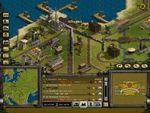
Visually the game is outstanding, and even minor tweaks from the demo
have been made. Players can zoom out to really take a full gander at the
breadth of their domain or zoom in to get a closer look at the economic
overview of a large city. RRT2 provides a 3D isometric view, and terrain
is more highly detailed, as are the individual trains--which look pretty
cool when they break down, as you'll see the black smoke and maybe if you're
(un)lucky some glowing fire too! The graphics look so good because they
have been developed for 1024x768 resolution and support either 16- or 8-bit
color. Certainly some of the delay in seeing this title is because PopTop
developed a proprietary 3D engine, but it is worth what we get to see.
Let's also hope that this engine is used in other simulations down the
line too.
The sound effects are also improved over the original game and have
a more genuine railroad feel. Sid Meier loves to create simulations and
Railroad
Tycoon was one of the best for its time, but in all fairness you can
really see that the designers of Railroad Tycoon II love
trains!
One minor complaint is the use of the bluesy background music. While it
might fit the modern railroad tradition, it's a bit out of place at times
and can get old really fast, nor do I really feel that Vanderbilt was a
fan of such music. Again, it's a minor complaint and otherwise the sound
effects really do help capture the spirit.
The interface in RRT2 is easy to use, with set screens for different
tasks. When pulling up screens for financial information or for assigning
cars to the trains, the game essentially pauses in the single-player mode.
Here players can--and should--carefully determine which cars are added
or removed at various stations. The train interface screen is a little
confusing so, it might take a game or two for the player to adapt to, but
soon it becomes second nature. Even as trains are added to the rolling
fleet and lines spring up around the map, the system is fairly manageable.
The financial screens are also easy to use, with players being able to
see how much money is being made, what the overhead costs are taking out
of the gross income, and even which runs are making more money. More than
once I quickly determined that I could completely skip or reroute trains
to avoid visiting certain markets--just because a city supplies materials
or goods doesn't mean it is necessary to pick them up, especially if the
product needs to be brought to a far-off destination.
Of course, like in the original game, playing the market successfully
can also make a profit. The stock market is affected by player actions,
and stock prices will go up when buys are made and fall slightly when a
sell-off occurs. And while bonds or more stock can be issued, sometimes
players should consider their actions carefully before doing so. It may
provide funds that will you to extend the lines to a new market, but make
sure that the new destination and runs will turn a profit, and a quick
one. Nothing is worse than floating a loan to loose more money.
One "improvement" over the original game is how stations are constructed
in this sequel. In the original game, it was only possible to enter or
exit a town in four directions--yet computer-controlled stations allowed
eight ways to come in and leave the station. Basically the computer "cheated"
in the original game. In RRT2 stations can be constructed to face any direction,
but they only allow lines to come into the station from two directions.
If a station has track that runs east-west, then lines must come in that
way and if they need to head north, the line needs to split after the city.
This is really annoying. Stations in some real-life cities, like Chicago
or Kansas City for example, had trains come into station from several directions.
The train yards could accommodate this and thus these stations became central
hubs for switching trains and routes. The new system often demands extra
track, and sometimes it nearly engulfs central points and thus limits city
growth.
In the original it also wasn't possible to connect to rival lines.
The developers have improved over that problem and now lines can connect,
which are much more realistic. Connecting to opponents' lines should be
a last resort to get into a city, at least early in the game--you pay a
percentage of your income to your opponent based on how much of the run
uses rival track. As mentioned previously, the computer will be careful
to avoid using a player's track if at all possible.
Working on the railroad can be a challenge, but Railroad Tycoon
II is actually a highly fun and addictive game. It starts out much
slower than Sim City, and it does require a bit of managing, but never
does the game feel like "sim work." With the isometric view of the open
countryside, realistic sound effects, and quick-moving gameplay, the game
really draws you in for some benign empire-building. All aboard, this train
is in station.
Tips:
The Good Press: More than a good-looking upgrade of a classic simulation--3D isometric views, challenging AI and excellent economic system.
The Bad Press: The game requires that you start out very slow so there isn't really such a thing as a "short game."
Overall
Rating:
Graphics:
9
Sound:
8
Documentation:
8
Getting
Started: 8
Value:
9