
I would like to thank Ms SANDHYA RAO, The Erehwon Thinking Programme,for her excellant guidance and support throughout the entire programme. She was a source of inspiration to me( i still have her visiting card that she gave to me in 1989).
I would like to thank people of 'The Erehwon Thinking Programme' for bringing out such projects to improve thinking skill of thousands of students.
Note: I have reproduced all the notes given to me during the entire course to help others and not for anyother reasons.
Lesson 4 - The Idea Triggers, POPBEANS
Lesson 1
Is 'thinking' like 'breathing' ???
Something that happens by itself (i.e)occurs naturally???
Something we are born with???
Is 'thinking' is like 'playing tennis'???
Something which has to be learnt???
Something which has to be developed???
Most people believe that 'thinking' is more like 'breathing', something that happens and hence, we cannot do much about it.
This is a mistaken belief.
'Thinking' is not like 'breathing' but more like 'playing tennis'. It is a skill which can be learnt and developed just like typing, carpentry or any other skill
How does one learn to play tennis???
1) First learn the right techniques- holding the racket, stroking the ball etc.,
2) Then practice each technique till you become totally familiar with it.
In order to learn any skill we must go through the same two stages :
Similarly, in order to develop your 'Thinking Skill' you :
1) will first be introduced to a set of techniques, and :
2) then you will be required to practice each technique to become familiar.
REMEMBER : Learning any new skill whether it is a game or music or dancing etc. is very exciting in the begining.
It is a laborious task requiring a lot of commitment and will-power.
So don't expect developing 'Thinking Skills' to be a matter of just fun & excitement.
If u really want to improve your 'Thinking Skills' you will have to practice hard. It may even be down-right boring on occasions, but will pay big dividents.
While attemping any excercise in this programme, try to:
Remember that both the quantity as well as the quality of ideas will be kept in mind while evaluating your answers.
Two students were asked to think of ideas with the color 'Red' (i.e) to write down all the ideas that 'Red' reminded them of.
The first student wrote the following ideas:
1. Post Box 2. Gas Cylinder 3. Fire-Engine 4. Fire-Extinguisher
5. Traffic Light 6. Railway Signal
The second student wrote:
1. Anger 2. The Red Sea 3. Red Indians
Which of the two students is more FLUENT, (i.e) has thought of more ideas???-the first student.
Which of the two students is more FLEXIBLE, (i.e) has thought of along different tracts???-the second student.
* All six ideas of the first student are along the same track. They are objects that bear the color RED.
* All three ideas of the second student are along different track. The first idea is an expression, the second idea is a place and the third is a group of people.
Which of the two students is more 'ORIGINAL' i.e. has thought of unusual ideas???-the second student again.
Thus even though the first student thought of more ideas he may score less than the second student.
Don't think of only one or two ideas.
Think of a large number of ideas.
Don't be one-track minded.
Think along a number of different tracks.
Don't think of oridinary ideas.
Think of unusual ideas.
These three are the most important characteristics of a good creative thinker.
Thinking Skills are used to :
* Solve Problems(in academic and in daily life)
* Make decisions , especially choosing between various options
* Find alternative ways of doing something
* Determine the weight of doing something
* Determine Priorities
* Describe an event or occurance Clearly and in detail
* Search for Information on any subject
* Determine the Focus of a discussions, articles etc.
* Resolve an Argument
* Appreciate other's View points
END OF LESSON ONE
LESSON 2
Have u seen a person listening to the cricket commentry???
The head is bent, the eyes focused on the ground or the gaze fixed at some distanct point.
What do you think is going on in his mind- a film strip! No! not exactly something as clear and vivid as a flim strip, but definitely a series of pictures; he is seeing or visualising the action in his mind's eye.
Images keep flashing through our minds when we hear, see, touch, taste or smell something.
Three basic methods to develop visualising skills are:
1) DOODLES : Thinking of visual ideas with aimless ahapes
2) GEOMETRICAL : Thinking of visual ideas with geometric shapes
3) STANDARD SHAPES : Thinking of visual ideas with the shapes of alphabets & numbers
NOTE: There are some figures that i couldnot include in this page.
 Look at the sketch on the left.
It is an aimless drawing, without any structure, i.e it does not represent anything in
particular.Such aimless drawings are called DOODLES.
Look at the sketch on the left.
It is an aimless drawing, without any structure, i.e it does not represent anything in
particular.Such aimless drawings are called DOODLES.
Try to think of ideas with doodles is an exciting way of developing visualising skills.
A group of students were asked to think of visual ideas or associations with the doodle above.shown below are some of them. You could, of course think of many more
A) Sand dunes in a desert.
B)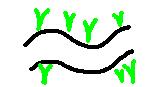 A Winding Road
C)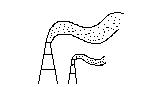 Smoke -Trails from a chimney
D) A Meandering River
E)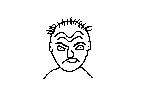 Lines on the head of a
frowning man
Lines on the head of a
frowning man
F) Ski-Tracks(no picture)
G) Hair blowing in air(no picture)
H) Two snakes(no picture)
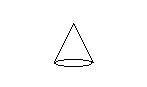 A triangle, rectangle, circle,
square are all geometrical shapes. Look at the geometrical shape on the left. It is a
CONE. A group of students were asked to think of visual ideas with this shape. Shown below
are a few of the ideas that they though of.
A triangle, rectangle, circle,
square are all geometrical shapes. Look at the geometrical shape on the left. It is a
CONE. A group of students were asked to think of visual ideas with this shape. Shown below
are a few of the ideas that they though of.
A) 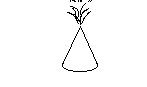 A Flower pot(fire cracker)
B) 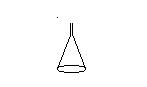 A Funnel(in inverted position)
C) A Tornado(no picture)
D) A Rhino's Horn(no pictire)
We will now use standard shapes(alphabets/numericals) to think of visual ideas.
Shown below are 5 possible ideas each with te shapes of:
A)  A Road
Intersection
A Road
Intersection
B) 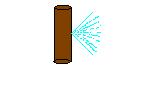 Water
squirting out of a hole in a tank
Water
squirting out of a hole in a tank
C) A Man excercising (no picture)
A) 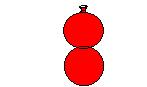 A Ballon tied in the center
B) 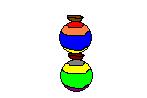 Two Earthen Pots-one on the top of
the other
Two Earthen Pots-one on the top of
the other
A lot of people believe that only artists need visualisation skills. Visualising Skills are essential in all walks of life; in acaedemic, practical & career situations.
IN ACADEMICS
History & Geography: Visualising skiss are used while trying to understand & appreciate eventys in History or Geography. Photographs can help, but you can't find photographs for more than 5% of the total subject matter. 95% of the work is still left to your visualising skills.
Science: Most of the concepts in science are abstract i.e one can't see or experience them physically. They have to be visualised (e.g)-The motion of electrons, Chemical reactions, Gravitational forces etc.
Compostion: While describing a scene, an event, a place etc. you need visualising skills as much as languages.
The sharper the picture in your hand, the better will be the description.
IN PRACTICAL SITUATIONS
1. While buying a plot of land: One usually tries to visualise one's house on the piece of land while deciding whether to buy a plot. The greater the visualising skill the better the decision.
2. While buying clothes: Visualising hat colors & patterns would suit you.
3. While deciding the layout of a room: Visualising how each piece of furniture should be placed
4. While planning a time table for a school: Visualising the movements of teachers & students.
IN CAREERS
Inventors, Architects, Engineers, Doctors, Managers, Businessmen etc., all need visualising skills to become competent in their professions.
PRACTICE SECTION
Think of all possible visual ideas with the following:
1)The geometrical shape of -SPHERE, RECTANGLE
2)The shape of letters-'Y', 'M'
3)The following DOODLES
A) 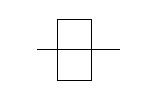
B) 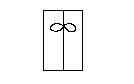
C) 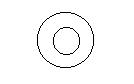
Fluency: The number of visual ideas thought of with a geometrical shape, doodle or standard shape(in a single track)
Flexiblity: The number of tracks used in thinking of visual ideas. Try to think along atleast 5-6 tracks
Originality: The number of unusual or exceptional visual ideas thought of. Remember-any wild idea is not original-it must also be revelant.
END OF LESSON TWO
LESSON 3
There is no way out!
There is no alternative!
This is the only way!
Very familiar statements aren't they! Most people have spoken or heard them at onetime or another. Whenever you hear any of these statements, don't believe them and ask the person concerned not to believe them either. For there cannot be situations in which there is only oneway of doing something or performing a task. There are always OTHER WAYS or alternatives. You must be willing to make an effort to look for them.
The stone age man has just thought of another way of using a log to pull heavy blocks(no picture).This was the first stage in one of man's greatest inventions-THE WHEEL!
Eyesight is thought of essential for reading. But LOUIS BRAILLE invented another way of reading-by touch. He invented the Braille system-a method of reading for the blind.
It has been this ability to think of another ways of doing something or accomplishing or performing a task that has lead to great ideas.
T.O.W is an acronym for 'THINK OTHER WAYS'
Before begining any task that you have been given in school or at home, 'Do a T.O.W' or think of all the other ways in whichyou can do it. Do not at once setttle for the most obvious way, because the most obvious way may not necessarly be the best or even the most suitable.
A T.O.W exercise can be done in the following three steps:
1) What is the task???
Let us assume that the task is -"To go from A to B"
2)What is the most obvious way of doing it???
Let 1 be the most obvious way of going from A to B.
3)What are the otherways of doing it???
Let 2,3,4 & 5 be the otherway in which one can perform the same task i.e going from A to B.
From the five ways thought of, one can now select the best.
The diagram below shows how to 'Do a T.O.W'.
The limitations of this kind of thinking is not that one thinks that the availability way is the correct, chosen or natural way, but that one also thinks that there is actually no other way: as a result , the mind does not explore other options(choices). This kind of thinking is narrow & limited, therefore poor!
Let's consider the following situation as an example:
An advanced military column has come across obstacles, a 20-ft high wall.
They have to get past this obstacle. The most obvious way, according to the commander, is to climb over the wall by throwing up a rope with a hook. When asked to think of OTHER WAYS, the commander thought of the following:
1) They could have a tank ram through the wall(no picture).
2) They could dig a tunnel below the wall(no picture).
3) They could blast a hole with dynamite(no picture).
4) They could try walking around it(no picture).
5) They could erect a wooden log with pegs, next to the wall(no picture).
6) They could send a wireless message requesting for a helicopter to drop them on the other side(no picture).
7) They could use a ladder made of tent poles, sticks & rope(no picture).
8) They could have four tall men stand one on top of the other(no picture).
In the above illustrations the 5th, 6th, and 7th ways are all along one track 9i.e) to go over wall. The 1st & 2nd ways are along another track- to go through the wall.
After doing a T.O.W. you will have before you several ways of accomplishing a task. You can select the most suitable way.
You may not come up with brilliant ideas like the wheel or Braille, but there are good chances that you wil discover a fasater and better method of doing the work.
The first illustrations was expectional (i.e) it may or not occur with many people.
A most obvious way that strikes people is 'Put up advertisements asking people to look after trees'.
A T.O.W. excercise yielded the following ways:
1) Make it compulsory for every person to plant atleast one tree(no picture).
2) Ban cutting of trees(no picture).
3) Any person planting 5 more trees should be given a bonus(no picture).
4) Any person cutting a tree should plant three more(no picture)
5) On every general election day, make it compulsary for every voter to first plant a tree(no picture).
6) Name trees after people who plant them(no picture).
7) Have seeds scattered through airplanes in the monsoons(no picture).
8) Make it compulsory for every person applying for a govt.job to attach a certificate stating that he has planted atleast 10 trees(no picture).
9) Set up a task forse to plant and mantain trees(no picture).
10) Make it compulsory for every colony to have trees equal to the number of people living there.
A TOOTH BRUSH is normally used for cleaning teeth(the most obvious way). What could be the other ways of using a tooth brush??? Or to waht other uses can a tooth brush be put???Illustrated below are some of the conventional /unconventional ways of using a toothbrush.
1) To roll a string(no picture).
2) To clean a comb(no picture).
3) For cleaning jewellary(no picture).
4) For applying polish on shoes(no picture).
5) For drawing a string(no picture).
6) For stirring liqiuds(no picture).
7) For scrubbing nails(no picture).
8) As a bolt(no picture).
9) Punching a hole in paper(no picture).
10) For spray painting(no picture).
The uses 2), 3), 7) are along the same track-using the brush for cleaning.
1) You have to spend one week in an empty room, alone. You will be given three meals a day, but nothing else. Do a T.O.W. and think all the ways in which you can keep yourself preoccupied, for the period(1 week).
2) To make 2nd class train more comfortable. Do a T.O.W and think of ways
3) Think of OTHER USES for a 'foot long electrical wire'
1) You have to stop an aircraft form landing. There is no electricity & no generator either. All systems of communication have broke down. The time is 11 p.m. Do a T.O.W and think of all the ways that come to mind.
2) Do a T.O.W on 'To improve a cricket bat'
3) Do a T.O.W on 'To tell the time of the day without a watch'.
4) Think of OTHER USES for 'a saucepan'.
How many different ways have been thought of?
How many different tracks has the person thought along ?(you must ensure that you think of ideas along different tracks).
The number of unusual ideas thought of. In the second illustrations "To increase the number of trees" is very original.
END OF LESSON THREE
LESSON 4
A senior student was asked this questions and given 2 minutes to list all the word, phrases etc., that he could associate with 'Green'. At the end of the time limit, he had thought of 5 associations.
He was then introduced to the 8 IDEA TRIGGERS-a technique to multiply ideas. He repeated the excercise using this technique and thought of 22 associations of 'Green'. He had mulitplied his ideas more than 4 times.
The 8 IDEA TRIGGERS are:
Take the first letter of each of the IDEA TRIGGERS and you form the acronym 'POPBEANS'.
POPBEANS is an easy word to remember. For any word or situations,you can now use these 8 Idea Triggers and discover a number of associations.
Imagine a mechanism with 8 triggers, each representing one letter of the acronym POPBEANS.
When you press a trigger, it sets off a chain reaction of ideas in that particular channel.
 The P trigger activates the PEOPLE channel-you must
think of all the PEOPLE who can be associated with the goven word or situation.
The P trigger activates the PEOPLE channel-you must
think of all the PEOPLE who can be associated with the goven word or situation.
The O trigger activates the OBJECTS channel-you must
think of all the OBJECTS that can be associated with the given word or situation.
Similarly, each of the remaining triggers will help you think along particular channels and multiply your ideas.
Hence, the 8 Idea Triggers of POPBEANS will set off 8 chain reactions of ideas in 8 different channels.
You musr try to make use of all 8 Idea Triggers in any situation. To use POPBEANS effectively, follow the 3 steps given below:
1) Imagine you are pressing the first trigger P.
2) Frame a question like 'What people, or kind of people, can be associated with the given word or situation ?'
3) List all the ideas that come to mind.
Use these 3 steps for each of the 8 Idea Triggers.
Question : What people, or kind of people, can be associated with 'COMMUNICATION' ?
IDEAS : Dilip Kumar, Shakespeare, T.V, Announcers, Transulators, Teachers, Authors etc.
Question : What objects does the word 'COMMUNICATION' bring to mind ?
IDEAS : Pen, Blackboard, Books, Mike, Telephone, T.V, Satellite, etc.
Question : What places can be associated with 'COMMUNICATION' ?
IDEAS : Classroom, Auditorium, Hollywood etc
Question : What brandnames does 'COMMUNICATION' remind me of ?
IDEAS : Onida, The Art of Public Speaking(book), Sony, HMV, Lintas(advertising agency) etc.
Question : What expressions are associated with 'COMMUNICATION' ?
IDEAS : Syle, Vocabulary, Phrases, Dialogues, Slang ,ect.
Question : What activities are associated with 'COMMUNICATION' ?
IDEAS : Talking, Gesturing, Signalling, Writing, etc.
Question : What, in nature, can be associated with 'COMMUNICATION' ?
IDEAS : Birds, Animals, Insects, Ionosphere, etc.
Question : What can be regarded as the symbols of 'COMMUNICATION' ?
IDEAS : Language, Morse, etc.
You cannot press two triggers at the same time on your imaginary mechanism-it will result in chaos and confusion. Similarly, when you are using one trigger, think in that particular channel only and don't let your mind drift to the other channels.
This is easier said than done! You should be aware of minds tendency to wander or drift, and if ideas along a different track do emerge, quickly put them down in the suitable track. Then get back to the one you were thinking about. This will help you to note down any useful ideas as well as prevent your mind from drifting.
Don't get discouraged if you are unable to think of ideas with all the 8 Idea Triggers
To Be Continued.....Come Back Later