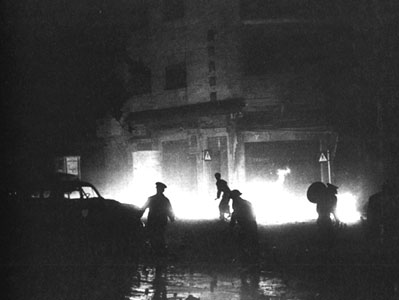
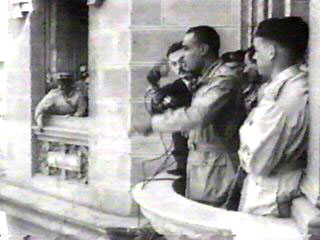
At the end of World War II Egypt was in a condition of extreme political instability. Theoretically an independent nation, it had really been dominated by Great Britain for decades. The British presence was motivated by a strong desire to protect the Suez Canal and the passage to India. Egyptian politics in the late 1940s was marked by rapidly increasing activity by radicals and nationalists, including Muslim fundamentalists. The Muslim Brotherhood promoted terrorist activities. Guerrilla warfare against the British broke out in 1951. The country was also ready for revolution against a corrupt and ineffectual monarchy. A group of military conspirators led by Colonel Gamal Abdel Nasser overthrew the monarchy in July 1952. Under his leadership, Egypt became a republic in 1953. Nasser proved to be a very effective Arab nationalist, and he quickly became the champion in the Arab struggle against Israel. He gradually drew Egypt away from the West and into the orbit of the Soviet Union.
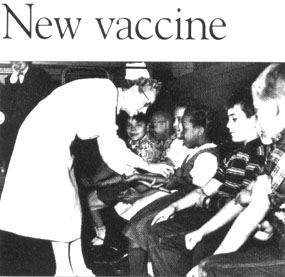
During the first half of the
20th century, the onset of summer usually brought with it outbreaks of
poliomyelitis, a dreaded disease. It was commonly referred to as infantile
paralysis, because the polio virus tended to attack children and young
people.Sometimes the virus caused only a mild infection, similar to influenza.
In many cases, however, it caused severe and sometimes permanent paralysis
of the limbs. Since the virus attacked the central nervous system, it could
have a variety of paralytic effects, including difficulties in breathing,
swallowing, and talking. There is no cure for polio, but two vaccines were
developed during the 1950s that have significantly curbed the incidence
of it. The first was developed by Jonas Salk. He identified the different
strains of virus that caused the disease and showed that killed viruses
would induce the formation of antibodies to fight the disease. His first
experiments were with monkeys. In 1952 he did field tests on children.
A larger field test was conducted in the United States in 1954, and the
next year the vaccine was released for general use. Whereas the Salk vaccine,
consisting of killed viruses, is injected, the other polio vaccine is taken
by mouth. It was created by American microbiologist and physician Albert
B. Sabin in 1957. Consisting of live, but weakened, viruses, it was approved
for use in 1960.