1967
The Six Day War
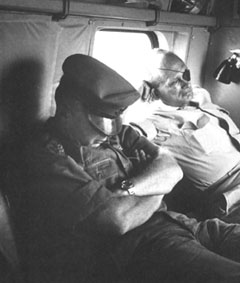
Early in 1967 Syria bombarded Israeli villages from the Golan Heights. In April Israel's air force shot down six Syrian planes. Egyptian leader Nasser mobilized forces in the Sinai Peninsula. When the war started on June 5, Israel was fighting on three fronts. Despite appearing cornered by its three neighbors, Israel nevertheless made short work of the Egyptian, Syrian, and Jordanian air forces, destroying them on the ground. Israeli armored forces then pushed deep into the Sinai and destroyed Egyptian resistance there by June 7. On June 9 the Israeli ground and air forces attacked the Golan Heights, capturing it the next day. Complete mastery of the air had proved decisive for Israel in winning the war in so short a time. In light of subsequent events, the Six-Day War has proved the most pivotal of the Arab-Israeli wars. As a result of the war Syria lost the Golan Heights, Jordan lost territory on the West Bank of the Jordan River, including the Arab sector of Jerusalem, and Egypt lost the Sinai Peninsula and the Gaza Strip.
When Nomi's sister called with the news that Jerusalem was captured she was unable to move and burst out crying. To her terrified daughters, she finally said: "Girls, promise me that you'll always remember this historic moment. We got Jerusalem back!" and she continued to cry.
A few days later her happiness was shattered when she learned that her niece's husband was killed in the battle to free Jerusalem.
Later that year, on a different continent, the first heart transplant took place…
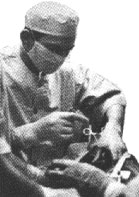
The first human heart transplant operation was performed on Dec. 3, 1967, by Dr. Christian Barnard at Groote Schuur Hospital in Cape Town, South Africa. This successful operation was the result of about ten years of research and experiment in various parts of the world. Although Barnard's success was followed by more than 100 similar operations in the next year in other places, the procedure proved to be one of limited application basically an operation of last resort. The procedure is very complex and costly. Long survival rates are rare because organ rejection by the patient's own system is common.
The development of the artificial heart in December 1982 seemed to provide an alternative to heart transplants, but its success by the early 1990s had been less than anticipated. Other kinds of organ transplants have been carried out by surgeons since the success of the heart transplant. Most common are kidney and liver transplants.
1968
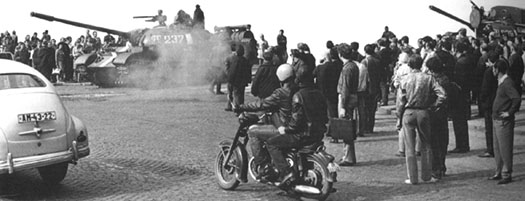
Tanks roll through the streets of Prague
By 1960 the Communist system had badly lowered the standard of living in Czechoslovakia. Younger members of the government's Central Committee demanded economic reforms. By 1968 little progress had been made under the leadership of hard-line Communist Antonin Novotny. He resigned in January and was succeeded by reformer Alexander DubCek. Other reformers were brought into the government and an Action Program was adopted on April 5. Sweeping reforms were adopted. An attempt was made to move from a completely planned economy to a mixture of planning and free markets. This period of reform is known as the Prague Spring.
On Aug. 20, 1968, military forces of the Soviet Union, East Germany, Poland, Hungary, and Bulgaria invaded Czechoslovakia. Soviet troops installed themselves and forced the election of an anti-reform government. It would be 21 more years before Czechoslovakia would be free of Soviet domination.
On that hot August day, Nomi was vacationing with her kids and was at the pool-side when the radio broke the news of the invasion. Again she had to explain to her daughters the meaning of world's event. Heated discussions and blunt hatred of Russia could be heard every where.
Go on…