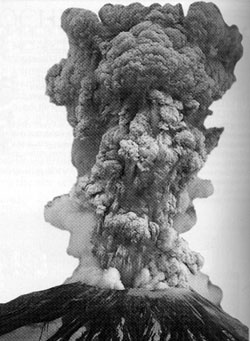
After lying dormant for more than 120 years, the Mount St. Helens volcano, in Washington state, erupted in spectacular fashion, on May 18th. It had been rumbling ominously for two months. It had been emitting ash and smoke for two weeks. The explosion, which measured 4.1 on Richter Scale, blew the top off the (2,949 m) peak.
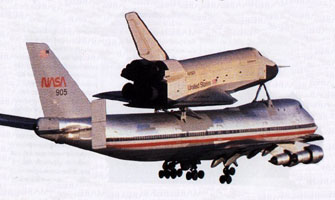
The first space shuttle was built in 1977 and was named Enterprise after the fictional starship in the science-fiction television show Star Trek. Enterprise flew only on voyages that tested the shuttle's landing capabilities, and it never went beyond the Earth's atmosphere.
On April 12, 1981, the shuttle Columbia was launched into space, and between then and July 1982 it was relaunched three times to test its ability to maneuver and carry payloads. During the 1980s three other shuttles were put into space Challenger, Discovery, and Atlantis. In January 1986 the Challenger blew up less than two minutes after launch, killing all seven astronauts aboard. This disaster halted the shuttle program for several years. The Soviet Union meanwhile began its space shuttle program in 1988 with an unmanned flight.
A strange, new, and deadly disease made its appearance in 1980. Physicians in such large cities as Los Angeles, New York, and San Francisco noticed that homosexual men were dying from rare lung infections or from a cancer known as Kaposi's sarcoma. By 1981 the disease was identified and given a name: AIDS, or acquired immunodeficiency syndrome. The virus that causes AIDS, human immunodeficiency virus (HIV), was identified by Dr. Luc Montagnier of the Pasteur Institute in Paris in research done during the years 1981-84. The results of Dr. Montagnier's studies were released in 1984.
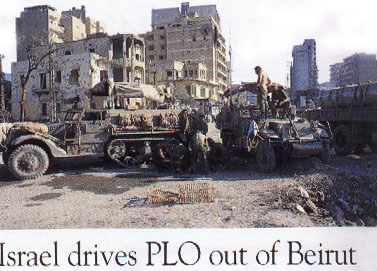
Both Israel and Jordan drove the militant Palestinians out of their countries during the 1970s. Many members of the Palestine Liberation Organization (PLO) and other terrorist factions moved into the southern part of Lebanon, a country being ravaged by civil war. As tensions between the PLO and Israel mounted, Israel invaded Lebanon in June 1982. Israel's troops swept northward to the outskirts of Beirut with little resistance. Shelling of West Beirut forced the PLO out, and many of the Palestinians were allowed to leave the country and set up headquarters in other Arab states. One result of this defeat for the PLO was to split it into factions, with some remaining loyal to Yasir Arafat, while others favoring the more extreme Syrian leadership.
On Jan. 3, 1985, the government of Israel announced that it had been resettling Ethiopian Jews in Israel since 1977. More than 10,000 Ethiopians had been secretly airlifted to Israel in the intervening years. Israel also announced that there were 4,000 black Jews still living in refugee camps in the Sudan and in Ethiopian villages. The chief rabbi of Israel had ruled in 1975 that Ethiopian Jews were descendants of the tribe of Dan, one of the original 12 tribes of ancient Israel. As such they were eligible for immediate citizenship in modern Israel under terms of the Law of Return. Their removal from Ethiopia in many cases meant an escape from famine. The Communist government of Ethiopia denounced Israel's airlifts as interfering with the lives of Ethiopian citizens.
The history of the world began one of its rare major shifts in 1985 when Mikhail Gorbachev was elected general secretary of the Communist Party of the Soviet Union. The long tenure of Leonid Brezhnev as head of the Soviet Union (1964-82) was followed by two leaders who were basically caretakers, Yuri Andropov and Konstantin Chernenko, each of whom lasted less than two years. Gorbachev was a much younger man than his predecessors, and unlike them he was keenly aware of the deep economic problems in his country. He began by stating the need for restructuring (perestroika) the economy. To achieve this he allowed the Soviet people more freedoms, or openness (glasnost), as it was called. But the democratic forces he unleashed brought results he had not intended. His refusal to use force to maintain Communism in Eastern Europe allowed the long-standing totalitarian systems of the Soviet Union and its satellites to collapse like a house of cards in 1989.
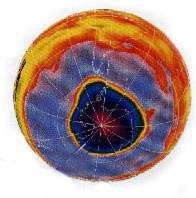
Ozone is a form of oxygen in which the molecules contain three atoms instead of two. In the Earth's upper atmosphere, ranging from six to thirty miles (9.6 to 48 kilometers) up, there is a concentration of ozone. Called the ozonosphere, it is often referred to as the ozone layer. This layer serves to absorb some of the sun's ultraviolet radiation. Such radiation would have very harmful effects on living things if it were not filtered out. In 1985 scientists working with the British Antarctic Survey discovered that a hole developed periodically in the ozone layer over the southern continent. Although this may have been a long-term natural event, the scientists believed that the effects were aggravated by the presence in the atmosphere of chlorofluorocarbons. These organic compounds are composed of carbon, fluorine, chlorine, and hydrogen, and they can be found in aerosol cans, refrigeration materials, and industrial solvents. Since this discovery there has been a call for an international ban on the production and use of the chemicals in question. The more recent discovery of temporary holes in the ozone layer in other places in the Earth's atmosphere including places over North America and northern Europe has contributed to the debate over global warming, a theory that the Earth is gradually growing warmer as the atmosphere becomes more populated.
Picture: Violet & pink areas show the sever depletion in the Ozon layer.
In December 1987 Palestinians living on the West Bank and Gaza Strip began an uprising against 20 years of Israeli occupation. Israel responded to the uprising, or intifada, with curfews and police patrols. The Palestinians answered with a general strike. By the end of 1988 more than 300 Palestinians had been killed and 6,000 placed in detention camps. The rage of the Palestinians was further fueled in 1990 with the mass immigration of Russian Jews to Israel and the consequent increase in Jewish settlements on the West Bank. The most serious incident of the intifada happened on Oct. 8, 1990 a confrontation between Israeli police and stone-throwing Palestinian youths on the Temple Mount in Jerusalem. Between 17 and 21 Palestinians were killed and about 150 wounded, while several Jews near the Western Wall were hit by rocks. In spite of the worldwide attention this incident received, Israel refused to allow an independent investigation. Israel's own official report blamed police for being unprepared to handle such incidents but generally accepted the killings as justified.