Incan Religion: 2
There are references that in the Inkan Society people practiced prayers, fasts, sexual abstinence in festivities, and there was a concept of sin. In family homes people had and still today have the Qonopa or Illa known as Wasiqamayoq or Ullti too, they are family idols or amulets in charge of protecting the house and bringing good luck and prosperity. They are sculpted in stone with different shapes and colours, and almost always with shapes of South-American cameloids having a hole on the back known as "qocha" (lagoon) where people pour wine, chicha or alcohol during the ceremony called "haywarisqa" (ceremony of offerings) and where they also deposit the "k'intu", that is, three coca leaves stuck with llama "untu" (tallow).
Offerings could consist in different elements such as food, chicha or Aqha (alcoholic fermented beverage made of maize), llamas, guinea pigs, etc. Liquid offerings were poured in fountains and channels named Phaqcha, thus chicha or animal blood was irrigated as a sacrifice. Occasionally food and some other offerings were given as ashes so that like this they could get more directly to the gods. Animal sacrifices were executed in order to foretell the future by means of the study of their viscera, heart, lungs and other organs. There is a strong controversy about the practice of human sacrifices in the Inkan Society. Some Spanish chroniclers, normally Catholic priests, wrote that in some special circumstances sacrifices of children were practiced (many scholars believe that this position springs up as an intent willing to justify the conquest and genocide since imposition of Christianity), like as the case of the priest Vasco de Contreras y Valverde, whom using different documents in 1649 asserted that when Wayna Qhapaq died "... his corpse was brought to this city, where in his funeral four thousand persons were killed...". On the other hand, Garcilaso Inca de la Vega states categorically that Inkas had already left that practice of some pre-Inkan Societies, he wrote, "... they did not have death sacrifices with human flesh or blood, but rather abominated and prohibited them as they did cannibalism, if some historian have said otherwise, this was because their informants deceived them and did not distinguish between the periods and places when and where such sacrifices of men, women, and children were made...". In short; today it is known that Quechuas in certain provinces practiced some human sacrifices; Huaman Poma between 1567 and 1615 wrote that " Capacocha" was the name of children sacrifices performed twice a year, while that Cieza de Leon wrote that that was the name for all gifts and offerings for their idols; Pedro Sarmiento de Gamboa wrote that "Capaccocha" was "the immolation of two male and two female infants before the idol of Huanacauri...". It is supposed that such human sacrifices were performed every year in the most important temples only, no human blood was shed in less venerated ones. Besides, Johan Reinhard (1992) gives information about remains of human sacrifices found by the summit of some high mountains. Father Cobo wrote by 1639 that when sacrificing boys, " They were killed by strangulation with a cord, or by a blow with a club and then they were buried, and sometimes they got them drunk before having them killed." The above mentioned Spanish soldier Pedro Cieza de Leon, called as the "Prince of Chroniclers" by Von Hagen, wrote by 1553 " It is told by many -perhaps by one of those writers who rushes up his pen- that there were feast days when they killed a thousand or two thousand children, and even more Indians. These and other things are the testimony we Spaniards raise against these Indians, endeavoring by these things we tell of them to hide our own shortcomings and justify the ill treatment they have suffered at our hands. I am not saying that they did not make sacrifices, and that they did not kill men and children at such sacrifices; but it was not as is told, not by long shot. They did sacrifice animals and llamas of their flocks, but many fewer human beings than I had though, many less, as I shall relate..."
When the Spanish conquest came, multiple events and actions happened tending to change radical and abruptly the religion of a whole continent, germinated and strengthened in millennia of existence. One of the superlative aims of the Spanish conquerors was to try to extirpate totally the "pagan" or "idolatrous" Tawantinsuyo's religion. When the "Indian Reductions" were established in 1572 by Viceroy Toledo, (for some people Peru's Solon, great organizer; but tyrannous and perverse for many others) the Spaniards tried to gather together all the Quechuas in small villages for four important reasons: in order to control them efficaciously; in order to gather more easily the tributes that Inkas' descendants had to pay to the Spanish crown; in order to exploit them indiscriminately without any payment or wage for their work; and in order to change the Tawantinsuyo's religion because like that it was easier to push the Quechuas into the churches. The conquerors began with the sadly famous " Idolatries Extirpation" by which everything that had any relationship with Inkan Religion must have been destroyed. Thus, the most important temples were burned and demolished frequently even to their foundations. A Peruvian version of the "sorcerers hunt" started, in which the Andean "Willaq Uma" and "Tarpuntays" were considered not as priests any more but as sorcerers or wizards, so they were potential or effective victims of the "Holy Inquisition". In short, every follower or practitioner of religion different to Catholicism was repressed, destroyed or eliminated. Nevertheless, in the colonizers' thinking there were different positions about the Andean Man and his religion. It is famous the controversy and dispute arose between the Spanish missionary and historian Bartolome de las Casas (1474-1568) and the also Spanish writer Juan Gines de Sepulveda (1490-1573). De las Casas suggested the imperative necessity of evangelizing the New World people in concordance with Christian precepts. On the other hand, Gines de Sepulveda argued that as a matter of fact, the Andean "Indian" had to be evangelized but before he had to be humanized. All that demonstrates that for an important segment of the Spanish colonizers the Andean Man, creator of one the brightest civilizations in the world, was one more animal specie that had to be humanized.
Although Catholicism arrived to the Andes almost 5 centuries ago, it is obvious that it did not have enough power or was able to banish completely the ancestral religion of Peru. Through the centuries there was and still exists a strong cultural and religious resistance, that is the reason why many gods, temples and ceremonies of the pre-Hispanic world have total force. Traditionally, theoretically or officially it is argued that religion in Peru is Catholicism, but in practice it is demonstrated that over here two blended religions are practiced, with a heroic continuity of the native Andean Religion and Culture. As Carmen Bernand says, " The Inkas are not fossilized people. Their image is still vivid in the minds of contemporary peasants who are excluded from all political power. Is this Inca image true to history, or does it serve a merely allegorical purpose? No matter. It lives in the hearts of those whom the modern world seems to have forgotten or rejected..."
The present day representatives of Andean Religion are the Paqo who have different hierarchies of priesthood and are represented by the Kuraq Tayta, Altomisayoq and Panpamisayoq. They are who perform different ceremonies to venerate the Apus (major spirits or deities), the Aukis (minor deities), the Pachamama (Mother Earth), etc. The Andean priests prepare the Despachos (dispatches) and Pagos (payments), that is, offerings for their deities, and they also offer them coca leaves selected among the best and formed as K'intu. The basic k'intu is made of three leaves; the biggest and lengthened represents the Apus (male deities), the medium and rounded the Pachamama (female deity), and the smallest and lengthened the humanity. Those leaves are placed one over the other facing to just one side and kept between the forefinger and thumb of the right hand while that the left one protects them. When more solemnity of the act is pursued then k'intus of 6 or 9 leaves are prepared. In the Qosqo region there are some divinities that stand out in importance: that is the case of Apu Ausangate (spirit of that snowcapped mountain) that is owner or ruler of cattle in general. The Apu Akhanaku in Paucartambo that rules over all the Andean tubers. The Apu Sawasiray between Calca and Paucartambo that is considered ruler of maize. The Apu Salkantay owner of jungle products.
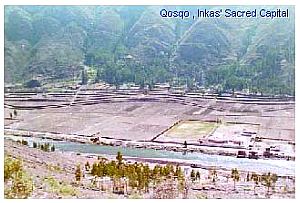 The Apu Willkamayu (pictured: Urubamba or Vilcanota
river) that represents the male virility materialized in water
that fecundates the Pachamama, because it drags from the glaciers
the fertilizing semen that gives to the land special properties.
The Apu Willkamayu (pictured: Urubamba or Vilcanota
river) that represents the male virility materialized in water
that fecundates the Pachamama, because it drags from the glaciers
the fertilizing semen that gives to the land special properties.
In these last decades the ancestral religion of the Andes is suffering considerable changes as consequence of commercialization induced by tourism. Nowadays it is possible to observe the appearance of numerous "altomisayoq", "panpamisayoq", "paqos" and "healers" that rinse their mouths with words like "mysticism", "esotericism", etc. Their main aim is to get money and goods from tourists when offering different ceremonies and courses of "initiation" or preparation in order to practice "Andean Priesthood", for almost astronomical amounts of money. They emulate to the true priests with solid vocation, conviction and belief, and obviously scoffing at the ancestral Andean Religion.