
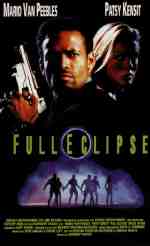
Full Eclipse
Home Box Office (HBO)
CAST: Mario Van Peebles, Patsy Kensit, Anthony John Denison,
Georgo C. Scott, Rita Moreno, Chris Owen, Bruce Payne
and Jason Beghe
DIRECTOR: Anthony Hickox
rating: R
running time: 97 minutes
1993
|
 |
Although a critically maligned troupe, the disciples of kinetic filmmaking have been pioneering the medium for decades. Oftentimes thought of as outcasts among the elite of film academia, these incredibly gifted directors are responsible for some of the most unique and innovative pictures ever to grace the silver screen. Not content to utilize the camera as merely a storytelling device, kinetic directors consider the camera to be an actual character in the film - not as a subjective entity, but as a literal visual protagonist. While the list of well-known kinetic directors includes James Whales, Sam Raimi, Dario Argento and Brian De Palma, there are a handful of other filmmakers who struggle to make movies not just visually interesting, but visually stunning.
Anthony Hickox is just such a director. While his breakout film Waxwork injected some visual punch into the old Hammer style of horror films, it was the kinetic masterpiece Sundown: The Vampire in Retreat (a clever nosferatu western) that thrust Anthony Hickox to the forefront of this under populated visual clique of filmmakers. His next accomplishment was the underrated Hellraiser III: Hell on Earth, where Hickox was able to stage a dance club massacre that is simply unforgettable, then immediately top it with a Cenobite street rampage. Anthony Hickox doesn't just make the camera come to life; he ruthlessly makes it attack the audience.
One of the more fascinating (and overlooked) horror films of the last decade is Full Eclipse, a 1993 HBO production that places werewolves in the urban jungle of Los Angeles. The catch is that these werewolves are actually members of an elite police force who use their enhanced powers to fight a criminal element thought to be untouchable. The premise is totally outlandish (and perhaps laughable), but the story is not only surprisingly engaging, but ultimately completely engrossing.
Mario Van Peebles (in an excellent performance) headlines as Max Dire, a veteran homicide cop who has seen too much of the ugly side of his profession. After seemingly losing his partner in a spectacular hostage gunfight, Max must also confront the emotional rift that has pushed his fiancé out of his life. Frustrated to the point of retirement, Max is a good cop looking for a way to make peace in his brutal world.
And so enters Adam Garou, a law enforcement therapist who specializes in coaxing these kinds of cops on the edge; giving them hope and a reason to face another tomorrow… with unbelievably macabre strings attached. Bruce Payne, a tremendous actor still best known as the villain in Passenger 57, plays Garou to steely perfection. Payne has an uncanny gift for showing menace through dialogue, and this role provides ample opportunity to showcase that talent. Bruce Payne is, without question, one of the most effective villains in the history of film. He's quite entertaining to watch.
Although Full Eclipse makes several interesting points about the psychological effects violence has on police officers, the plot is but a launching pad for the imagination of Anthony Hickox. In a film replete with incredible imagery, it is the sheer spectacle of seeing a marsupial supercop engaging a drive-by shooting perpetrator that makes this film memorable. The absurd concept is given respectability by the astonishing visual ballet Anthony Hickox is able to stage. It's his singular vision that keeps Full Eclipse from biting the big silver bullet.
--Yim Kip
WRITE YOUR OPINION
Copyright © With All The Trimmings Newsstand Distribution
|