
PEARL HARBOR
Touchstone Pictures
CAST: Ben Affleck, Josh Hartnett, Katie Beckinsale, Cuba Gooding Jr., Tom Sizemore, William Lee Scott,
Greg Zola, Ewen Bremmer, Jon Voight, Alec Baldwin, James King, and Catherine Kellner
DIRECTOR: Michael Bay
RATING: Rated PG-13 for sustained intense war sequences, images of wounded,
brief sensuality and some language.
RUNNING TIME:
2001
 |
 |
 |
Aptly dubbed the “Master of Disaster” amongst his peers, legendary producer Irwin Allen garnered a reputation for providing audiences with grandiose cinematic spectacle. By single-handedly creating the disaster genre, Irwin Allen ushered in a fresh style of movies that captivated audiences worldwide. The templates for his films never wavered: Place a diverse group of ordinary characters into a unique setting and besiege them with the horrific forces of nature. It was fire in The Towering Inferno; the ocean in The Poseidon Adventure; and killer bees in The Swarm.
Although languishing dormant for many years, the latest cycle of disaster films began anew in 1993 with Jurassic Park. While previous entries focused on natural disasters, Steven Spielberg's classic provided antagonists that were entirely man made; FX bogeymen that could provide ample villainy in the waning days after the cold war. This unique run of effects-driven disaster films culminated in 1996 with the blockbuster Independence Day.
In 1997 came James Cameron's monumentally successful Titanic, a disaster film that returned to the formulaic roots established by Irwin Allen. Being one of the smartest filmmakers in the history of the medium, James Cameron ingeniously tapped into another facet of this particular genre: Reality. By fusing his fictional characters with a real-life tragedy, James Cameron ultimately created one of the most beloved films of all time.
While not exactly a blatant steal, the Titanic cinematic baton is clearly in director Michael Bay's grip during Pearl Harbor. Light years from the juvenile mess that plagued Armageddon, the serviceable histrionics' of Pearl Harbor allow Bay ample breathing room to explore the Day of Infamy with his own unique visual style. The movie certainly comes across like a History Channel presentation for those with ADD, but that's a vast improvement over the mentally challenged qualifications it took to enjoy Bay's earlier films. This time the audience is allowed to be dumb, but not stupid.
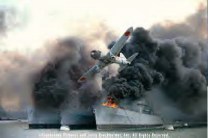
Although the title suggests otherwise, the Japanese surprise attack on the Pacific Fleet is merely the second turning point of Pearl Harbor. While other filmmakers would have no problems focusing their story solely on the attack itself, Bay uses the Japanese assault as a springboard for a rousing and effective third act. It's by far the films biggest and best surprise.
For reasons best known to screenwriter Randall Wallace, the plot of Pearl Harbor primarily focuses on a clichéd love affair between ace fighter pilots Rafe McCawley (the always enjoyable Ben Affleck) and Danny Walker (a wasted Josh Hartnett) as they pine for the affections of nurse Evelyn Johnson (a superb Kate Beckinsale). The Affleck/Beckinsale romance comes off the best simply because it's the relationship that is the most sincere. The characters are given time to relate to one another and because of this their feelings ring true. The Hartnett/Beckinsale fling is absurd to the point of irritation. Not one single moment of their relationship comes across as genuine, and their fetish-strewn love scene is as hilarious as it is entirely unnecessary.
It is interesting to note that it is the relatively minor love story between Nurse Betty (a surprisingly effective James King) and nervous pilot “Red” (an excellent Ewan Bremnar, who was so memorable as Spud in Trainspotting) that give this movie the only scene of heartfelt emotional impact. Although given sparse screen time to develop their relationship, both actors fare far better than their marquee co-stars.
Coincidentally, it is other supporting actors that give both weight and credence to the film. John Voight is stunning as embattled President Roosevelt; Cuba Gooding delivers the definitive portrayal of the heroic Doris “Dorie” Miller; and Alec Baldwin gives his best performance in years as squadron leader Jimmy Doolittle (whose character gives the most rousing speech since Mel Gibson fired up the troops in Braveheart.)
Apart from the secondary love affair of the story, the most unfortunate aspect of Pearl Harbor is the portrayal of the Japanese. The Empire is simply a guest star in the attack, while the various Asian actors are given token scenes of mindless exposition. The mind-boggling effectiveness of General Yamamoto's attack is reduced to scenes of training with model boats, while clever espionage is portrayed as simply phoning up Hawaiian barbers for information. Imagine what the film would have gained if only Josh Hartnett's character were eliminated from the story and replaced with scenes of the Japanese meticulously planning the infamous attack. In this regard Tora! Tora! Tora! will forever remain the most accomplished film to highlight the background and motivations for this attack. What's unforgivable is that Pearl Harbor didn't even bother to try.
For all its story faults, Pearl Harbor ultimately succeeds with sheer patriotic force. A rarity in modern Hollywood, this is a film of deep convictions. The characters are allowed to fight for the sake of love: Both of country and of each other. In such a cynical age, Pearl Harbor is not just a fresh reminder of the incredible spirit of humankind, but a silver screen textbook of the sacrifices it takes to achieve freedom. As the characters from Pearl Harbor struggle valiantly to find emotional reconciliation after that Day of Infamy, a quote from another famous disaster film becomes apropos: “Life will find a way.”
--Yim Kip
Pearl Harbor Official Web Site
Download The Pearl Harbor Screen Saver
Download the Full Length Trailer
Download the Teaser Trailer
Get the Player

WRITE YOUR OWN OPINION
Copyright © With All The Trimmings Newsstand Distribution
Multimedia courtesy of Film.com and IDMb
|