
Shallow Grave
Polygram Pictures
CAST: Kerry Fox, Christopher Eccleston, Ewan McGregor, Ken Scott, Keith Allen and Colin McCredie
DIRECTOR: Danny Boyle
RATING: R
RUNNING TIME: 94 minutes
1994
 |
 |
 |
A long-winded pontificator on the merits of textbook cinematic endeavors, the Professor of Film Theory & Application at the University of Southern California did teach me an invaluable lesson. Providing the only nugget of worth out of countless hours of fool's gold diatribe was the Professor's innovative lecture on “Collaboration & Communication.” In the midst of that topic's discussion an interesting parallel was presented to the class. The basic idea was that the best filmmakers operate in much the same fashion as an Olympic relay team; handing off the baton to an athlete of specialized skill and strength whose ultimate goal isn't individual glory, but victory itself. The relay comparison to film goes as thus: The screenwriter hands the baton to the producer, and then the producer hands the baton off to the director. Although severely flawed in its utter simplicity (the baton in the hands of the editor, composer and DOP is just as important), the concept has, over the years, proven itself to be irksomely correct.
Fine examples of the movie relay team are screenwriter John Hodge, producer Andrew MacDonald, and director Danny Boyle. Although they won a cinematic gold medal in 1996 with Trainspotting (which was not only the best film of that particular year, but one of the three best films of the 90's), this dynamic trio exploded onto the silver screen scene with 1994's stunning Shallow Grave. While that year it was Pulp Fiction that critics hailed in nearly a masturbatory fashion, Shallow Grave most deserved the recognition.
The story centers around three yuppie roommates living in middle-class London: doctor Juliet Miller (Kerry Fox), accountant David Stephens (Christopher Eccleston) and journalist Alex Law (Ewan McGregor). All wildly diverse individuals, the three characters do share a perverse fascination with emotional anguish, and relish the verbal abuse they heap upon one another. Entering into this insane world is the mysterious Hugo (an unforgettable performance by Keith Allen), a doomed character who, later on in the film, is accurately described as being: “…a wandering, drugged-up, suicidal, search-for-the-self fuck up.” He's also a man who carries around a suitcase full of stolen drug money… and has a convenient habit of dying.
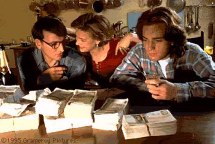
The film begins proper after the three roommates stumble upon this suitcase and decide to keep it. It's here that Shallow Grave takes the Hitchcockian conceptions of betrayal and greed and throws them aside like a rag doll. In this twisted world betrayal doesn't come with a spoken word, but with the quick flicker of an eye.
Although John Hodge's screenplay is a modern masterpiece of the genre, special kudos must be given to director Danny Boyle for the way this film moves. Not only is the camerawork stunningly innovative (i.e. the cash machine murder POV), but the editing and pace rival the latest Tony Scott vehicle for sheer momentum.
The strongest thriller in years, Shallow Grave is also a frightening treatise on friendship and the cost of betrayal. For the three primary filmmakers involved, Shallow Grave represents the greatest cinema hand-off of the 90's.
--Yim Kip
WRITE YOUR OWN OPINION
Copyright © With All The Trimmings Newsstand Distribution
Multimedia courtesy of Tony's Film Stills
|