from HopTech. Click on the banner to get started.

News and Updates
Click here to jump to the latest news
Support the Gluten Free Brewing Project by purchasing your
homebrewing supplies
from HopTech. Click on the banner to get started.
January 15, 1999
My apologies for the lack of updates. Work related issues and addition of new
brewing equipment has taken its toll on my time. The second gluten-free beer has
been brewed for some time now. I was once again disappointed in the original gravity
of the wort (around 1.040), showing once again the difficulty in mashing these low enzyme
grains. It is a 70% sorghum/30% corn recipe. Aggressively hopped entirely with
homegrown Chinook hops. The malted corn used was darkly roasted, which gives the
beer an unusual roasted taste, and also a undesirable aroma, much too pungent...almost
skunky/sour. This ain't beer yet!
The third GF brew is ready and waiting. Waiting, that is, on my lazy butt to get in gear and brew it. Once again, the plan is to use mostly sorghum. This batch of sorghum turned out better than any before. Rich, malty aroma. The big test this time is the use of amylase enzyme in the mash. I am hoping that the addition of this enzyme will greatly increase starch conversion, thus increasing fermentables in the wort. I will post the info that I obtained from Crosby & Baker Ltd. about their amylase enzyme in the near future.
February 13, 1999
The new brewing equipment is in! Weather and time permitting, the next gluten
free brew session should take place the week of February 15. I brewed a Scottish
Light last Tuesday to break in the new kettle and burner, and it worked wonderfully.
You can check out the new burner I got at the Sabco link below. It is on
their main page. My kettle also looks like the one sitting on the burner, but it is
not set up with the spigot/thermometer...not yet anyway.
Now that the hits are coming in mass, I can no longer overlook the need for a Frequently Asked Questions document. Check out The Gluten Free Brewing FAQ here, let me know what you think.
February 27, 1999
The third gluten free batch has been brewed! Woohoo! All things considered, I
think it went well. This batch was intended to be on the light side. Specifics
for this batch: 100% sorghum malt. This batch of sorghum malt was made using
techniques for crystal malts, kilning at low temperatures with wet malt. Total malt
was 9 pounds, 3 ounces. Also used was 1 pound of medium amber candy sugar.
(Homemade, of course). I was shooting for an OG of 1.032, but hit a bit lower at
1.028. I used the amylase enzyme as planned, but did not see the big increase in
conversion that I was hoping for. I used 0.16 oz., which roughly converts to 0.25
teaspoon per pound of grain. This was the minimum recommended by Crosby & Baker.
I take some of the blame for the enzyme not working fully...my mash temperature did
not hold steady at my target of 158F. Temperature regulation of the mash, another
weak spot in my brewing routine. To continue with the recipe, I used all plug-type German
Hersbrucker hops, 0.7oz at 60 minutes for bittering, 0.4oz at 10 minutes for flavor/aroma.
At an alpha of 4.5, that should yield 14.3 IBU's. I used the Wyeast #1728
Scottish Ale yeast cake from the primary fermenter of the above mentioned Scottish Light
batch for this gluten free brew, washed several times with distilled water to remove as
much of the beer as possible. Still not technically gluten-free I suppose, but there
probably won't be any gluten intolerant people drinking this batch. Considering it
was a quart of heavy slurry, it took off like a rocket. I would expect this light of
a brew to be completely fermented out in a few days. Other details: All
brewing water used was boiled tap water. I began acidifying my sparge water with
phosphoric acid a few brews ago. That may have kept some of the grainy/husky
character out of this batch. Color for this batch looks to be a nice golden hue.
1.5 hour mash, 1 hour sparge, 1 hour boil. Post boil net was very close to 4
gallons. Since the OG was so low, I wasn't about to de-brew (dilute) the wort.
Any other questions about this brew or anything else about the gluten free project, let me know. I will post another update, if not before, when this batch goes on tap.
March 1, 1999
I will be updating the good/bad grain tables in the Challenge 1 section to include
links, on a seperate page, to actual descriptions and other information about each grain.
See
page in development here. I will also update and move the Links section to a
separate page here.
March 14, 1999
Racked the 3rd gluten free batch into the secondary. Final gravity looks to be
1.006, yielding a 2.86% abv (alcohol by volume). Nobody is gonna get drunk on this
one! The flavor, as expected, is rather thin, but with surprising body. Its
rather rich tasting for an otherwise flimsy beer. Flavor is a bit sour, not
unexpected due to the 100% sorghum grain bill. I expect some of the sour character
to fade as the beer clears. Hop aroma is a bit low, but may improve after the beer
gets carbonated, hop flavor is just right...something like a German pilsener. I
expect another 2-3 weeks before this batch is clear enough and ready to keg and carbonate.
Stay tuned.
March 22, 1999
A small milestone, but meaningful to me...as you can see below, my webcounter rolled
over 1000 visitors today. This counter logs hits to my various pages, but most are
attributed to the Gluten Free Brewing section.
April 11, 1999
Transferred the 3rd gluten free batch into a keg for carbonation today. I force
cleared it yesterday with bentonite. I intend to take it to National Homebrew Day on May
1st, so I needed it clear right away so I could get it carbonating. If nothing else,
the beer is a great color. Medium brown with red shades mixed in. Smells good
too. I have not tasted it yet, but will do so in the next day or two. A full
evaluation will follow then.
April 24, 1999
My apologies to those who could not reach my webpages for the last few days. The
service where my pages are currently kept had an outage April 20-23. Just goes to
show...you get what you pay for. ;-)
May 7, 1999
Some comments from those that tasted the 3rd gluten free beer at National Homebrew Day
this past weekend. All who tried agreed that this attempt came closer that ever
before to being called a 'beer'. Still underhopped (flavor, aroma and bittering),
the beer had a mild flavor that was quite refreshing. Because the gravity was so
low, the body/mouth feel was quite thin which made the carbonation much too fizzy. (Think
soda-pop!).
My next attempt (gluten free beer #4) should happen within a week or two. The next recipe will include buckwheat, with sorghum again being the base grain. I also plan to double the amount of Belgian candy sugar in this batch...at least 2 pounds this time. My goals for this batch are twofold: To increase the gravity, producing a heavier, fuller-bodied beer, and to increase hopping rates. Although I cannot explain it yet, it seems hop utilization for gluten free brews is lower than 'normal' barley based beers. I plan to compensate in this batch by increasing the quantity of hops used by 25-30%.
June 11, 1999
The weather here in the Saint Louis, Missouri, USA area has taken a decidedly
bad turn, becoming unusually hot for this time of year. Therefore, the
next gluten free brewing session will have to wait until Sunday, June 13 at the
earliest. I brewed on the hottest day of the year last summer
(104°F, ~70%RH), and vowed never to do that again!
I would like to take a moment to thank the folks that have corresponded with me lately regarding my gluten free brewing project. I would not be nearly as enthusiastic about this experiment without the comments, constructive criticism and encouragement that I receive via e-mail and the guestbook.
June 22, 1999
The 4th gluten free batch is underway. Brew date was last Thursday,
June 17. Everything is going well. Rapid fermentation proceeded over
the weekend. The original gravity was still not as predicted, indicating a
poor malting in this batch of grain. OG landed at 1.042, much higher than
the last batch, but most of that increase was probably due to the increase in
candy sugar used this time. Check out the new Recipes
page, where I will endeavor to post the complete details of each batch of
non-gluten beer.
A note about a new addition to my brewing equipment: I bought an Igloo Ultra Cold 50 chest-type cooler for use as a mash vessel, and eventually as a combo mash/sparge vessel. This new offering by Igloo contains 3 times the insulation in the body of the cooler, and the same insulation in the lid as the body. Igloo claims "keeps ice for 5 days in 90°F heat". I don't know about that, but it did hold my mash to less than 1°F loss in 90 minutes. Very nice. When I convert this cooler to a sparge vessel, by adding a system of perforated copper tubing at the bottom, draining out the existing drain, I will be able to do much larger sparges, maybe up to 30 pounds of grain. This will benefit the non-gluten project, as the grains used are a poor source of fermentables, and larger quantities are needed to increase gravity levels.
Stay tuned for updates as the 4th gluten free brew progresses. If this one turns out at all drinkable, I will be taking it for evaluation to the August meeting of the St. Louis Brews, my local homebrew club. August is wildcard month, which means anything goes. This beer definitely fits into that category.
July 12, 1999
The latest gluten free brew is coming along nicely. It is in the
process of dry hopping now with one ounce of whole leaf homegrown Cascade
hops. It will go into the keg for carbonation next Thursday. I will
evaluate it then, and post my initial impressions. If it is truly ready
for public scrutiny, I plan to take it to the next homebrew club meeting.
If that occurs, I will post the club's comments after August 5th.
July 27, 1999
I finally kegged and carbonated the 4th gluten free brew. My initial
impressions? HOPPY! As it was intended. Something along the
lines of an English ESB (Extra Special Bitter), with definite dry-hopped
characteristics. Great Cascade hop aroma...citrusy/spicy. Color is
good, a light golden brown. My biggest complaint now is the body. As
with the previous brews, this one in thin. The carbonation is too fizzy,
like soda-pop. I will seriously consider addition of lactose to the next
brew, to try to improve mouth feel/body.
Now that it has passed my initial taste-test, and I know it will not entirely disgust my homebrew club, I do plan to take the 4th gluten free brew to next Thursday's meeting for evaluation by the membership. I will post their comments here after the meeting. Stay tuned.
August 9, 1999
The 4th Gluten Free Beer made its public debut at last Thursday's St. Louis
Brews brewclub meeting. Comments were overwhelmingly positive. More
than one person detected a 'ginger' aroma. This is a mystery to me.
I have a suspicion that it might be the Horizon hops used for bittering this
batch, although that should not be the case, as aroma from the Horizon shouldn't
have carried over into the final beer. More likely is that this 'ginger'
aroma came from the dryhopping with homegrown Cascade hops. This gave the
beer a strong citrusy aroma. Another comment about a slightly stale
character may have been linked to these Cascade hops.
I was glad to hear no comments about the possible winey/cidery effects from the large amount of candy sugar used in this batch. It is possible that the large quantity of hops used partially masked this. Most members agreed this brew would certainly substitute for 'beer' for someone who had nowhere else to turn. All agreed I was on the right track, and the project was coming along nicely. Many thanks to the kind St. Louis Brews membership for suffering through my experimentation.
Now my attention can turn to...Gluten Free Beer #5!!! Check out my comments at the bottom of the Recipes page for an idea of where I am going to take the next batch. As for a date when this batch can be brewed, that is mostly up to Mother Nature. We are in the dog days of summer here in the Midwest United States, and as my brewing is done outside, hot weather is miserable. Of course, if a wealthy patron-of-the-arts would care to donate/grant/loan enough money to enable me to purchase a proper brewing facility, this project could proceed without delay. Hmm, anyone know a gluten intolerant billionaire? I will post again as soon a I can pin down a brewdate.
September 22, 1999
As you can see, the big news is that I moved the Updates section to its own
page. Something I knew I was going to have to do eventually, when the
section began to take up too much of the main page. So here it is.
On another semi-beer related subject, you may have noticed at the bottom of the main project page, a new Webring section. The Gluten Free Brewing Project joined the Homebrew - Fire Brewing Webring. This hopefully will bring added interest to my project. Many thanks to both of the webrings, they are quality organizations.
Now, back to Gluten Free Brewing. Malt production is coming along nicely. I have 15 lbs. of sorghum ready, and the buckwheat is on its way. If I had to pin down the next brewdate, I would have to say within the next 2-3 weeks. I would brew sooner, but now that it is the perfect Autumn weather for brewing, I am trying to cram in other 'regular' batches, to get ready for upcoming parties, holidays, and picnics. Also some of the herbs that I grew specifically for brewing, such as Lemon Balm, have to be used fresh, so I have to brew with them soon.
As if my brewing dancecard weren't already full, I am trying to complete my Stone Brewing equipment. Look for a link to a separate webpage that details this rather unusual project to be posted here.
September 30, 1999
Today I received the analysis of the malto-dextrin available at my local
brewstore. I always disregarded this product because I assumed it was
derived from barley. To my delight, it is manufactured from corn!
Woohoo! This is a great addition to the gluten free brewing project, as it
will allow me to boost the mouthfeel and body of the brews, something that has
plagued my GF beers (and probably always will).
Many thanks to Kathy Tighe and the good folks at LD Carlson for the quick and complete response to my query, and to the folks at GPC (Grain Processing Corporation) for producing such a fine product.
October 9, 1999
Gluten Free batch #5 is officially on it's way! It was brewed on
Wednesday, October 6, 1999. I deviated somewhat from my intended
path because of ingredients I had on hand, and the good news about malto-dextrin
mentioned above. I had on hand some Wyeast #3068 Weihenstephan Wheat
yeast, so batch #5 was formulated to approximate a hefeweizen-style beer. (Of
course, without the 'weizen' part, which is wheat). Check out the Recipes
section for a full description of this batch. On the whole, I think this
batch will end up fine, but getting there was no joy. I did a long mash
cycle, over 3 hours, to try to increase fermentables and allow the enzymes to
more fully convert the grains. All I ended up with, however, was a ultra
thick, sticky mash and a impossibly slow sparge. The resulting wort was
far too cloudy, but I am hoping an extra addition of alpha amylase enzyme in the
fermenter will help break down some of that starch. The fermentation is
proceeding just as expected, giving off the wonderful banana and clove aroma of
a 'normal' hefeweizen. This batch should finish up quickly, so I will
update as soon as I know anything about its final character.
On another note, check out the newspaper article about my local brewclub's exploits here. We did a homebrewing demonstration at a beer festival put on by a local brewpub, The St. Louis Taproom. Unfortunately, my gluten free project did not make it into the article, even though the reporter did get quite a bit of information from me that day. Maybe sometime in the future.
November 3, 1999
I finally got around to bottling the 5th gluten free batch yesterday.
Final gravity was 1.008, a bit dryer than I was expecting. I netted only a
little over 4 gallons because of the extra large amount of trub left on the
bottom of the fermenter, due to the poor sparge on this batch. Oh well,
still plenty to drink. Since I let this batch sit for so long to clear, I went
ahead and made up a new starter of a lager yeast (Wyeast 2112 California Common)
and pitched that at bottling...a technique used by some of the commercial
hefeweizen brewers. This batch also utilizes some of the new heading agent
I found. I tiny little bottle of something called Qualia Bark Extract,
produced by a British company. I used the recommended dosage of 4.67ml per
5 gallons. We'll see if it makes any difference. In a few weeks I will
post my tasting notes and final evaluation of this batch.
Thoughts now turn to Gluten Free Batch #6. Tentative plans are for a dark beer. Something along the lines of a Black Beer (Schwarzbier) or Porter. I have a small amount of very darkly roasted buckwheat, and I am considering using some coffee and/or cocoa to impart the needed flavors of these styles. No definite brewdate yet, but stay tuned.
On a related subject, the one year anniversary of the Gluten Free Brewing Project is rapidly approaching. I have designated December 10 as the founding of the project. It's been a lot of fun, and finally feels like I am making headway with the experimentation. I will celebrate the event by entering either batch #4 or #5 in my homebrew club's annual competition, The Happy Holidays Homebrew Competition on December 11, 1999. I think my GF beer's qualify for the 'Specialty' category, don't you?
November 19, 1999
A short update so you don't think I died. ;-) I will be posting the
Promash recipe file with each gluten free batch I produce, as well as some of
the past GF and non-GF batches I have brewed. Check them out in the Recipes
section. If you don't know what Promash is, go check it out here.
Promash is the finest brewing software available. I recently paid my money
and got the full version. Something I have wanted to do for some time now,
but was too much of a cheapskate. If you homebrew and don't use Promash
now, go and get the evaluation version. You will be glad you did.
The next update will probably be after the competition mentioned above. I will post the results, the judges notes and a summary of the project at the end of its first year. Stay tuned and wish me luck!
December 21, 1999
The competition is over. Check out the results
here. I am also working on that promised year-end summary of the
project. Christmas and an unscheduled cold have dragged me down a
bit. Stay tuned...it's coming soon!
January 13, 2000
The sixth gluten free batch was brewed yesterday. The first attempt at a
'dark' beer, using darkly roasted buckwheat malt, as well as corn malt as 50% of
the base malt for the beer. The beer will be an ale, using Wyeast 1084
Irish Ale liquid yeast. The original gravity came in a bit lower than
expected at 1.042, but this is to be expected because of the new use of corn
malt. I will endeavor to produce better performing corn malt next time
around. Also added was one pound of lactose (milk sugar), used in the
brewing industry to add body to the beer along with a slight sweetness.
Check out the full details in the Recipe
section.
An additional note. I brought gluten free batch #5, the hefeweizen-style beer, to the January meeting of my brewclub. This time, the president didn't give away the fact beforehand that the beer being tasted was indeed a gluten free, only that it was a 'hefeweizen-style beer'. Therefore, the members evaluated as if it were a 'real' beer, without any prejudices toward gluten free. Their response was overwhelmingly positive. Some comments were: "fruity and flowery in the aroma" and "berries in the flavor" and "great body and mouthfeel" as well as a generally positive feeling for the beer. I was pleasantly surprised, as was the club when they found out that it was gluten free. Many commented that this was another big step ahead in the project.
January 29, 2000
Batch #6 has been transferred to the secondary and is lagering at
40-45°F. Lagering? Contrary to the previous update, batch #6 is now
a lager/ale hybrid, due to the fact that the Irish ale yeast that I originally
pitched completely failed. I had to scramble to find another yeast, and I
happened to have a pitchable quantity of Wyeast 2206 Bavarian lager yeast on
hand. It took off like a bandit, completing the primary fermentation in a
bit over a week at low ale temperatures, in the low to mid 60'sF (which
technically makes this a Steam beer, one brewed with a lager yeast but at ale
temperatures). I will now allow this batch to lager at low temps for a
month or more to smooth out and clear. At transfer, I tasted the beer and
was happy to find that the roasty and hoppy characters were blending well.
I now have increased hopes that, once aged a bit, this beer may well turn out to
be a winner. It is looking more and more likely this may be the batch that
I take to the MCAB II banquet. If you don't know what that is, check out
the webpage here. I
would have liked to brew another batch, something along the lines of batch #4 (ESB),
but due to time constraints caused by other brewing projects, I may not find the
time. I am currently brewing a 10 gallon batch of mead for a friend's
wedding, brewing a 10 gallon pilot batch of beer for a local brewmaster to help
him evaluate a new hop he is interested in using, as well as brewing another
batch of a beer called a Pennsylvania Swankey, also for consumption at MCAB
II. I will be publishing a separate and detailed document concerning my
research into the Swankey beer style in the coming weeks. Stay tuned for
that and additional comments on batch #6 when it is finished. It is also
time to start thinking about Gluten Free batch #7!!!
February 16, 2000
A bit off topic, but I thought you may enjoy a look into my beer brewing
insanity. Last year I took one final step to make my brewing efforts
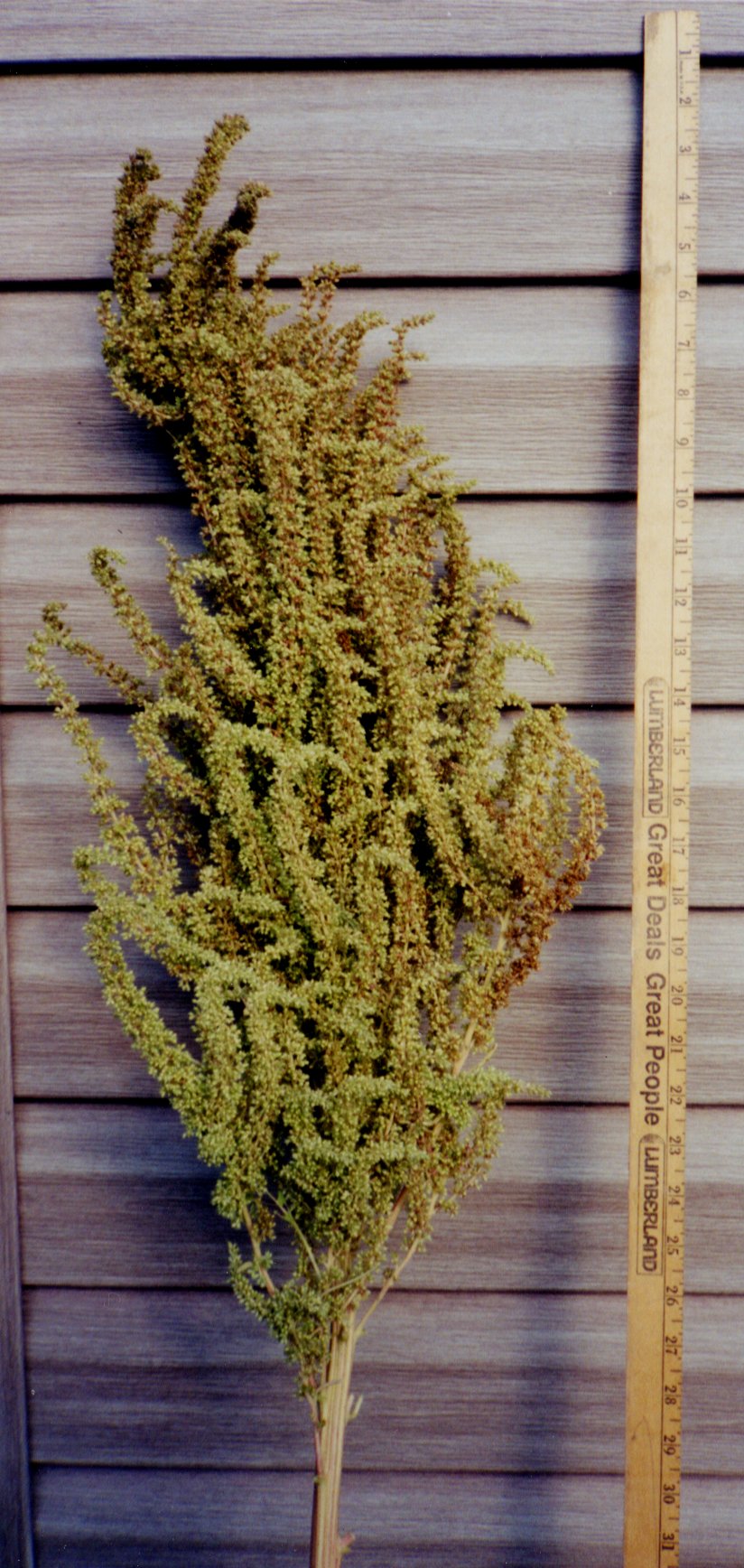
complete: I grew my own grain! Here is a photo of a seed head from an
Amaranth plant. Click on the image for a high-res close up view. I
have not used the grain in a beer yet, but it is high on my list. The
grain, when ground, has a strong nutty aroma and should lend this character to
beer. Not to mention it is GLUTEN FREE!!! Please let
me know if you've ever had personal experience with Amaranth.
March 22, 2000
I am sorry for the lack of updates concerning the Gluten Free Brewing Project,
as well as the periodic downtime that my webhost has been experiencing
recently. On the upside, FortuneCity
has increased the amount of free webspace I am allotted to 100MB. Woohoo,
I can now post more Gluten Free Brewing photos!
Gluten Free batch #6 is ready and waiting for it's debut at MCAB II this Saturday, March 25, 2000. I tasted it only last weekend in it's finished form and was pleasantly surprised to find a very tasty and complex beer. This was my first attempt at using darkly roasted grains in a GF beer. Other than a slightly pungent aroma, the beer has a remarkably good roasted flavor. It has a fine balanced hop character and finishes smooth and clean. I will report back with the evaluations from the convention early next week.
Gluten Free batch #7 is scheduled to be brewed next week. I am planning a light 'session beer' this time around. Something everyone will like. Think Bud/Miller/Coors. I will be posting the recipe as soon as it is finalized. I plan to use some malted millet in this batch for the first time, as well as powdered rice syrup solids as an additional fermentable source.
April 2, 2000
Batch #7 is underway! I have posted the full details in the Recipe
section for your enjoyment. The brewday (03/31/00) went well, with
slightly lower than expected original gravity. Understandable with the use
of a new ingredient: millet malt. Still a respectable 1.050 beer. I
am shooting for a lighter, less hoppy and bitter, more drinkable beer this
time...much more mainstream. Stay tuned as it progresses.
Batch #6 made its public appearance at the second annual Master Championship of Amateur Brewers event last weekend and it received rave reviews from everyone who tasted it. The dark roasted flavors turned out to be more well received than I expected. Comments were made that if they didn't know it was a 'gluten free', most could not tell it wasn't made from 'normal' ingredients, just that it may have some 'unusual ingredient' in it. Flavors and aromas mentioned were chocolate, coffee, bread-like, toasty, woody (wood smoke and/or aged in wood), earthy, peaty, etc., with a rich flavor and plenty of mouthfeel and body and great long lasting head.
I will probably be taking a month or so off from the gluten free project in order to get some other 'regular' beers brewed. I want to stock up for the upcoming summer season, as well as brew for a few competitions.
May 15, 2000
Nothing much new to report. I am kicking around ideas for the next gluten
free batch. Some possible formulations might include a unfiltered 'wheat'
style beer using millet malt, a light fruit beer or possibly a Belgian Wit
style. These beers are traditionally brewed for warm summer weather
consumption. I might also try to work in some amaranth for flavor and
aroma.
June 18, 2000
Happy Father's Day all you fathers out there. Still nothing new to
report. The next gluten free brewing session is still some time
away. I am trying to crank out other 'real' beers
for future competitions and club events, not to mention the summer drinking
season. On the suggestion from a fellow St. Louis Brews member, the next
GF beer may be a coffee flavored beer, maybe with some ground amaranth tossed in
for the nutty flavor. We'll see.
A reader from the UK recently asked about the possibility of a gluten free beer-like beverage made without grains, only various fermentable sugars. I've explored this idea in the past only in passing, but I may just have to give it a second look. There are numerous sugars that could be used to give a wide range of flavor. Off the top of my head I can think of: Plain old cane sugar, beet sugar, palm sugar, corn sugar, molasses, sorghum syrup, invert candy sugar, brown sugar, treacle, honey, agave extract and maple syrup/sap. If you can think of any other interesting sugars, let me know. Combine these with a base of a fruit juice like apple, pear or grape and there might just be a tasty beverage in there somewhere. I hesitate to call it a 'beer', more like a soda. I'll keep you posted.
June 28, 2000
I brewed the 'all sugar beer' yesterday. I was brewing a Gruit
anyway, so I thought I'd give it a try. The sugars included yellow lump (a
kind of unrefined rock candy from Asia), palm sugar, light and dark brown sugar,
blue agave nectar, honey, black strap molasses and sorghum syrup. I hopped
with some Spalt hops. The brew smelled wonderful when boiling in the
kettle. It is fermenting away nicely with Weihenstephen Weizen beer yeast
now, with aromas of banana and clove coming off. I will post the complete
recipe in the Recipe
section soon. I am looking forward to trying this stuff. I'll let
you know as soon as I try it when it comes time to bottle.
August 27, 2000
Still waiting for the atrocious summer heat to break so I can go back to brewing
the gluten free beer. Due to the acquisition of some new laagering
equipment, the project will now turn to experimentation with lager beer
styles. I am hoping that the knowledge gained in the early phases of the
project will enable me to rapidly develop a GF lager. As always, stay
tuned.
On a related note, for those of you that have been dying to see photographic evidence that I actually do exist, I have posted some new images in my Bio section. I accept no responsibility for computer equipment that is damaged or destroyed while viewing pictures of yours truly. Please, no laughing.
October 24, 2000
Contrary to reports, the Gluten Free Brewing Project has not fallen off the face
of the Earth. All is well and we are on track to brew batch #8 very
soon. A couple of components have come together in the last few weeks to
allow the project to continue with brewing the first gluten free lager. I
received a sample shipment of white sorghum from Twin Valley Mills in
Nebraska. I will post additional contact information as soon as I get
permission from the company. This sorghum is a very pale cream
color. In contrast to the feed grain quality red sorghum that we have used
in previous batches of GF beer, this white sorghum should not contribute any of
the tannic bite and unusual grainy flavors found when using the red
sorghum. The sample I received is very high quality and free of contamination from other grains. The kernels were in
very good condition with very few being broken. This made for an excellent
malting. I would estimate better than 95% germination was achieved.
Here is a photo of the raw grain...
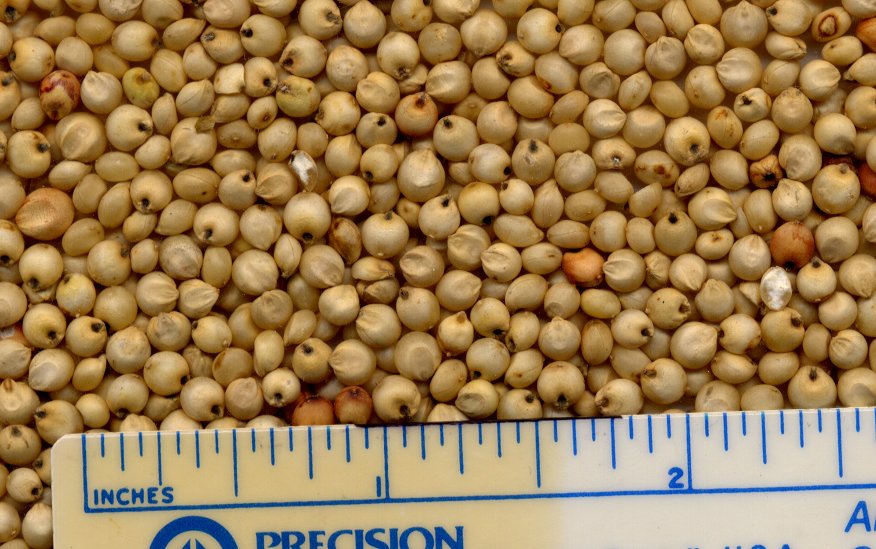
White Sorghum - Click to enlarge image
In addition to the new grain, I am also setting up the needed laagering facilities, namely another refrigeration unit to house the fermentation vessels. With that in place, I hope for a brewdate within the next week. Because of the additional cold maturation time necessary with lager beers, I expect batch #8 to be done around the Christmas holidays.
I am also working on several new pages for the Gluten Free Brewing Project, as well as a complete overhaul of the main page. The first new page contains details about contributing financially to the project. The second is a step-by-step 'How-to' for brewing your own GF beer at home. Although I appreciate each and every letter I get from visitors to the project webpage, I am hoping that these two pages will answer some of the frequent questions I get now.
On a beer related note, my attempt at brewing the ancient beer style Gruit ale won critical acclaim and the right to represent my homebrewing club at the upcoming AHA club-only competition in December. Check out my Gruit Ale webpage that details that project.
January 6, 2001
After the longest hiatus in the project's history, the latest gluten free beer
has finally been brewed! Gluten free batch #8 was brewed today with great
success. This batch is the first in the new phase of the project to test
lager beer brewing with our gluten free techniques, recipes and
ingredients. This batch utilized the white sorghum mentioned above in
malted form as the main fermentable. It also contained some of the drum
dried rice syrup solids samples that I received from California
Natural Products. I have posted the recipe for batch #8 in the Recipe
section.
August 21, 2001
Ugh! Nothing like going a half a year without an update. Don't be
discouraged, however. This does not mean that the Gluten Free Brewing
Project has come to a grinding halt. Quite the contrary. The project
is still humming along nicely.
December 3, 2001
Once again, too much time has passed since I updated the news page. My
sincerest apologies. The Gluten Free Brewing Project has made some
significant advances lately. The most visible is the article that I wrote
for Sully's Living Without magazine,
which appears in the Fall 2001 issue. If you are gluten intolerant in any
way, this magazine is for you. Please go to their website and check it
out. The magazine has extremely high production values, and is filled with
valuable information for persons with gluten intolerance as well as other food
allergies. I will post a complete copy of my article here, but not until
their Spring 2002 issue is released. I want the magazine to get the most
traffic to their website and as many opportunities for new subscribers as
possible before I give the article away for free. Besides, if you have
read my main Gluten Free Brewing webpage, you have gotten most of the article
anyway.
Gluten free batch #9 and #10 have been brewed. Batch #9 was kegged and poured at the national conference of the Home Wine & Beer Trade Association several months back. Several brewing industry luminaries gave it high marks for its similarity to 'real' beer.
March 14, 2002
Batch #10 is in the bottle. It will be a few weeks before it is carbonated
enough to sample and give tasting notes, so please stay tuned.
As promised, here is my article from the Fall 2001 issue of Sully's Living Without magazine. Click here to download the .PDF file in .ZIP format. If you need a utility to uncompress the file, go here. Most operating systems already have this functionality built in, however. If you need a free PDF file viewer, go here.
The Gluten Free Brewing Project continues to make headway in the direction of commercial production. We are still working on several fronts to refine our brewing techniques, develop plans for larger scale brewing and malting, and to secure funding for this expansion.
