Common
SpecialEstablishing trust is especially important in cross-industry electronic commerce since industries will often have to deal with partners who are less familiar in their own industry. Business-to-business transactions that are extensions of real-world deals will have a basis of trust based on previous relationships and reputation. However, in cases where the Internet is the only connection between two parties, more is needed to establish trust in the relationship.
Trust has the following dimensions: security, reliability, confidentiality. Transactions must be processed without fear of network attacks. Both buyers and sellers need to be able to count on consistent service. The information should be presented in accessible, easy to navigate format. Companies must be sure that any transaction information will be maintained between the trading firms.
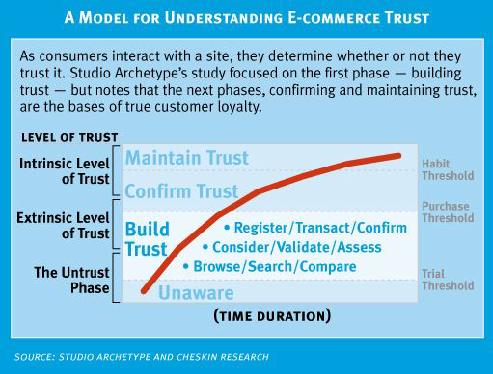
Although technology overcomes many of the limitations of traditional
commerce, business relationships still rely upon building trust. As time
progresses, continuing to confirm this trust reinforces the relationship
between the trade partners, allowing them to move into the next level of
intrinsic trust. This relationship eventually becomes habitual and increasingly
easy to maintain over time. (See figure below.) The rewards of establishing
this level of trust are multiplied by an order of magnitude in this case
of cross-industry, because of the synergistic effects from bringing together
buyers and sellers that otherwise would not have found each other.
Critical Mass
Just as the case with IndustryNet attaining critical mass is the difference between life and death. Analysts estimate that the United States will have a critical mass of Internet users--that is, more than 50 percent of U.S. households with Web access--in 18 months to three years. That number is heavily dependent on the proliferation of access devices and easy-to-use, inexpensive hardware.
However, unlike consumer markets, e.g. AOL, that can acquire users by mass marketing techniques, B2B require carefully built alliances. As IndustryNet demonstrated, critical mass is not measured by subscribership. Instead, it is measured by "mind share." Perhaps a more appropriate term is "critical momentum" - an increasing buildup of mind share much like accumulation effect of a snowball rolling down a hill.
In the industrial economy returns are made at the initial period, followed by diminishing returns for each additional resource. Now, the object is to manage each individual customer relationship until an "acceleration point" is reached at which stage the customer gets more remunerative at an increasing rate due to both disproportionate growth in opportunities and reductions in cost.
Beyond this accleration point in the firm-customer relationship, increasing proportions of customer business can be attained for decreasing amounts of energy, because the relationship becomes "self-sustaining." Returns can even become exponential (as opposed to remaining constant or increasing at a diminishing rate).
Two factors in attaining critical mass are essential: simplicity and
price. The technology must make it easier for buyers to find sellers and
vice versa, and it must be accessible to cost-conscious companies. Again,
this is especially important in cross-industry E-commerce since many of
the goods have commodity price behavior.
Stickiness, Internet equivalent of brand loyalty, is the decisive
factor in sustaining E-commerce site dominance. It is a subjective measure
of how well an
site obtains new customers and retains existing ones. This is especially
important in cross-industry electronic commerce since the main differentiation
is price in a commodity-like market.
Long-term vs. Short-term
Simple site value, content freshness, brand equity, performance, personalized
email only create "short-term" stickiness, which is short-lived because
competitors can easily duplicate it. However, these do not create competitively
sustainable hurdles. Any value and distinction gained is quickly eroded
by competition between competing ecommerce sites.
On the other hand, site integration saves times, lower costs, and locks
customers into a process not easily duplicated, replicated, and (when performed
well) not
easily abandoned. This "long-term" stickiness does create a competitive
advantage when it becomes too expensive, risky and impractical for customers
to alter
workflows and switch to rivals.
The original notion of customer retention was that existing customers
cost less than new: the longer a firm sold to or did business with a client,
the less that client or sale was likely to cost. This progressed to the
situation today across the world where corporations know and can prove
that not only does customer retention cost them less per transaction, but
that they also get more over time per customer through cross-selling and
value-added services.
Channel conflict concerns—over sales rep commissions, pricing or who will be responsible for servicing customers drawn in over the Web—are fairly common when a company starts to use the Web as anorder-taking channel. Maintaining thestatus quo by such strategies as continuing to give sales reps commissions may temporarily work, the real challenge is define the role of the Web site so that different channels complement eachother. For example, the site may be able to serve customers or sell products that cannot otherwise be cost-effectively handled through the traditional sales force. Companies must measure the Web's impacton other channels—i.e. find out whether the Web is actually serving customers at a lower cost or bringing in new customers and new revenue—and change the role of the other channels accordingly. Otherwise, it is only adding cost.
Example: When Aviall Inc., a $400 million Dallas-based, aviation parts distributor tried to implement a Web-based order-entry system, its 300 sales reps worldwide, fearing their jobs were at stake, badmouthed the site to customers and told them not to use it. The company had not accounted for fear of disintermediation. Even though the site was pitching as a tool to let customers take care of routine order processing, while allowing sales reps more time to develop deeper relationships and win new customers, the reps still resisted - even with commissions for orders placed over the Web. Why? Sales reps viewed customer service they offered as a way to distinguish the company from other distributors. Eventually, the e-commerce effort was re-designed and implemented. This time Aviall took a much more cross-functional, customer-centric approach to roll out an improved site.
The new e-commerce strategy was implemented
in conjunction with an overhaul of
the overall sales strategy. The committee overseeing the sales revamp identified
target market segments, brought in customers and Aviall business people
from those segments and asked them
how e-commerce could help solve their problems. The pitch to the sales
reps also stressed the customer-service benefits. Every rep has received
a kit explaining how to use the new
Web site, which was launched in August
1999, along with a canned demo on a
CD-ROM for reps who did not feel comfortable
demonstrating it live.
Aside from common e-commerce issues (above) cross-industry e-commerce companies are even more likely to deal with cross-platform, legacy system integration, because of their span across different industries.
For example, the sales force at Aviall was segmented by what products they used: airline sales used one legacy system, general aviation used another, and an Australian group used another. The first order-entry Web site did not even attempt to integrate with these home-grown, back-end systems; orders entered online generated e-mail forms that went to sales reps, who rekeyed orders into the appropriate system—hardly an efficiency booster. But when Bouline embarked on a Y2K-influenced, $8 million infrastructure upgrade, she chose an Internet-ready ERP system by Lawson Software that supported Web ordering for the second-generation site. In the future, she hopes to beable to use the system to link to supply chain partners—for example, to let a supplier see what inventory Aviall has so that the supplier's sales rep can sell off excess inventory in Aviall's warehouse.
Although Electronic Data Interchange (EDI) service providers are now incorporating Internet services, the constraints due to setup costs and lack of standardization make it poorly suited to the pace of today's business relationships. However, many large corporations and their satellite suppliers still rely on EDI to conduct business over a Value Added Network (VAN).
Meanwhile, Applied Industrial turned to extensible markup language (XML) to integrate its home-built Web site and its Cobol order-entry processing system. Unlike HTML, which just marks up text, XML lets developers write custom tags to identify objects. Beyond solving its interoperability problems, Applied Industrial even reengineered its processes to be XML-centric—i.e. to build code components that can be easily combined or reorganized. It is now starting to use XML as a way to bridge the gap between its systems and suppliers' and customers' systems. By sharing XML definitions and access points with trading partners, systems integrations can performed much more rapidly, independent of the systems or interfaces.
Finally, many companies will have data about clients scattered across several different databases and want to get a single view of the business with the company. For example, a large financial services institution may offer several products—brokerage, mutual funds, insurance, credit cards, savings accounts—each managed by its own legacy accounting system.
At office supply distributor W.B. Mason, CIO Peter Dupre found that using an commercial, off-the-shelf (COTS) e-commerce package from Ironside made the task of legacy-system integration easier. "They give you a shell of a data gatewaythat has all the routines written in, and you have to write the data cases," Dupre says. "It was the hardest part [of the rollout], but we did it in 30 days."
For more on XML, see Developments