Technologies
Extensible Markup Language (XML) -
enabling technology that provides a common data format for suppliers and
buyers. Commerce One has made XML its standard for application development.
By acquiring Veo Systems Inc., Commerce One has advanced its XML effort
to the forefront. CommerceNet, an e-commerce consortitum uses Veo's Common
Business Library (CBL) to establish the eCo Framework. This initiative
deals with the ever-growing complement of electronic commerce relatedspecifications,
including Catalog Information Specification, Channel Definition Format
(CDF), Common Business Library(CBL), Electronic Data Interchange (EDI),
Internet Content Exchange (ICE), Open
Buying on the Internet (OBI), Open Financial
Exchange (OFX), Open Trading Protocol (OTP), and XML.
Benefits of XML:
-
Businesses can describe services in a manner
that can be widely understood
-
One set of documents, forms and messages can
be exchanged by businesses with different internal business systems
-
Errors in re-keying data are reduced because
data can be transformed through gateways
-
Frequent changes in business process can be
handled without substantial engineering cost
-
Leverages investment in legacy systems and
can be used with latest Internet technology
Meanwhile, Ariba Technologies has adopted
Commerce XML (cXML) document type definitions to facilitate Internet transaction
processing. XML is considered a broader, updated approach to reflect the
World Wide Web Consortium's efforts. cXML is designed to be a set of lightweight
XML DTDs based on the World Wide Web Consortium’s XML standard. Ariba
sees it as a faster means to adopt XML specifically for electronic commerce
applications.
Micropayments and Product Unbundling
- payment mechanism for individual product pricing, allowing short-term
purchases and offering more choices. Digital coins and smart cards have
received much attention for their cash-like anonymity. A more compelling
economic rationale for micropayments, however, is their role in enabling
short-term contracts and quality-assured intermediation. Product customization
means the finest market segmentation. A flexible and profitable product
selection strategy would enable firms to charge the maximum price.
The primary argument against micropayments
is based a perceived preference for subscription and bundling, such as
newspapers and cable programming. However, the reasons for this preference
are more technological than economic. Cable system operators have traditionally
used "take-it-or-leave-it" marketing, being content with charging monthly
fees for a given number of channels, and not invested in elaborate billing
systems like the telephone companies. If cable operators had invested in
the necessary technologies and equipment to support detailed billing, they
would have been well prepared to offer more choices to their subscribers
beyond a few tiers. Even with a few tiers, an empirical test shows that
two-tier cable systems can charge 15% to 20% more for the same cable service
than one-tier systems. The increased price and profit comes from market
segmentation (Choi 1996). Profits increase as the segmentation becomes
finer. If technologies were not cost prohibitive, there would be finer
differentiation and market segmentation even in newspaper production and
delivery.
Despite this clear trend toward unbundling,
microtransactions and micropayments are dismissed in the digital marketplace
in favor of selling large bundles in aggregated bills without encouraging
a market for information on demand, small applets or your personal columns.
Large digital content providers are engaged in a two-pronged strategy for
electronic commerce. On the one hand, they don't see any commercial value
in the exploding information offered via millions of World Wide Web homepages.
That's bad news for those individuals who wish to cash in by selling bits
of information. On the other hand, these large companies are developing
technologies to measure and control usage so that every bit of use will
be metered and billed for their software and information products. If you
are a small player and have no links to large payment clearing service
providers, there will be no way of billing visitors to your homepage.
In cross-industry application micropayments open up a whole range of
new possibilities. Firms can be established that bundle orders for other
firms, offering them the same products at prices that would never have
been possible before. With microtransactions electronic intermediaries
can offer their services on pay-per-view basis to small companies that
cannot afford the full service plans. This is especially valuable to firms
that deal with commodity-like goods since profit margins are typically
small and large capital investments in information technology present risks
that they are often not willing to face.
Standards

CommerceNet
is
a non-profit industry association for companies promoting and building
electronic commerce solutions on the Internet. Members include more than
500 companies and organization worldwide representing the leading banks,
telecommunications companies, online services, software and service companies,
as well as end users, who together are transforming the Internet into a
global electronic marketplace.

ClearCommerce
the leading provider of packaged and modular online transaction processing
software for Internet purchasing, announced September 9, 1998 that it has
established an E-commerce Advisory Board. The board is comprised of e-commerce
experts from @Home Network, Chase Manhattan Bank, The e-tailing group,
First Data Merchant Services, J. Crew and ZDNet who represent the hosting,
financial, consulting, retail, and publishing industries. The cross-industry
advisory board will discuss and promote standards to accelerate the migration
of businesses to online selling and transactions. In early fall, the board
will deliver to the e-commerce community significant work surrounding issues
that impact the industry.
Payments Mechanisms
Commerce One, Inc. and Signio, Inc., a leading provider
of e-commerce payment connectivity and services, announced a strategic
partnership to integrate Signio's Internet payment platform with MarketSite™,
on October 6, 1999. This enables Commerce One to provide a broad range
of enhanced electronic payment services to streamline electronic payment
processing for all MarketSite trading partners. Customers and trading partners
will have access to real-time consolidated payment services for credit
cards; debit cards; procurement card (P-card) authorization and capture;
digital checks; and automatic clearing house (ACH) transactions. These
payment services enable buyers and suppliers to automate commerce and increase
efficiencies by replacing traditional paper-based payment processes with
an end-to-end integrated payment processing capability, reducing the cost
and time associated with traditional billing methods.
In addition, Commerce One and Signio have agreed to collaborate to define
XML based payment documents utilizing components from Commerce One's Common
Business Library (CBL) 2.0. This collaboration is expected to help further
drive the definition of common payment document standards across
key XML industry initiatives. Signio will leverage Commerce One CBL 2.0
elements, XML document framework and XML tools as a basis for its own XML
schema-based product development efforts.
Ariba, Inc. and U.S. Bancorp, the largest provider of
purchasing cards in the world, announced an alliance to develop an integrated
electronic buying and payment infrastructure for business-to-business eCommerce.
U.S. Bank currently provides purchasing card programs for more than 500
corporations and government clients.The joint solution delivers fully electronic
orders and invoices, automatically reconciles purchase orders with purchasing
card charges, and integrates purchase data with the buyer’s financial systems,
enabling businesses and their suppliers to streamline commerce, reduce
operating costs and increase internal efficiencies by replacing paper-based
payment processes with integrated electronic payment systems.
As part of the alliance, U.S. Bank will become the preferred provider
of business-to-business payment services to buyers and suppliers on the
Ariba
Network. Additionally, Ariba will become the preferred provider of
business-to-business eCommerce solutions to U.S. Bank customers. The two
companies will work together to jointly market and sell their combined
solutions.
This integrated solution has been successfully implemented at numerous
organizations, including Hewlett-Packard Company, Boehringer-Ingelheim
and Visa. It is designed to eliminate much of the traditional, labor-intensive
paperwork associated with payment processes between buyers and suppliers.
These processes include suppliers’ invoice creation and distribution and
buyers’ invoice-to-order matching, check-writing, and check distribution.
By reducing the cycle time between order and payment, suppliers receive
payment more quickly. Buyers benefit from increased management control
over purchasing and increased savings from channeling purchases to preferred
suppliers.
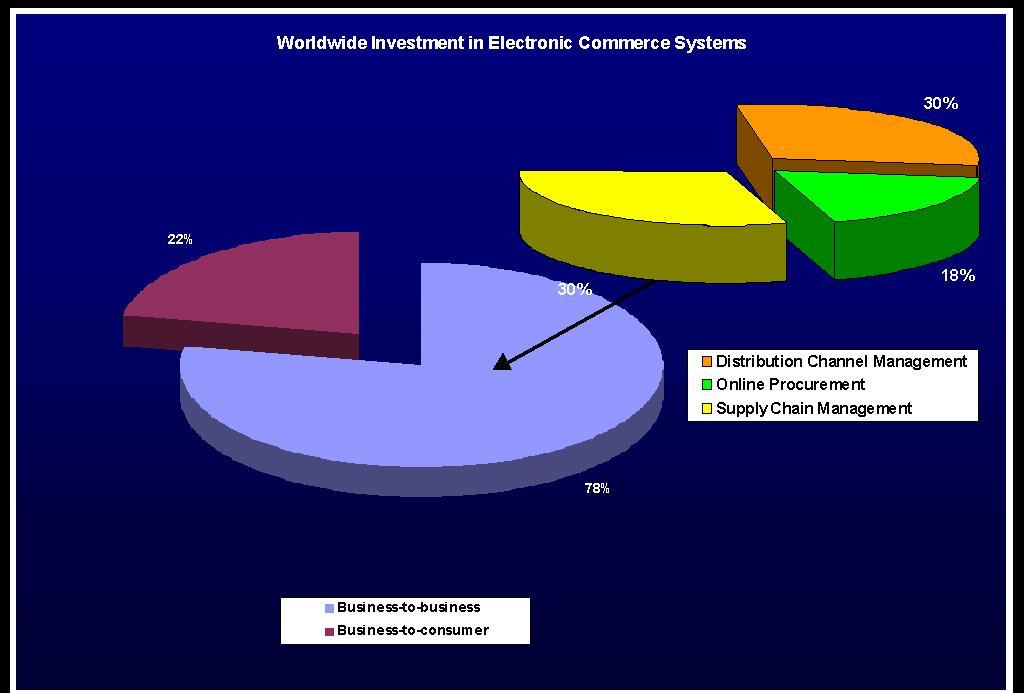
Worldwide investment in
electronic commerce systems
-
Projected to grow from $187 million in 1998
to $8.5 billion in 2003 ( Treasury & Risk Management, August 1999)
-
E-commerce software investment estimated $2.8
billion by 2002, up from $167 million in 1997 (Datamonitor, June 25, 1999)
Towards Opens Trade
Framework for
Global Electronic Commerce is a draft policy developed by interagency
working group that has been meeting for eight months, analyzing the issues
and consulting with academics, business representatives, consumer groups,
and members of the Internet community. Electronic commerce has the potential
to revolutionize trade in this area and others by lowering transaction
costs dramatically and facilitating new types of commercial transactions.
Many businesses and consumers are still wary of conducting extensive business
in cyberspace because of the lack of a predictable legal environment governing
transactions and resulting concerns about contract enforcement, intellectual
property protection, liability, privacy, security, and other matters. Another
concern of Internet users is the possibility that governments will impose
disparate and extensive regulations on the Internet in areas such as taxes
and duties, content restrictions, and standards.
Major policy recommendations include:
-
Fostering the Internet as a Non-Regulatory, Market-Driven Medium
-
Ensuring a Transparent and Harmonized Global Legal Environment
-
Allowing Competition and Consumer Choice to Shape the Marketplace
Link to White House
Site

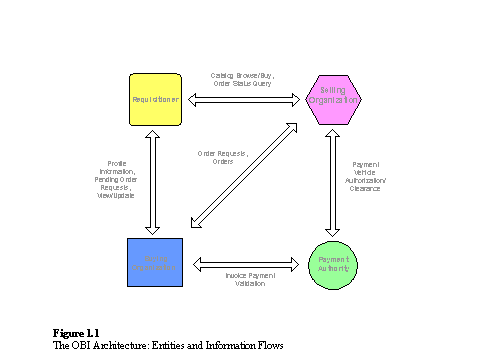
Open Buying on the Internet (OBI)
Consortium was formed out of a roundtable of a number of Fortune
500 buying and selling companies who met to create an open, vendor-neutral,
scaleable, interoperable and secure standard for conducting business-to-business
(B2B) electronic commerce in October, 1996. Companies involved in developing
the OBI standard were driven by a shared vision to facilitate the rapid
implementation of Internet-based electronic commerce solutions utilizing
interoperable, standards-based Internet purchasing systems that are characterized
by:
-
universal, high-speed access
-
inexpensive and paperless information and transactions
-
platform-independent software and services
Goal: to increase efficiency, reduce costs, improve overall buy/sell
process, and increase service levels to customers and end-users. Adoption
of the standard will provide companies with a secure, common method for
conducting business online, enabling them to realize the full potential
of the Internet as a platform for B2B commerce. Continuing to develop the
standard, international support and inclusion of XML are among the planned
enhancements.
Members
The OBI Consortium now has over 60 member companies and continues to grow.
Link
to OBI
Closed Trading Tendencies
In spite of these initiatives, some critics say that B2B E-commerce
will only encourage closed trading communities over the next five years.
While a restricted market is needed to ensure efficient online trading,
this will also reinforce established partnerships. The results will be
1) increase in demand for private IP networks 2) greater business opportunity
higher up on the commercial services chain.
Virtual Private Networks (VPN) are a compromise between the security
features of EDI and the cost / time savings of Internet technology. Companies
can set up encrypted links with known trading partners within hours instead
of months. Additionally, VPN offers a solution flexible enough that it
can be scaled to support a wide range of needs from small suppliers to
even the largest trading networks. Turnkey service providers further simplify
the problems of network complexity and compatibility issues associated
with having diverse business partners using varying technologies, especially
those that need to cross international borders.
This report was completed in October 1999 for the class
International
Electronic Commerce taught in
the program of Management
Of Global Information Technology at the Kogod
School of Business
at American University
in Washington D.C.
Home
| Industry
| Traditional
Intermediaries | Electronic
Intermediaries | Emerging
Trends | International
Intermediaries | References
| About
the Authors | Links