WORKING CONDITIONS FOR WOMEN IN INFORMATION TECHNOLOGY
WORKING CONDITIONS FOR WOMEN IN INFORMATION TECHNOLOGY
Cynthia gave us a very clear picture of what it was like to do her job. She told us that very few females worked on the network side. She described what it was like for her to work herself through the system as the only woman on the team: "You have to do little things like minutes for the meetings, typing, coffee.... Sometimes you have to put your foot down and say: 'Fellows, it's not my role; it's not my responsibility'. The guys have tried it on me. Some of them still have that attitude towards women. This is especially among the older guys. They are coming around a lot, but you have to understand this group is either older or younger. You don't have middle of the road types. There are lots more people in their 20's in this department than when I first started. It's amazing; lots of people are coming here right from school and making good money. It's a great job and it's a job they are crying for everywhere across Canada as well as across the States....So today, it's not like when I went to university and had to go out there and find a job afterwards. Then you actually had to go out there and beat the streets. Nowadays in the computer field, you come out and you walk right into a job.
TABLE 1: Presence of Youth in Employment and New
Hires 1996
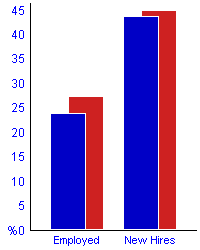

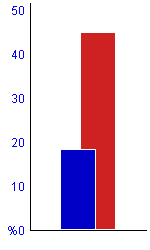
TABLE 2: The Percentage of Women 1996
Cynthia explained to us the demanding nature of her job. At the moment, she is monitoring a whole system, making sure it's alive, talking to the network, connecting to all the switches, making sure that all 125 service reps can get in and do their work. She is writing any reports that need writing and keeping them in working order. Her job is not just in the office for seven and a half hours:
"If something happens to the system and it dies in the middle of the night, I'm paid to come out and work on it. In this particular system, the server is at the Toll Office on North Street. I would have to go there and make sure it was fixed because it's a no outage system. It has to be on at all times."
Cynthia's job is a 7.5 to 24 hour job, Monday to Friday. On
weekends she's on call. She has her laptop computer with her at all
times and her pager. She's 100% responsible for this system because
she's the primary person. When she goes on vacation, she has to make
sure someone else knows the system that can handle the job. At the
same time she is responsible for administrating and updating as necessary
the Octel Voice Messaging System for Nova Scotia and P.E.I. She can
be told to create a new data base all of a sudden by the end of an hour,
by the end of a day, or the beginning of a day. There is never a
dull moment.
We began to see why so much of what we take for granted depends
on people like Cynthia. We suddenly realized why so many people are
worried about all the computers crashing in the year 2000. At MT&T
there is a special project team in place to make sure that every system
in the company has been reprogrammed, recoded, or changed to be year 2000
compliant. In August of 1998, Cynthia upgraded the Octel Voice Messaging
System by wiping everything out, taking a good backup of everything and
starting from scratch. It took her a week to load the upgraded program.
One side of Cynthia's job requires that she works on a screen.
The other side of her job is to put a server together, and to order the
circuits and everything else. This aspect of her work requires that
she get both cold and dirty She suggests that this may be one more
reason why females don't enter the field.
"You are underneath the floor doing your connections because all your power is underneath the floor. It's a bit scary, a little bit short, and you're always bending over. You have to have a flashlight because the floor is a raised floor. Your computer room has to be cold. Unfortunately, if you don't like the cold, it's not an area to get into. The temperature has to stay about 60 to 62 degrees at all times."