INFORMATION TECHNOLOGY AS A CAREER
INFORMATION TECHNOLOGY AS A CAREER
There are a number of reasons to choose Information Technology as
a career:
First of all, the rapid spread of computers has created a need for
highly trained workers to design and develop new hardware and software
systems and to incorporate technological advances into new or existing
systems. Second, it is a challenging, interesting and unwardly mobile
career for anyone who likes learning about computers and trying to fix
things.
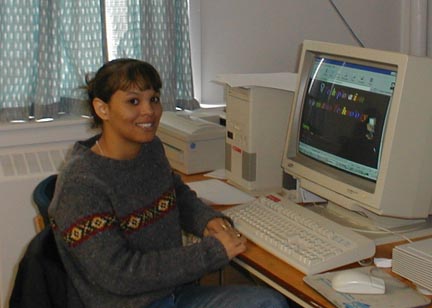
Cynthia told us that the most important aspect of the job is the use of logic. She has to think about what to do to get from one point to the next in the fastest and most economical way without getting off the beaten track and creating new problems. Her logical routes have to be uncomplicated enough to train other users on them. Cynthia finds the two different aspects of her job very satisfying: (1) She enjoys the interactions with her clients and customers when she satisfies them by successfully troubleshooting and solving their problems. (2) She enjoys ordering and setting up the equipment for the server because "it's your baby and it's brand new" and she is doing something on her own that is challenging.
An Information Technologist Specialist like Cynthia
works with computer networks such as Local Area Network Systems and Wide
Area Network Systems. These networks include major components such
as computer workstations, secondary computer equipment, and network components
such as bridges, routers, switches and cabling. These systems have
already been designed and manufactured, but the information technologist
specialist has to select the right "systems" for a particular local or
wide area network based on the user requirements, technical specifications
required and budget available to do the work. To implement
network systems, she has to install and configure complex network operating
systems based on the system's specifications and customer requirements.
She has to troubleshoot and resolve any problems that may occur.
After the "network system" is up and running, she has to troubleshoot,
manage, reconfigure, upgrade and administer the systems.
Skills:
* can manage, plan, design, install, maintain,
troubleshoot computer systems, components, local area networks and embedded
computer controlled equipment;
* can work well with others since she is
often part of a team, but she is able to work independently and take initiative
when necessary;
* can demonstrate good communication, management
and analytic skills, adaptability, flexibility, and comfort with computers;
* shows a willingness to engage in continual
professional development because of the rapid pace of technological change;
Knowledge:
* knows operating systems such as UNIX,
SOLARIS ETC.
* knows computer programming and digital
logical fundamentals
* knows network design, configuration,
administration and management
* knows telecommunications
* knows computer communications such as
WANs, ISDN
* knows database systems such as ORACLE
* knows internet and intranet systems design
and configuration such as LANs
* knows digital system design and computer
control design and applications
The Information Technologist Specialist
performs three major roles:
1. Programmer Analyst: She analyzes
information processing or computation needs and writes specifications for
computer programs, identifying the steps in the program and the algorithms
to be used. Effectively communicates program specifications to other
computer programmers, tests and implements computer programs and provides
user training.
2. Network Specialist: She performs
network (LAN) planning, installation, configuration, troubleshooting and
upgrading services. She works with a team to operate, maintain and
safeguard the network by identifying improvements to existing networks,
determining users' information requirements, analyzing system performance
and optimizing the working of the network.
3. Computer Programmer: She writes
computer programs or software packages by coding instructions and algorithms
into machine readable form. She tests, de-bugs, documents and implements
computer programs or software packages, maintains existing computer programs
by making minor changes as required, and solves computer problems for other
users.
RELATED JOBS
Network Administrator
Microcomputer Specialist
Help-desk Support (solves problems on PCs)
Desktop Support (fixes computer hardware)
Computer Service Technician
LAN Administrator
Electronics Engineering Technician/Technologist
Computer Scientist
Computer Engineers
Systems Analysts
Financial Analysts
Urban Planners
Statisticians
Mathematicians
Management Analysts
Actuaries
Operations Research Analysts