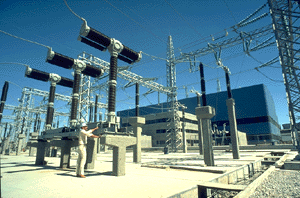
 The power lines go into
substations near businesses, factories and homes. Here transformers change the very
high voltage electricity back into lower voltage electricity.
The power lines go into
substations near businesses, factories and homes. Here transformers change the very
high voltage electricity back into lower voltage electricity.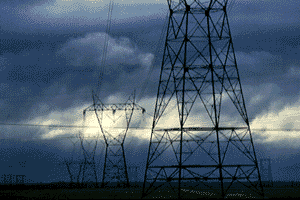 After electricity is produced at power plants it has to get to the customers that use
the electricity. Our state and country are criss-crossed with power lines that carry the
electricity.
After electricity is produced at power plants it has to get to the customers that use
the electricity. Our state and country are criss-crossed with power lines that carry the
electricity.As generators spin, they produce electricity with a voltage of about 25,000 volts. A volt is a measurement of electromotive force in electricity. This is the electric force that pushes electrons around a circuit. "Volt" is named after Alessandro Volta, an Italian physicist who invented the first battery. The electricity first goes to a transformer at the power plant that boosts the voltage up to 400,000 volts. When electricity travels long distances it is better to have it at higher voltages. Another way of saying this is that electricity can be transferred more efficiently at high voltages.
The long thick cables of transmission lines are made of copper or aluminum because they have a low resistance. You'll remembers from Chapter 2 that the higher the resistance of a wire, the warmer it gets. So, some of the electrical energy is lost because it is changed into heat energy. High voltage transmission lines carry electricity long distances to a substation.
The power lines go into
substations near businesses, factories and homes. Here transformers change the very
high voltage electricity back into lower voltage electricity.
From these substations (like in the photo to the right), electricity in different power levels is used to run factories, streetcars and mass transit, light streetlights and stop lights, and is sent to your neighborhood.
In your neighborhood, another small transformer mounted on pole or in a utility box converts the power to even lower levels to be used in your house. The voltage is eventually reduced to 220 volts for larger appliances, like stoves and clothes dryers, and 110 volts for lights, TVs and other smaller appliances.
 Rather than over head lines, many new distribution lines are underground.
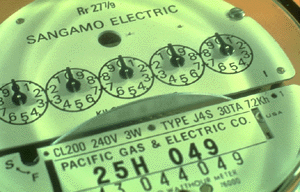
When electricity enters your home, it must pass through a meter. A utility company
worker reads the meter so the company will know how much electricity you used
and can bill you for the cost.
Rather than over head lines, many new distribution lines are underground.
When electricity enters your home, it must pass through a meter. A utility company
worker reads the meter so the company will know how much electricity you used
and can bill you for the cost.
After being metered, the electricity goes through a fuse box into your home. The fuse box protects the house in case of problems. When a fuse (or a circuit breaker) "blows" or "trips" something is wrong with an appliance or something was short- circuited. You should never touch live wires in your house. You should only let an electrician who knows electricity safety work on the wires.
*****
*****