
Denim is made all over the world from the United States, Mexico and Canada, to Italy,
Spain and Greece to Japan, China and Thailand to Pakistan, India and Australia. Denim is
made wherever people love jeans.
How much denim is produced every year in the world?
We have not been able to get a fixed number but we heard 2.5 billion yards.
Who is the largest denim supplier in the world ?
An American Company, Cone Mills.
Who buys the most denim in the world ?
Levi Strauss and VF
Corporation.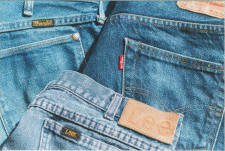
How many jeans are sold in the United States?
511,000,000 pair give or take a few were sold in 1998 and approximately 8.6% more in
1999 .
Does the production of denim fabrics pollute the environment ?
Is the Pope Catholic ? Unfortunately, any industrial production causes some damage to the environment. The good news is that denim producers are increasingly more sensitive to this issue and are developing Ultra filtration systems to recycle water and dyestuff, cotton growers are increasing production of Organic cotton, ... we all must play our part!
(if you are not familiar with Agent Orange, then look in Textile dictionary,
under Defoliants.)
Where does the word jean come from ?
While the French were making garments using what we now call denim, the Italians in
Genoa were using the fabric to make garments which the French called "genes",
after Genoa.
Are all jeans made from denim ?
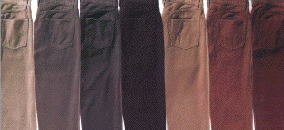
While the historical definition implied that all jeans were made of denim, today, jeans usually refer to a garment that has 5 pockets (two in the front, two in the back and a small change pocket inside the front right pocket) and this style can be made using any kinds of fabrics be it corduroy, twills, canvas or bull denim.
What is the difference between the jeans Levi Strauss sold in 1864 and the ones Levi's sell today ?
The indigo dyes used today are synthetic, the yarns and fabrics are more technically
produced in mass scale, and styles have changed.....
How many jeans do Americans own?
The average American owns 6.7 pairs of jeans (men) or 7.6 (women). So, 7.2 on average.
Selvage what ?
The "selvage denim"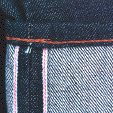 or "akamimi" as they call it in Japan, is the denim used by Levi's for their 501
jeans until 1986. The fabric was produced on narrow looms and a -normally- red thread was
woven into the selvage (occasionally, pink was also used, and so were blue, green or
white). Lee used a selvage denim in the early days, their line however was green/blue
rather than red; Wrangler's (Blue Bell) was yellow, blue or completely white. All are
highly collectable !
or "akamimi" as they call it in Japan, is the denim used by Levi's for their 501
jeans until 1986. The fabric was produced on narrow looms and a -normally- red thread was
woven into the selvage (occasionally, pink was also used, and so were blue, green or
white). Lee used a selvage denim in the early days, their line however was green/blue
rather than red; Wrangler's (Blue Bell) was yellow, blue or completely white. All are
highly collectable !
How are jeans made to look faded?
They are washed in industrial laundries and depending on the amount of bleach (don't
bleach your jeans if you want them to stay dark) and the time of washing the color will
fade. Long stonewashing cycles will also make the dark blue denim fabric turn lighter.
How are you supposed to wash your jeans at home?
All cotton garments should be washed at medium temperature and low dry cycle. We like
to use softeners so the fabric feels better.
How do you wash jeans to keep them dark?
Wash them inside out and add a thimble full of vinegar.
How long do jeans last?
It depends on who is wearing them and what they are doing in them. Making jeans from
good fabric also helps.
Does denim still shrink the first time you wash it?
Not as much as in the 1960's! Today's industrial washes on jeans make denim fabric
shrink as far as it will go.
Can denim jeans be recycled?
Sure, you can even make paper from it.
Is denim better than it used to be?
This depends on your point of view. Since vintage jeans sell for so much (we saw a 1950's Levi jean in Japan once that had never been washed that cost ¥10 million (yen) or $91,000). We don't think any "new" jean would cost that much!
How can I find out if my old jeans are worth any money?
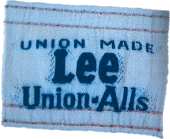
There is great book by David Little we suggest you buy called "Vintage Denim"
that was published in 1996 by Gibbs Smith Publisher in Layton, Utah. There is enough
information here to answer any of your questions. Keep in mind your jeans are always worth
more in Europe or Japan where vintage Americana is appreciated a lot more than in the
United States and Canada.