|
Andersonville
|
|
|
This is a web site dedicated to the Andersonville prisoner of war camp
and all the people who died there. Our names are Brett Shoffner and
Thomas Gorman. We are currently studying the Civil War in history
class. Tom and Brett hope you can get good insight and info from
this site.
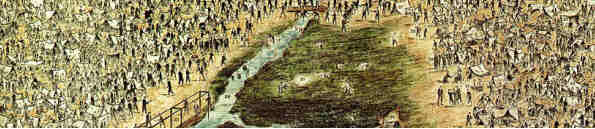
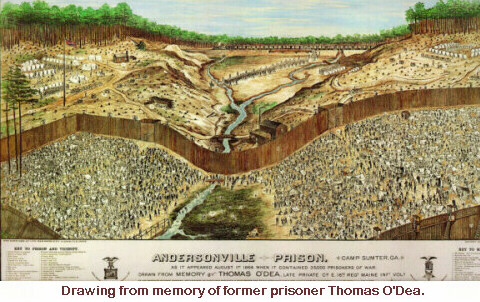
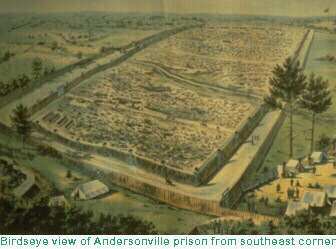
Click here for the Andersonville Camp Plans. Andersonville Prison Camp opened in December 1863. The camp was founded by Confederate Captain W. Sydney Winder, who was sent to Georgia to find a suitable site for a prison camp. He chose a small town of twenty people in Sumter County. At first the prison was officially named Camp Sumter. The deep south location, the availability of fresh water, and it's proximity to the Southwestern Railroad made Andersonville a ideal location. At the time Richmond, Virginia, the Confederate capital, was overpopulated by hordes of Union prisoners. Captain Richard B. Winder was sent to construct "Camp Sumter" in June 1863. He used slaves from neighboring plantations to build the camp. The whole prison covered an area of sixteen and a half acres. The outer wall was fifteen feet high and flanked by guard towers every twenty feet. In the middle of the prison grounds stood the central stockade twelve feet high encircling the inner prison as well as the corner redans. The stockades were built of unhewn pine logs set in four foot deep trenches. A stream running through the prison doubled as drinking water and farther downstream a bathroom.
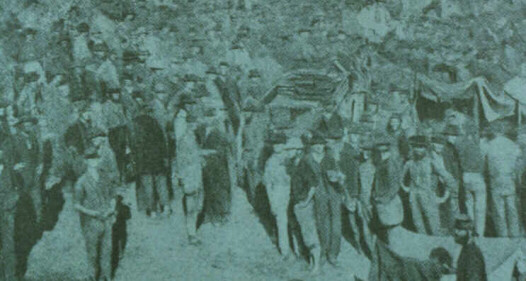
In January !863 Henry Wirz, a wounded captain, took control of Andersonville. For more on Wirz click here. The first prisoners started arriving in late February 1864. When the prison expanded to twenty-six acres in June 1864, approximately 20,000 prisoners were stationed there. By then four hundred prisoners were arriving each day. Due to the threats of a Union raid, Wirz commanded the building of defensive earthworks. Construction of these earthworks began July 20, 1864. These earthworks consisted of Star Fort, located to the southwestern portion of the camp. They also consisted of a redoubt in the northwest, and six redans. In September of 1864 Union General William Tecumseh Sherman advanced into Atlanta and captured the city. This caused all but 5000 prisoners to be relocated. For the rest of the war Andersonville never held more than 5500 prisoners at a time. Each prisoners daily rations consisted of a teaspoon of salt, three tablespoons of beans, and half a pint of unsighted cornmeal. In August, the Georgian heat, disease, filth, exposure, and lack of medical supplies took a large toll on the 32,000 soldiers living there. Wirz did not allow the building of shelters; therefore, for a place to go prisoners dug holes then covered the hole with a thin blanket. As you found out from this site, Andersonville really was a living hell. Just imagine your ancestors getting less than a half of a pound of food a day.
Now Andersonville is a small town again. It consists of historic
sites, a national cemetery, and the usual houses and stores. In the
fifteen months Andersonville was in operation, over 47,000 Union troops
entered the camp. Of those over 13,500 died. On one day a man died
every eleven minutes.
Here are our other pages to visit:
|