
|
|
|

| |||||||||||||
|
|
The Genetic Transmission of Amyloidosis Amyloidosis in Chinese Shar-Pei is described in the research literature as a disease which is caused by a defective recessive gene. Source: The following material is based on "Amyloidosis" Dr. L. Tintle, Barker July/August 1993 and "Familial Shar-Pei Fever and Familial Amyloidosis of Chinese Shar-Pei Dogs" Dr. L. Tintle, Barker March/April 1997. Recessive genes are inherited in the following manner: Each parent contributes half of the genetic material which is transmitted to their offspring at the time of fertilization. Genetic material contained within the sire's sperm cell combines with genetic material contained within the dam's egg cell to form a new individual which exhibits characteristics from both sire and dam. Each parent can only contribute the genes that they carry. If a dog's genotype is AA, it carries a pair of normal genes and can only contribute an "A" gene to it's offspring. If a dog's genotype is Aa, it carries one "A" (normal) and one "a" (defective) gene and can contribute either an "A" or an "a" to its offspring. If a dog's genotype is aa, it carries a pair of defective genes and can only contribute an "a" gene to its offspring. |
|
AA = Normal These are dogs that do not carry the defective gene that causes amyloidosis. This dog
can only contribute gene "A" to its offspring. Aa = Carrier These are dogs that have one normal "A" gene and one defective "a" gene. These dogs may or may not exhibit fevers or Swollen Hock Syndrome. These dogs do not deposit amyloid protein in their bodies. These dogs can contribute either an "A" or an "a" gene to their offspring. aa = Affected These dogs have two defective "a" genes. One copy came from each of its parents. These dogs will develop amyloidosis. These dogs may or may not exhibit fevers and/or Swollen Hock Syndrome. These dogs deposit amyloid but can be assisted to produce less if given colchicine therapy. |
|
A Punnett Square is used to illustrate the probable outcome of breeding two animals with specific genotypes. The following Punnett Squares are examples of the probable outcomes with regard to the defective gene which causes amyloidosis in Chinese Shar-pei. AA = Normal Aa = Carrier aa = Affected with the disease |
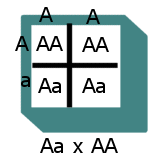
| In this case, a normal is bred to a carrier. This produces approximately 50% normal and 50% carrier offspring. |
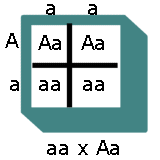
| In this case, an affected dog is bred to a carrier. This produces approximately 50% affected and 50% carrier offspring. |
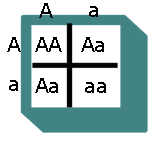
| In this case, a carrier is bred to a carrier. This produces approximately 25%affected, 25% normal and 50% carrier offspring. |
| It is important to remember that these examples provide probable outcomes. Statistical probability cannot predict specific outcomes, only likely outcomes. |
