The
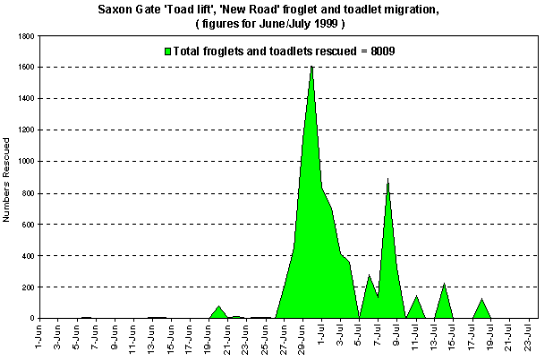
main toadlet migration started on the 26th June following
heavy rain. Huge numbers were seen leaving the pond heading
in westerly and northerly directions. Many members of the public
helped to collect the young amphibians and car drivers shewed
great concern for the migration, stopping until the road had
been cleared. Subsequent checks shewed that gardens, roads and
drains of the nearby housing estate were populated with very
many froglets and toadlets! Children and adults helped in collecting
the young amphibians which were then released in the fields
to the east of the pond. At one stage it was necessary to cone
off a section of the swimming pool car park to allow volunteers
to collect juveniles. Bark chipping mounds were used to good
effect in aiding the amphibians on their way.
Migration in the southerly direction was observed soon afterwards,
finishing on the 10th of July. Migration routes are shewn on
figure 1 and have been determined from data. The southerly migration
necessitated drain work on the road to Dunton.
ANALYSIS OF JUVENILE
MIGRATION DATA
Over 8000 toadlets and froglets were rescued from the drains
on the new road between 6th June and 20th July. 400 juveniles
were rescued from one drain on one evening. This indicates that
migration routes are clearly defined rather than being a generalised
movement away from the spawning site.
From Figure 1 it can be seen that there are 3 main migration
routes, west, south and north. The west and north migrations
were the first to be observed on the 26th June and resulted
in many juveniles occupying the gardens and drains of the local
housing estate. The westerly migration made good use of the
speed ramps on the road to the swimming pool car park.
Many of the juveniles on the northern migration route were seen
traversing the car park in a north easterly direction and made
use of the temporary bark chipping kerb humps. The greatest
number of juveniles were counted in drains 3W and 8W on the
new road. High numbers were also recorded in drains 2W, 4W,
5W and 6W shewing a widespread migration along these drains
and kerbs in between; many having possibly made their way directly
from the north east bank of the pond. Approximately 3 times
as many juveniles were recorded on the west side of the new
road as compared to the east side. This could be due either
to the effectiveness of the drains as pitfall traps, reluctance
of juveniles to cross the new road or success of predators in
picking off the unlucky ones. It took just less than 3 weeks
after commencement of migration for juveniles to start appearing
in the drains at the north end of the new road. Migrations from
the pond continued for 3 weeks, numbers rescued from new road
drains with corresponding dates are shewn in figure 2.