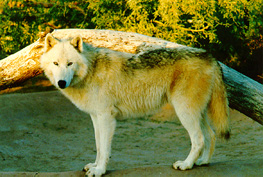
The reason so many are afraid of the wolf is because, as usual the people do not know all of the facts. The Wolf is not the evil creature so many think of it as. So allow me to try to answer a few questions that are constantly raised about this wonderful creature.What is a wolf?
Wolves are the largest members of the dog family, it is believed to be an ancestor of the dog. Many believe that a long time ago man tamed wolves and that is why we have dogs today, because they chose to stay by our side instead of answering the call of the wild.
What does it look like?
The body of the wolf looks much like a large German shepherd. But a wolf has longer legs, bigger feet, a wider head, and a long bushy tail. Adult male wolves weigh about from 75 to 120 pounds, while the female adult wolves are smaller than the males. Wolves fur can be a range of colors from pure white to jet black. But most wolves have gray fur. The Wolves of the northern and Arctic regions grow long, thick winter coats that protect them from the bitter cold.
What is a pack?
A pack is a group or family of wolves. Packs tend to have eight members, but some may have more than 20. Packs often stay together, for they have strong affection for one another. Some wolves leave the pack and become lone wolves. A lone wolf travels alone until it finds a mate. These two may have pups and form their own pack.
In regions where typical prey is small, packs may consist of seven or less. Where larger animals are prevalent, packs of up to 30 individuals may occur. In this case the members of the pack cooperate in a grueling contest of wits and endurance, maneuvering in an attempt to make the hunted animal expose its vulnerable flanks.What is life like in a pack?
Packs have a social order called a dominance hierarchy. The top wolves are apart of the dominant wolves, and the low ranking are called subordinate wolves. The dominate wolf stands erect, holds its tail aloft, and points its ears up and forward. It may show it's teeth and growl. The subordinate wolf crouches, holds its tail between its legs, and turns down its ears. It may also whine. In a pack, usually
only one male and one female breed and keep order within the group. These two are called the alpha pair. All members of a pack, both male and female, take care of the alpha pair's pups.Where do they live?
Wolves live in almost any climate, though they are seldom found in deserts or tropical forests. In ancient times, they roamed throughout the northern half of the world. But wherever large numbers of people settled, they destroyed wolves. Today, most wolves live in sparsely populated northern regions, such as Alaska, Minnesota, Canada, China, and Russia. Small numbers of wolves still inhabit wilderness areas of Greece, India, Mexico, Spain, and other countries.What types of wolf are there?
Almost all wolves belong to a species called the gray wolf. Gray Wolves are split into two separate
groups, the timber wolf and the tundra wolf. The timber wolf lives in wooded, sub arctic regions. The
tundra wolf, also called the Arctic wolf or white wolf, makes its home on the treeless plains of the Arctic. The pure red wolf is thought to be virtually extinct in the wild as a result of hybridization with migrating coyotes
What do they eat?
their number one prey has always been on large hoofed animals; such as caribou, deer, elk, and moose. The vision of a wolf is excellent, their sense of smell is keen, and fine hearing. These three senseshelp the animal locate prey. A wolf can see and smell a deer more than a mile away. A wolf has 42 teeth, including four fangs at the front of the mouth that are used to wound, grab, and kill prey. Wolves' stomach is large, and they can eat as much as 2 pounds of food at one time. However, a wolf can go without food for two weeks or longer. Wolves eat almost any animal they can catch. Many of the animals they hunt, such as caribou and elk, are faster and stronger than wolves. Therefore, wolves must be quick, tireless, and clever to catch them. Wolves will eat a wide range of food, including small animals such as mice and squirrels, large animals such as deer and moose, and occasionally carrion and plant material. Where domestic animals are available, wolves often prey on them because of their vulnerability; it is this practice that has resulted in the wolf's persecution by poisoning, trapping, and shooting.
Why do they howl?
When the members of a pack gather to begin a hunt, they greet each other with howls. Their howling may become very loud, and it warns other wolves to stay out of the pack's territory. Howling helps wolves identify and locate each other. Wolves generally travel in packs and frequently establish territories ranging from 40 to more than 400 square miles (100 to 1,000 square kilometers). They define their ranges with scent markings and such vocalizations as growls, barks, and their legendary howl. To find out more or to hear a few different wolf howls, please visit my Howls & Growls page.Don't they attack humans?
No. A wolf has never attacked a human without provocation. Attacks on humans are believed to occur only in isolated cases of famine or epidemic among the wolf population. Just like any other wild animal they attack to protect what is theirs.