 "To
me the best description of Antarctica is perhaps "sensory overload". It
touches not only your five senses but also your soul --- the most isolated
continent in the world brings such an extent of feeling that you feel as
if you might just burst."
"To
me the best description of Antarctica is perhaps "sensory overload". It
touches not only your five senses but also your soul --- the most isolated
continent in the world brings such an extent of feeling that you feel as
if you might just burst."
"To
me the best description of Antarctica is perhaps "sensory overload". It
touches not only your five senses but also your soul --- the most isolated
continent in the world brings such an extent of feeling that you feel as
if you might just burst."
Our group of 9 Singaporeans set off on a journey on the 9th of December 1997. We flew 28 hours from Singapore to Kuala Lumpur to Johannesburg, and then to Cape Town and Buenos Aires where we spent the night. On the following day we flew to Ushuaia at the extreme tip of South Africa to board the M.V Professor Molchanov, the little polar ship.
Bidding farewell to Ushuaia, and soon afterwards the calm waters of the Beagle Channel, we entered the unpredictable Drake Passage, known also as the Dreaded Drake. For two whole days we were surrounded by an endless expanse of sky and sea, accompanied by seabirds and dolphins. Our expedition staff, comprising scientists (such as a penguin expert, a seal expert and a geologist) who have great experience in the area and are studying the wildlife and terrain in Antarctia, shared with us their knowledge through daily lectures. Their passions and dedication left us not only yearning to see and feel Antarctica for ourselves, but also gave us the push to be environmentalists ourselves and the determination to be responsible visitors in the days ahead on the Antarctica Peninsula and its islands.
It did not matter if we were of different nationalities and backgrounds onboard the ship because such things did not matter at all. It was amazing how we were able to transcend racial, age and occupational barriers to share the same passion to explore and discover the Antarctic Peninsula.
We were briefed on "The Antarctic Visitor's Etiquette". The impact of both tourists and scientists has been immense in the last few years. We were told not to bring food ashore and not to litter -- not even the accidental tissue dropped from the pocket is excusable. Cigarettes are strictly prohibited onshore for environmental reasons and also because the cold and dry conditions favours the rapid spread of fires. No natural object is allowed to be removed from the continent. We also had to watch our step in case we stepped on moss or algae, or an unsuspecting nesting penguin, seal or bird as we backed away. It is important that we maintain a minimum distance of 5 meters from penguins, seals and other wildlife because our presence may result in a lot of stress on the animals, possibly causing them to abandon or even kill their babies or eggs.
One other very important ritual that we had to perform was washing our gum boots before and after each landing. Buckets of water and huge brushes were provided and all of us queued diligently to scrub each other's boots. The purpose of this is to prevent organisms and germs from being transmitted from ship to land and vice versa, and between different landings, as the environment is extremely fragile with many species that are indigenous to each particular spot despite being on the same island. As tourists, we have to take precautions to minimise our impact on Antarctica.
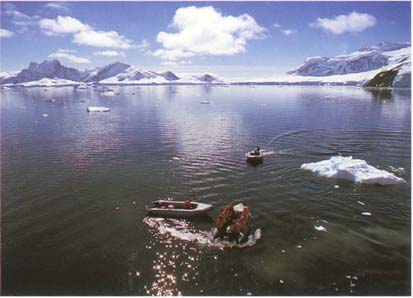
The sheer vastness
and beauty of the continent, its immense ice walls, icebergs, glaciers
and snow capped peaks often shrouded in thick clouds, contrast starkly
with what I have grown up with in Singapore. Here
in Antarctica your senses are sharpened -- you are made aware of the silence,
the crystal clear cracking of the ice, the sounds of the wildlife, and
the continual humming of the zodiac engine. All the sounds that remind
me that this planet is indeed living, and I, however insignificant, stand
within it breathing, listening and capturing whatever image I can, moved
to the point where I can no longer speak."