Geography
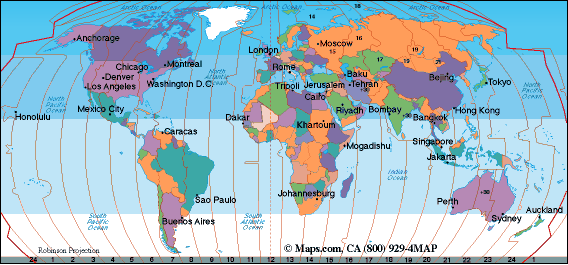
Here is a quick look at a few places in the world. In no particular order, not even alphabetical.
Canada
Independent nation (1995 est. pop. 28,435,000), 3,851,787 sq mi (9,976,128 sq
km), N North America. Canada occupies all of North America N of the United States
(and E of Alaska) except for Greenland and the French islands of St. Pierre
and Miquelon. It is bounded on the E by the Atlantic Ocean, on the N by the
Arctic Ocean, and on the W by the Pacific Ocean and Alaska. A transcontinental
border, formed in part by the Great Lakes, divides Canada from the United States;
Nares and Davis straits separate Canada from Greenland. The Arctic Archipelago
extends far into the Arctic Ocean.
Canada is a federation of 10 provinces-Newfoundland, Nova Scotia, New Brunswick,
Prince Edward Island, Quebec, Ontario, Manitoba, Saskatchewan, Alberta, and
British Columbia-and three territories-Nunavut, the Northwest Territories, and
the Yukon Territory. Canada's capital is Ottawa and its largest city is Toronto.
Other important cities include Montreal, Vancouver, Edmonton, Calgary, Winnipeg,
Hamilton, and Quebec.
Canada (Land and People)
Occupying more than half of the nation's land area in the east
and north is the vast CANADIAN
SHIELD, a sparsely populated expanse of ancient, metamorphic rocks locally
rich in iron, nickel, gold, and other minerals. Its rim extends from Labrador
in the east, along the northern edge of Canada's urban-industrial heartland
(the SAINT LAWRENCE
R. valley and the peninsula of S Ontario), through WINNIPEG
and the GREAT SLAVE
and Great Bear lakes to the ice-clogged ARCTIC
OCEAN in the north. Southeast of the Shield, occupying the Maritime Provinces
and the island of Newfoundland, are the worn-down northern ranges of the APPALACHIAN
MOUNTAINS system. To the west, in SW Manitoba and most of Alberta and Saskatchewan,
are the great wheat-growing, oil-rich plains, or prairies, underlain by sedimentary
rock in the Interior Lowlands region. The plains continue north through the
PEACE R. and Athabasca
districts to the area at the mouth of the MACKENZIE
R., in the far north. West of the plains, along the western boundary of Alberta
and in British Columbia and the Yukon, is the c.500-mi-wide (800-km) complex
of high mountains and plateaus known as the Western Cordillera. It includes
the ROCKY MOUNTAINS
(E) and COAST MOUNTAINS
(W), and reaches an elevation of 19,524 ft (5,951 m) at Mt. LOGAN,
Canada's highest point, in the Yukon. Canada's climate ranges from temperate,
with short, mild winters, in the southwest, to bitter, Arctic cold. It is temperate,
with long, cold, and usually snowy winters in E Canada and the Prairie Provinces.
Climatic conditions become progressively harsher to the north, where permafrost
severely limits development. Most Canadians live along the southern edge of
the nation, within 100 mi (160 km) of the U.S. border. More than half are concentrated
in S Ontario and S Quebec. TORONTO,
MONTREAL, EDMONTON,
VANCOUVER, and
CALGARY are the
largest urban areas. The population is predominantly of British or French origin,
with smaller minorities of other Europeans, some Asians, and an indigenous population
of over 493,000 (many on reservations), including 28,000 Inuit (ESKIMO).
Roman Catholicism and Protestantism are the largest faiths; the main Protestant
sects are the United Church of Canada, Anglican Church of Canada, and Presbyterian.
French (spoken by a majority in Quebec) and English are both official languages.
Canada (History)
Newfoundland and the eastern seaboard were discovered for England in 1497 by
John cabot and the mouth of the St. Lawrence R. and the gaspé peninsula
for France in 1524 by Jacques cartier. Port Royal (now annapolis royal), Canada's
first known permanent mainland settlement, was founded by the French in 1605,
and, traveling out from the colony of New France (made a royal colony in 1663),
French fur traders, explorers, and missionaries rapidly extended French influence
deep into the North American interior. British interest was sparked by the commercial
efforts of the hudson's bay company after 1670. Through the 18th cent. Anglo-French
hostility in Europe kept spilling over into the New World (see french and indian
wars). In 1713 Britain gained control of Nova Scotia (the heart of the French
colony called acadia), Newfoundland, and the Hudson Bay region. The rest of
French Canada fell to the British in 1763, following the defeat (1759) of Gen.
montcalm by James wolfe on the Plains of Abraham, near the city of Quebec. French
residents, then in the majority, were granted rights to their own language and
religion and given other concessions under the Quebec Act of 1774. Tensions
mounted, however, as British settlement accelerated, especially after the American
Revolution, with an influx of loyalists from the former American colonies (see
united empire loyalists). In an effort to deal with the growing Anglo-French
antagonism, Quebec was divided (1791) into English-speaking Upper Canada (now
Ontario) and French-speaking Lower Canada (present-day Quebec). Following revolts
in both colonies and the report by the earl of durham in 1839, Upper and Lower
Canada were again merged (1841) to form a single colony called Canada Province.
The union lasted until confederation: the creation (1867), under the British
North America Act, of a self-governing Dominion of Canada. Ontario and Quebec
(as separate provinces), New Brunswick, and Nova Scotia were the four founding
members at confederation. They were later joined by Manitoba (1870), British
Columbia (1871), Prince Edward Island (1873), Alberta and Saskatchewan (1905),
and Newfoundland (1949). The Northwest Territories were purchased from the Hudson's
Bay Company to become (1869) a federal territory, from which the Yukon was created
as a separate territory in 1898. A strong, sometimes violent French Canadian
separatist movement in Quebec, seeking independence or sovereignty for the province,
gathered momentum in the late 1960s. In the 1970s new regional strains arose
as residents of the rapidly developing western provinces (especially oil-rich
Alberta) chafed under a federal system that, in their view, deprived them of
the full benefits of their resources. Such controversies pointed to the need
for reform of the federal-provincial power arrangement and led to agitation
for the patriation of the constitution. In 1982 Canada's constitution was returned
to the Canadians, together with an amending formula and a Charter of Rights
and Freedoms. In the same year first steps toward the redistribution of federal
and provincial powers were taken by Prime Min. Pierre trudeau. In 1984 Trudeau
retired, and his successor, John Turner, called an election. The Progressive
Conservatives won a sweeping majority, and Brian mulroney became prime minister.
Mulroney signed free trade agreements with the U.S. (1988) and with the U.S.
and Mexico (1992). In 1990 the 1987 Meech Lake accord, which recognized Quebec
as a «distinct society,» failed to win provincial approval; a similar
but broader set of constitutional revisions was rejected (1992) in a national
referendum. Mulroney resigned in 1993 and was briefly succeeded by fellow party-member
Kim campbell, Canada's first woman prime minister. Elections (1993) led to a
Liberal victory and a Progressive Conservative rout, and Jean Chrétien
became prime minister. Two relatively new parties, the Bloc Québécois
(based in Quebec and favoring its independence) and Reform party (based in W
Canada), won nearly all the remaining parliamentary seats. In 1995 the Quebec
separatists' campaign for independence, which revived after the defeat of the
Meech Lake accord, narrowly lost in a provincial referendum.
China
Mandarin Zhonghua Renmin Gongheguo [central glorious people's united country;
i.e., people's republic], officially People's Republic of China, country (1996
est. pop. 1,217,600,000), 3,691,502 sq mi (9,561,000 sq km), E Asia. The most
populous country in the world, China has a 4,000-mi (6,400-km) coast that fronts
on the Yellow Sea, the East China Sea, and the South China Sea. It is elsewhere
bounded on the east by Russia and North Korea, on the north by Russia and Mongolia,
on the west by Tajikistan, Kyrgyzstan, Kazakhstan, Pakistan, and Afghanistan,
and on the south by India, Nepal, Bhutan, Myanmar, Laos, and Vietnam. China's
capital is Beijing; Shanghai is its largest city.
China, People's Republic of (The People's Republic)
Under the Communists, high inflation was brought under control, a land reform
program introduced, industry nationalized and expanded with Soviet aid, and
agriculture collectivized. The Chinese People's Volunteers entered the korean
war against UN forces in 1950, participating on a large scale until the armistice
of 1953. A liberal «hundred flowers» period (1957) was followed
by a crackdown on intellectuals and the Great Leap Forward (1958–60), a massive
industrial and agricultural development program that was intended to transform
China's economy overnight but that ended in the largest famine in world history,
with an estimated 20–40 million deaths. At about the same time a growing ideological
rift between China and the USSR led to withdrawal of Soviet aid and technical
assistance. Evidence of internal tension began to surface in the 1960s, culminating
in the cultural revolution of 1966–69, a massive upheaval launched by Mao to
purge the revolution of liberal elements. Tension increased in the early 1970s
with the revelation that Lin Biao, China's defense minister and Mao's designated
heir, had died (1971) in a plane crash after an attempt to assassinate Mao.
In international affairs, China's progress toward recognition as a world power
was aided by its explosion of an atomic bomb (1964) and the launching of its
first satellite (1970). An easing of relations with the West led to the admission
of China to the UN in 1971 and to a visit to China by U.S. Pres. nixon in 1972.
Zhou Enlai and Mao Zedong died in 1976. Following the assumption of power by
hua guofeng, the country was shaken by the arrest, trial, and conviction (1981)
of Mao's widow, jiang qing, and three colleagues (the gang of four). deng xiaoping,
who came to power in 1977, adopted a program of rapid economic modernization.
Liberal economic and trade policies were instituted, and the U.S. and China
normalized diplomatic relations in 1979. In 1981 the Communist party publicly
criticized Mao's later policies, although his thought was reaffirmed as the
nation's guideline in new party and national constitutions (1982). In early
1989 China was the scene of massive demonstrations calling for democratic reforms
and an end to official corruption, but in June the army brutally suppressed
the Beijing demonstrators, killing perhaps 1,000. A period of repression and
reaction followed, but many of the economic reforms survived and new ones have
since been instituted. In 1993 a revision of the constitution called for the
development of a «socialist market economy.»
China, People's Republic of (History)
A protohuman toolmaker known as Peking man (Sinanthropus pekingensis)
lived in N China about 500,000 years ago. Modern humans first appeared in the
region around 20,000 years ago, establishing primitive agricultural villages
by 5000 B.C. The first documented Chinese civilization was the Shang dynasty
(c.1523-c.1027 B.C.), which had cities, bronze metallurgy, and a system of writing.
It was succeeded by the often turbulent Chou dynasty (c.1027-256 B.C.), which
nevertheless gave rise to China's golden age of philosophy, highlighted by the
works of CONFUCIUS,
LAO-TZE, and Mencius.
The Ch'in dynasty (221-207 B.C.) united China under a centralized imperial system;
construction of the GREAT
WALL was begun during this period. The Han dynasty (202 B.C.-A.D. 220),
considered China's imperial age, was notable for its long, peaceable rule, territorial
expansion, and technological and artistic achievement. There followed four centuries
of warfare among petty states and invasions by the Huns; however, despite the
chaos, the arts and sciences flourished, and BUDDHISM
and TAOISM developed
as important Chinese religions. Political reunification, begun under the Sui
(581-618), paved the way for the glorious age of the T'ang dynasty (618-906),
which at its height controlled an empire stretching from Korea to Turkistan.
Prosperity continued under the Sung dynasty (960-1279), a time of scholarly
studies and artistic progress, marked by the invention of movable type. In the
13th cent. N China fell to the MONGOLS
led by JENGHIZ KHAN.
His grandson KUBLAI
KHAN founded the Yüan dynasty (1260-1368) and subdued (1279) the Sung. Kublai's
vast realm was visited and described by Marco POLO.
After a massive peasant rebellion (14th cent.) native rule was restored with
the establishment of the Ming dynasty (1368-1644). However, in 1644 foreigners
from the north-the Manchus-once again conquered China, establishing the Ch'ing
(MANCHU) dynasty
(1644-1912), the last in China's history. (See CHINESE
DYNASTIES for a table of the dynasties of the Chinese Empire.
Japan
Jap. Nihon or Nippon, country (1994 pop. 125,107,000), 142,811
sq mi (369,881 sq km), occupying an archipelago off the coast of E Asia. The
capital is TOKYO.
Japan proper has four main islands; these are, from north to south, HOKKAIDO,
HONSHU (the largest
island, where the capital and major cities are located), SHIKOKU,
and KYUSHU. Many
smaller islands lie in an arc between the Sea of Japan and the East China Sea,
and the Pacific Ocean. Honshu, Shikoku, and Kyushu enclose the INLAND
SEA. Mountains, including a number of volcanoes, cover two thirds of Japan's
surface; the most famous peak is Mt. FUJI.
The land is also marked by short, rushing rivers, forested slopes, irregular
lakes, and small, rich plains. Rainfall is abundant, and typhoons and earthquakes
are frequent.
Japan (History)
Japan (History)In legend, Japan was founded in 660 B.C., but
reliable records date only to about A.D. 400. By the 5th cent. Japan was unified
by the Yamato clan, and the foundations of a centralized imperial state were
laid by the 8th cent. Court culture was influenced first by Chinese learning
and institutions and then by a rebirth of native Japanese culture. By the 9th
cent. the powerful Fujiwara family ruled as regents, and imperial authority
was undermined. The 12th cent. ushered in Japan's medieval period, with the
development of feudalism, the rise of a warrior class called the SAMURAI,
and the establishment of military rule under Minamoto Yoritomo, the first SHOGUN.
After civil war between rival warrior clans, the country was unified in 1600
under a new shogun, Tokugawa IEYASU.
For more than 250 years the TOKUGAWA
family ruled over a Japan internally at peace and largely cut off from the outside
world. In 1853 the U.S. naval officer Matthew C. PERRY
arrived in Japan to force the opening of trade with the West, and in 1868 the
shogunate collapsed, when the Meiji Restoration returned formal power to the
Emperor MEIJI.
A new government was established under the able leadership of former samurai.
Adopting the techniques of Western civilization, Japan modernized rapidly into
an industrial state and military power. A constitutional monarchy and a parliament
(diet) were established by the constitution of 1889. The success of Japan in
the First Sino-Japanese War (1894-95) and the RUSSO-JAPANESE
WAR (1904-5) brought the nation to international prominence. An Anglo-Japanese
alliance was formed in 1902. Japan annexed Korea in 1910, established a puppet-state
in MANCHURIA in
1932, and began the Second SINO-JAPANESE
WAR (1937-45) by invading N China. Japan formed a military alliance with
Germany and Italy in WORLD
WAR II and opened hostilities against the U.S. with an attack on PEARL
HARBOR in 1941. After rapid initial success, the Japanese were defeated
by the Allies. Following the dropping of atomic bombs by the U.S. on HIROSHIMA
and NAGASAKI,
Japan surrendered in Aug. 1945 and was occupied by U.S. forces. The signing
of a peace treaty in 1951 led to full Japanese sovereignty over the main islands
in 1952. The U.S. returned the BONIN
and nearby islands to Japan in 1968 and the RYUKYU
ISLANDS (Okinawa) in 1972. The LIBERAL
DEMOCRATIC PARTY (LDP) dominated postwar politics, but beginning in the
1970s various scandals increasingly tarnished its image. TAKESHITA
NOBURU served as prime minister (1987-89) until, amid reports of scandal,
he resigned, and Uno Sosuke replaced him. Uno resigned after a sex scandal and
an election defeat, and Kaifu Toshiki became (1989) prime minister. In 1991
MIYAZAWA KIICHI
succeeded Kaifu as prime minister. Miyazawa's government fell in 1993 after
the LDP split over political reforms. No party won a majority in the subsequent
elections, but an opposition coalition formed a government, and HOSOKAWA
MORIHIRO became prime minister. Hosokawa resigned in 1994. Fellow coalition
member HATA TSUTOMU
served briefly as prime minister but was forced to resign. An unlikely LDP-Socialist
coalition then formed a government, with Socialist MURAYAMA
TOMIICHI as prime minister; in early 1996 he was succeeded as prime minister
by LDP-leader Hashimoto Ryutaro.
England
England, the largest and most populous portion of the United
Kingdom of Great Britain and Northern Ireland (1991 pop. 46,382,050), 50,334
sq mi (130,365 sq km). It is bounded by Wales and the Irish Sea on the west
and Scotland on the north. The English Channel, the Strait of Dover, and the
North Sea separate it from the continent of Europe. The Isle of Wight, off the
southern mainland in the English Channel, and the Scilly Islands, in the Atlantic
Ocean off the southwestern tip of the mainland, are considered part of England.
London, the capital of Great Britain, is located in the southeastern portion
of England. The Thames and the Severn are the longest rivers.
Behind the white chalk cliffs of the southern coast lie the gently rolling downs
and wide plains stretching to the Chiltern Hills and the Cotswold Hills. Along
the east coast are the lowlands of Norfolk, reaching up to the Fens, formerly
marshy country that has been drained, lining The Wash, an inlet of the North
Sea. In the east and southeast, river estuaries lead to some of England's great
commercial and industrial centers: London, on the Thames; Hull, on the Humber;
Teeside, on the Tees; and Newcastle upon Tyne, on the Tyne. The north of England,
above the Humber, is mountainous; the chief highlands are the Cumbrian Mts.
in the northwest and the Pennines, which run north-south in N central England.
The famous Lake District, in the Cumbrians, has England's highest points. The
center of England, the Midlands, is a large plain, interrupted and bordered
by hills. In the Midlands are the industrial centers of Birmingham and the Black
Country. The Midlands, especially its northern edge, was formerly a great coal-mining
region. On the Lancashire plain is the great city of Manchester, the center
of the English textile industry. Durham and W Yorkshire are also highly industrialized,
but E Yorkshire is an area of bleak moors and wolds, and the upper reaches of
Northumberland are sparsely populated. In the west and southwest the border
with Wales and the peninsula of Devonshire and Cornwall have a hilly, upland
terrain. The main ports in the west are Bristol, on the Avon (which flows into
Bristol Channel), and Liverpool, on the Mersey. In southern England, the main
ports are London, Southampton, and Plymouth.
Despite its northerly latitudes (London is on the same parallel as the easterly tip of Labrador), England has a mild climate, attributable to warm currents in the surrounding seas. Most of the region is subject to much wet weather, and some of it experiences severe cold, but in general the climate is favorable to a wide variety of agricultural and industrial pursuits.
England comprises seven metropolitan counties: Greater London, Greater Manchester, Merseyside, South Yorkshire, Tyne and Wear, West Midlands, and West Yorkshire; and 39 nonmetropolitan counties: Avon, Bedfordshire, Berkshire, Buckinghamshire, Cambridgeshire, Cheshire, Cleveland, Cornwall and Isles of Scilly, Cumbria, Derbyshire, Devon, Dorset, Durham, East Sussex, Essex, Gloucestershire, Hampshire, Hereford and Worcester, Hertfordshire, Humberside, Isle of Wight, Kent, Lancashire, Leicestershire, Lincolnshire, Norfolk, Northamptonshire, Northumberland, North Yorkshire, Nottinghamshire, Oxfordshire, Shropshire, Somerset, Staffordshire, Suffolk, Surrey, Warwickshire, West Sussex, and Wiltshire. The counties are divided into districts and parishes; Greater London consists of the City of London and 32 boroughs. For the history of England as well as more information on government and economy, see Great Britain.
France
Pronounced As: frans, Fr. fräNs , officially French Republic,
republic (1999 pop. 58,416,500), 211,207 sq mi (547,026 sq km), W Europe. France
is bordered by the English Channel (N), the Atlantic Ocean and the Bay of Biscay
(W), Spain and Andorra (SW), the Mediterranean Sea (S), Switzerland and Italy
(SE), and Germany, Luxembourg, and Belgium (NE). The natural land frontiers
are the Pyrenees, along the border with Spain; the Jura Mts. and the Alps, along
the border with Switzerland and Italy; and the Rhine River, which is part of
the border with Germany. France's capital and largest city is Paris.
Portugal
Pronounced As: pôrchgl , officially Portuguese Republic,
republic (1995 est. pop. 10,562,000), 35,553 sq mi (92,082 sq km), SW Europe,
on the western side of the Iberian Peninsula and including the Madeira Islands
and the Azores in the Atlantic Ocean. Portugal is bordered by Spain on the east
and north and by the Atlantic Ocean on the west and south. The capital and by
far the largest city is Lisbon.
Malaysia
Pronounced As: mlazh , independent federation (1995 est. pop.
19,724,000), 128,430 sq mi (332,633 sq km), Southeast Asia. The official capital
and by far the largest city is Kuala Lumpur. A new administrative capital, Putrajaya,
is expected to be completed by 2012.
Australia
Pronounced As: ôstraly , smallest continent, between the
Indian and Pacific oceans. With the island state of Tasmania to the south, the
continent makes up the Commonwealth of Australia, a federal parliamentary state
(1995 est. pop. 18,322,000), 2,967,877 sq mi (7,686,810 sq km). Australia's
capital is Canberra. Its largest city is Sydney, closely followed in population
by Melbourne. There are five continental states in the nation (Queensland, New
South Wales, Victoria, South Australia, and Western Australia) as well as the
Northern Territory and the Australian Capital Territory (an enclave within New
South Wales, containing Canberra). Australia's external territories include
Norfolk Island, Christmas Island, the Cocos (Keeling) Islands, and the Australian
Antarctic Territory.
Hong Kong
Pronounced As: hong kong , Mandarin Xianggang, special administrative
region of China, formerly a British crown colony (1997 est. pop. 6,300,000),
land area 422 sq mi (1,092 sq km), adjacent to Guangdong prov., SE China, on
the estuary of the Pearl River, 40 mi (64 km) E of Macao and 90 mi (145 km)
SE of Guangzhou (Canton). The region comprises Hong Kong island, ceded by China
in 1842 under the Treaty of Nanjing; Kowloon (Mandarin Jiulong) peninsula, ceded
(with Stonecutters Island) in 1860 under the Beijing Convention; and the New
Territories, a mountainous mainland area adjoining Kowloon, which, with Deep
Bay on the west and Mirs Bay on the east and some 235 offshore islands, was
leased from China in 1898 for 99 years. China regained sovereignty of the colony
on July 1, 1997. The capital, officially named Victoria but commonly called
Hong Kong, is on the northwest shore of Hong Kong island.
Sweden
Swed. Sverige, officially Kingdom of Sweden, constitutional monarchy
(1995 est. pop. 8,822,000), 173,648 sq mi (449,750 sq km), N Europe, occupying
the eastern part of the Scandinavian peninsula. It borders on Norway in the
west, on Finland in the northeast, on the Gulf of Bothnia in the east, on the
Baltic Sea in the south, and on the Øresund (The Sound), the Kattegat,
and the Skagerrak in the southwest. The country includes several islands, notably
Gotland and Öland, in the Baltic. Stockholm is Sweden's capital and largest
city.
Norway
Nor. Norge, officially Kingdom of Norway, constitutional monarchy
(1994 pop. 4,347,695), 125,181 sq mi (324,219 sq km), N Europe, occupying the
western part of the Scandinavian peninsula. Extending from the Skagerrak, which
it borders in the south, c.1,100 mi (1,770 km) northeast to North Cape and Vardø
on the Barents Sea in the extreme northeast, the country forms a narrow mountainous
strip along the North Sea in the southwest and in the west the Atlantic Ocean,
whose local waters are also called the Norwegian Sea. It has a long land frontier
with Sweden in the east and in the northeast borders on Finland and Russia.
Oslo is the capital and largest city. The nation's outlying possessions are
Svalbard and Jan Mayen in the Arctic Ocean and Bouvet and Peter I islands in
the S Atlantic; Norway also has claims in Antarctica.
Germany
Pronounced As: jûrmn , Ger. Deutschland, officially Federal
Republic of Germany, republic (1995 est. pop. 81,338,000), 137,699 sq mi (356,733
sq km). Located in the center of Europe, it borders the Netherlands, Belgium,
Luxembourg, and France on the west; Switzerland and Austria on the south; the
Czech Republic and Poland on the east; Denmark on the north; and the Baltic
Sea on the northeast. The official capital and largest city is Berlin, but many
administrative functions are still carried on in Bonn, the former capital of
West Germany.
New Zealand
Pronounced As: zlnd , island country (1996 pop. 3,618,302), 104,454
sq mi (270,534 sq km), in the S Pacific Ocean, over 1,000 mi (1,600 km) SE of
Australia. The capital is Wellington; the largest city and leading port is Auckland.
Taiwan
Pronounced As: tiwän , Portuguese Formosa, officially Republic
of China, island nation (1995 est. pop. 21,501,000), 13,885 sq mi (35,961 sq
km), in the Pacific Ocean, separated from the mainland of S China by the 100-mi-wide
(161-km) Taiwan Strait. Together with many nearby islets, including the Pescadores
and the island groups of Quemoy and Matsu, it forms the seat of the Republic
of China. The provisional capital is Taipei; Nanjing, on mainland China, is
regarded as the official capital of the republic.
Korea
Pronounced As: kôr, k- , Korean Choson, Jap. Chosen or
Tyosen, historic region (85,049 sq mi/220,277 sq km), E Asia. A peninsula, 600
mi (966 km) long, Korea separates the Yellow Sea (and Korea Bay, a northern
arm of the Yellow Sea) on the west from the Sea of Japan on the east. On the
south it is bounded by Korea Strait (connecting the Yellow Sea and the Sea of
Japan) and on the north its land boundaries with China (c.500 mi/800 km) and
with Russia (only c.11 mi/18 km) are marked chiefly by the great Yalu and Tumen
rivers. Seoul was the traditional capitalKorea
Pronounced As: kôr, k- , Korean Choson, Jap. Chosen or Tyosen, historic
region (85,049 sq mi/220,277 sq km), E Asia. A peninsula, 600 mi (966 km) long,
Korea separates the Yellow Sea (and Korea Bay, a northern arm of the Yellow
Sea) on the west from the Sea of Japan on the east. On the south it is bounded
by Korea Strait (connecting the Yellow Sea and the Sea of Japan) and on the
north its land boundaries with China (c.500 mi/800 km) and with Russia (only
c.11 mi/18 km) are marked chiefly by the great Yalu and Tumen rivers. Seoul
was the traditional capital
Brazil
Pronounced As: brzil , Port. Brasil, officially Federative Republic
of Brazil, republic (1997 pop. 159,800,000), 3,286,470 sq mi (8,511,965 sq km),
E South America. By far the largest of the Latin American countries, Brazil
occupies nearly half the continent of South America, stretching from the Guiana
Highlands in the north, where it borders Venezuela, Guyana, Suriname, and French
Guiana, to the plains of Uruguay, Paraguay, and Argentina in the south. In the
west it spreads to the equatorial rain forest, bordering on Bolivia, Peru, and
Colombia; in the east it juts far out into the Atlantic toward Africa. It is
a federation of 26 states and Brasília, the federal district and site
of the capital city of the same name. Its largest cities are São Paulo
and Rio de Janeiro.
Argentina
Pronounced As: ärjntn, Span. ärhantnä , officially
Argentine Republic, republic (1995 est. pop. 34,293,000), 1,072,157 sq mi (2,776,889
sq km), S South America. Argentina is bordered by Chile on the west, Bolivia
and Paraguay on the north, Brazil and Uruguay on the northeast, and the Atlantic
Ocean on the east. Buenos Aires is the country's capital and largest city.
Chile
Pronounced As: chil, Span. chla , officially Republic of Chile,
republic (1995 est. pop. 14,161,000), 292,256 sq mi (756,945 sq km), S South
America, west of the continental divide of the Andes Mts. Chile is bordered
by Peru on the north, Bolivia on the northeast, Argentina on the east, and the
Pacific Ocean on the west and south. Santiago is the capital and the largest
city.
Egypt
Pronounced As: jipt , Arab. Misr, biblical Mizraim, officially
Arab Republic of Egypt, republic (1996 pop. 59,272,382), 386,659 sq mi (1,001,449
sq km), NE Africa and SW Asia. It borders on the Mediterranean Sea in the north,
Israel and the Red Sea in the east, Sudan in the south, and Libya in the west.
Egypt's capital and largest city is Cairo. In addition to the capital, major
cities include Alexandria, Port Said, Suez, Tanta, and Aswan.
Greece
Gr. Hellas or Ellas, republic (1995 est. pop. 10,648,000), 50,944
sq mi (131,945 sq km), SE Europe. It occupies the southernmost part of the Balkan
Peninsula and borders on the Ionian Sea in the west, on the Mediterranean Sea
in the south, on the Aegean Sea in the east, on Turkey and Bulgaria in the northeast,
on Macedonia in the north, and on Albania in the northwest. Athens is its capital
and largest city.
Spain
Span. España Pronounced As: aspänyä , officially
Kingdom of Spain, constitutional monarchy (1995 est. pop. 39,404,000), 194,884
sq mi (504,750 sq km), including the Balearic and Canary islands, SW Europe.
It consists of the Spanish mainland (190,190 sq mi/492,592 sq km), which occupies
the major part of the Iberian Peninsula; of the Balearic Islands in the Mediterranean
Sea; and of the Canary Islands in the Atlantic Ocean.
Continental Spain extends from the Pyrenees, which separate it from France, and from the Bay of Biscay, an arm of the Atlantic Ocean, southward to the Strait of Gibraltar, which separates it from Africa. (Gibraltar itself is a British possession, although Spain has long claimed sovereignty over it.) The eastern and southeastern coast of Spain, from the French border to the Strait of Gibraltar, is washed by the Mediterranean. In the west, Spain borders on the Atlantic Ocean both north and south of its frontier with Portugal. The small republic of Andorra is wedged between France and Spain in the Pyrenees. The five enclaves in Morocco are the only remnants of Spain's former empire. Two of the enclaves, Ceuta and Melilla, are Spanish municipalities and may become provinces. Madrid is the nation's capital and largest city.
Vietnam
Pronounced As: vetnäm , officially Socialist Republic of
Vietnam, republic (1995 est. pop. 74,393,000), 128,400 sq mi (332,642 sq km),
Southeast Asia. Occupying the eastern coastline of the Southeast Asian peninsula,
Vietnam is bounded by China on the north, by Laos and Cambodia on the west,
and by the Gulf of Tonkin and the South China Sea on the east and south. The
capital is Hanoi and the largest city is Ho Chi Minh City, formerly Saigon.
Italy
Pronounced As: itl , Ital. Italia, officially Italian Republic,
republic (1995 est. pop. 58,262,000), 116,303 sq mi (301,225 sq km), S Europe.
It borders on France in the northwest, the Ligurian Sea and the Tyrrhenian Sea
in the west, the Ionian Sea in the south, the Adriatic Sea in the east, Slovenia
in the northeast, and Austria and Switzerland in the north. The country includes
the large Mediterranean islands of Sicily and Sardinia and several small islands,
notably Elba, Capri, Ischia, and the Lipari Islands. Vatican City (see under
Vatican) and San Marino are two independent enclaves on the Italian mainland.
Rome is Italy's capital and largest city.
Source: www.encyclopedia.com
 |
 |
 |
[ Me | Facts | Gallery | Humor | Miscellaneous | Guestbook ]