Nearly all the materials where the theory works are crystals. We need a vocabulary of terms and concepts to deal with them. The mathematical abstraction the lattice dates back to Laues experiments in X-ray diffraction in 1912.
2.2 The Lattice
A lattice is an infinite array of points in a space arranged so that every point has identical surroundings. All the lattice points are equivalent. The lattice describes the translational symmetry operations which carry the crystal into its-self. All the physical properties must have the same symmetry as the lattice. The are 14 possible Bravais lattices arrangements which can fill three dimensional space.
2.3 Lattice Vectors
R=pa+qb+rc
where p , q and r are integers. This is the generalised Lattice Vector. Moving by R quantity the view of the observer is unchanged. By choosing a , b and c to show the crystal symmetry if at all possible <p,q,r> is a set of vectors that are symmetrically equivalent to [p,q,r] .
2.4 Basis
The group of atoms which is the repeated at each lattice point which reproduces the crystal
crystal=lattice+basis
where the + is the condition. This can be one atom or a few that can make an enormous molecule.
2.5 Primitive Unit Cell
The primitive unit cell is the volume of space associated with each lattice point. This volume is fixed by a crystal, but you often have a selection of of sharpe. The Wignor Seitz Construction will always construct you a primitive unit cell, however this rarely shows crystal symmetry.
2.6 Conventional Unit Cell
Convention Unit Cell's often contain more than one lattice point (eg. face centred cubic cells contain four lattice points). It often shows the full translational and point symmetries (eg. planes of reflection and axes of rotation). combination of translational and point symmetries gives 230 point groups.
2.7 Example - Diamond and Zincblende Lattices
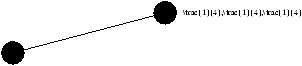
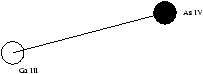
Both diamond and zincblende lattices are face centred cubic and the basis for both is two atoms (which are the same in diamond, carbon).
Figure 2.1 - Diamond (or Silicon)
Figure 2.2 - Zincblende (or III-IV compound)
2.8 Crystal Planes
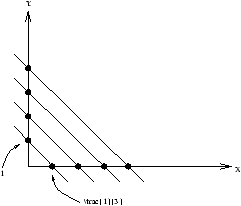
We can define the crystal in sets of planes that intersect every lattice point. These define periodicities in certain directions. This is named in Miller notation.
2.9 Example
Figure 2.3 - Example ?????
The example cuts the axes at 1/3 and 1 , we can multiply this up to obtain integers and write in round brackets (1,3) . In cubic crystals only [p,q] vector is perpendicular to (p,q) planes. There are families of symmetrically equivalent planes denoted by { p,q,r } .
Planes that have high symmetry have low indices. There are sets of planes that intersect every lattice point. Planes that make negative intercepts may be written as (1,0,0) . The families of symmetrically equivalent planes can be written as { h,k,l} .
Figure 2.4 - Planes????
2.10 Plane Spacing
The plane (h,k,l) intercepts the axes at a/h,v/k,c/l . For cubic crystals only
dhkl=
a
(h2+k2+l2)
1
2
2.11 Bragg Diffraction
Figure 2.5 - Bragg Diffractio
If there is a thick line at nl then the reflections from multiple planes are added in phase.
2dsinq=nl
In practive it is very unlikely to happen, as we need l ,d,q to be correct at the same time. Typically a plane of atoms scatters <10-3 of X-ray beam as thousands of planes contribute to the signal, this provides q to be very well defined.