Take the primitive lattice vectors a , b and c to form the vectors and the permitations
A=
2p (b×c)
a.(b×c)
we note that A is perpendicular to a , same for B and b and also for C and c . A , B and C are primitive vectors of the reciprocal lattice, ie.
G=pA+qB+rC
where p , q and r are integers. Mathematically the reciprocal lattice is a spatial Fourier Transform of the Real lattice. So when you take a crystal you also must rotate its reciprocal lattice.
4.2 First Brillouin Zone
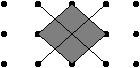
The First Brillouin Zone is like the real space lattice where every reciprocal lattice unit cell is equivalent. Often it is convenient to present all the information in just one reciprocal lattice unit cell. A popular choice is the First Brillouin Zone, a Wigner-Seitz cell of the reciprocal lattice
Figure 4.1 - First Brillouin Zone (Primitive Unit Cell of The Reciprocal Lattice)
4.3 The Ewald Construction
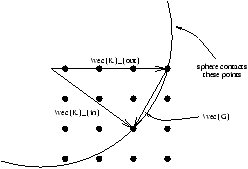
The Ewald Construction is a clear and beautiful way of deciding whether diffraction is possible. We remember that |Kin|=|Kout| which is true for elastic scattering. So we deduce that
Kin-Kout=G
we draw Kin ending on a reciprocal lattice point, a sphere centred at the beginning of Kin (radius |Kin| ).