
A Porter Family History

We may credit the Romans with originating our modern system of names; but we may equally blame the demise of this intelligent practice on the Barbarians who swept across Western Europe between the 3rd & 4th centuries A.D. During the Dark Ages (following the Fall of Rome) most Europeans were known only by their given name and later occasionally by their given name prefixed to their place of birth. ( i.e. Robert of Locksley )
 The advent of the 11th century, however, saw the cultural, social & economic conditions in Europe grow more complex. Populations increased dramatically; the rise of feudalism and the early stirrings of mercantalism supplanted the simple communal life of the country village. All these developments forced people into ever-growing towns and cities. Communications, the handmaid of commerce, became more efficient. Under such conditions, the use of a single name caused increasing confusion; and soon, the hereditary surname (a last name, bequeathed to each generation in the same or similar form) found great acceptance. Perhaps the most notable instance of this development was the introduction of feudalism into England with the Norman Conquest of 1066. Within the space of three generations, the French worked an almost total transformation of English culture. In particular, the Anglo-Saxon & Celtic language was merged and in some cases was replaced by the native tongue of the Norman rulers. In the course of time other modifications followed and hereditary surnames achieved a clearly defined order previously unknown. Beginning in the 17th century this system was transferred virtually intact to the American colonies. The Porter family is an ancient English group descended from William de la Grande who came with William The Conqueror to England and acquired lands near Kenilworth & Warwickshire. Ralph or Roger LaGrande was "Keeper of The Doors" or "Grand Porteur" at the court of Henry I.
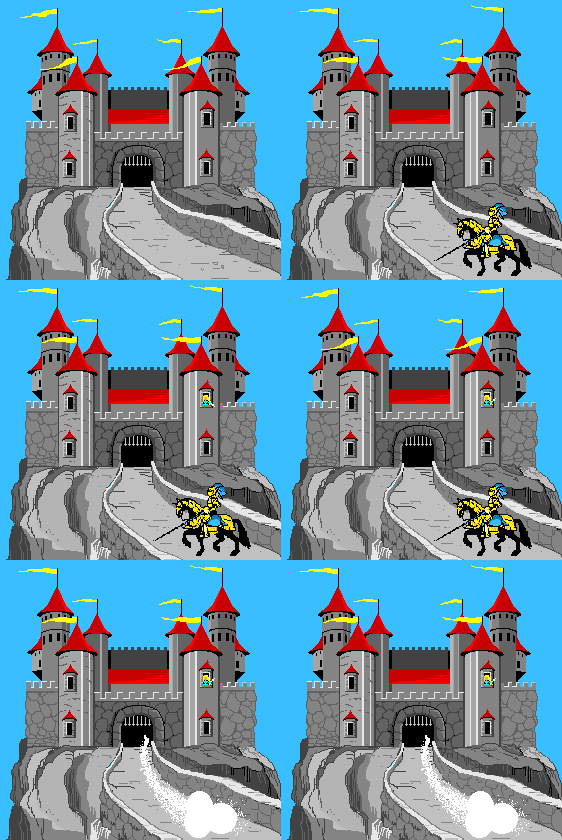 The surname Porter is a good example of this evolutionary nature of names. The French word "potier" (from the Latin Porta, "City Gate") means "Gate-Keeper" or "Carrier". The first Porter ancestors of feudal times were gatekeepers & castle retainers who guarded the castle gate & supervised the passage of goods into and out of the castle. A great many family names originated this way from the profession of manor servants.
 Porters were numerous in Cambridgeshire, Hants & Norfolk in the year 1273; therefore it can be assumed that the family predates the mid 13th century. The Porters of England today are most common in the counties of Somerset, Oxfordshire, Leicestershire, Rutlandshire, Essex, Norfolk & the southern part of Lancashire.
Porters were recorded frequently on the Norman tax rolls. A Francis LaPorte, recorded in the tax census of Henry III (1216-1272) is the earliest known ancestor of the family. A Robert & a Richard LePorte are recorded during the reign of Edward I (1272-1307). A man named Endymoin Porter was groom of the royal bedchamber of king Charles I (1625-1649). Many Porters immigrated to America. The 1790 census indicated that there were 587 Porter families living in the colonies. They were primarily concentrated in Connecticut (123), Massachusetts (116), Pennsylvania (87), Maryland (60), North Carolina (44) & Virginia (35). The remaining were scattered throughout five other colonies.
(Ref: "The Porter Family" by American Genealogical Institute (AGRI), Arlington, VA (1973) Pages 1-3)

PORTER HERALDRY

Return To Home Page