
Porter Family Website | home
Introduction | A Porter Family History | PORTER HERALDRY | Ancestral Connections | Related Links | Porter Genealogy | Contact Us

PORTER HERALDRY

 Heraldry, the study of armorial bearings, is an adjunct to the study of family history. Coat armor was completely unknown in Europe before the 12th century & did not appear in England until about 1250 A.D. Its sudden rise has been ascribed to several varied events, including the First Crusade (1097); the advent of body armor; and the growing use of seals on personal documents. The early development of the use of heraldic devises followed closely upon the need for better family identification & the trend became widespread. First embellished on shields & other pieces of armor, the imaginative, elaborate heraldic designs soon were including 'bends' (diagonal stripes); 'fesses' (horizontal stripes); 'chevrons' & 'crosses' were chosen because they were conspicuous even in the chaos of bloody battle. For the same reason bright colors were used. Charges, or representations of animals & natural objects did not become popular until the 2nd half of the 12th century, when, as stated above, the use of surnames was revived.
PORTER FAMILY COAT OF ARMS
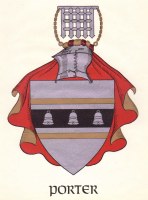
ARMS: Argent, on a fess sable between 2 barrulets or, 3 bells of the first. (on a silver field, between two golden bars; a larger black bar set with 3 bells)
CREST: A portcullis argent chained or. (A silver gate-fortification of a castle; adorned with a gold chain)
MOTTO: Vigilantia et Virtute. (Vigilence & Valor)
The bells that appear as the principle charges on the emblazon were the bells of a castle. As the PORTER of a castle, our ancestors had the responsibility to sound the alarm should anyone try to force their way past the fortified gate into the castle keep, or courtyard. The bell & the fortified gate both are naturally prominent in the PORTER arms.
The emblazon displayed here represents the Coat of Arms brought to New England in 1635 by RICHARD PORTER of Weymouth, England.
 With the advent of gunpowder in the 14th & 15th centuries, and the concomitant decline of armor as an essential in warfare, the need for armorial bearings also declined. By then, though, coats-of-arms were cherished for their decorative effect, and family crests were handed down from proud sire to aspiring son. The ancient art was debased, however, by the frenzied efforts of many people to coin their own armorial bearings and adorn them with embellishments & devices of doubtful historical significance.
Central authorities were established to inquire into the validity of the new creations. Their work was generally ineffectual in maintaining the simplicity and purity of the earlier designs. However, thorough records have subsequently proved very useful to the genealogical researcher. These records, showing hereditary usage of certain symbols & devices, represent in many cases the only means of unraveling the complex familial relationships of medieval Europe.
In the United States, democratic tradition has mitigated interest in holding & preserving official armorial bearings. However, there is nevertheless a great informal interest in the science of heraldry. The question of rightful ownership of coat armor does not pertain to
this country, for the very nature of the settlement and development of America makes it unlikely that any more than
a few families have legitimate claim to specific insignia. heraldry is instead highly regarded for its aesthetic & historical qualities - for the symbols, devices, and colors generally associated with any particular surname tell a story of our ancestors. There approximately 39 coats-of-arms registered to the PORTER families of Great Britian & Ireland. [Ref: "The Porter Family" by AGRI (1973) Pages 5-7]


ANCESTRAL CONNECTIONS
