
North Sydney is the town where I was born and raised
and I have lived here most of my life. It is a small town located
on Cape Breton Island, Nova Scotia, Canada.
The Micmac were the original native people who
lived here for centuries. The Atlantic Ocean brought European fishermen
to the northern arm of Sydney Harbour as early as the fifteenth century,
but it was the expulsion of the loyalists following the American Revolution,
that sent the first settlers to what was to be known as the Upper North
Sydney. In 1785, three ship loads of loyalists arrived in Sydney.
Two of the new Cape Bretoners decided to settle in Upper North Sydney.
They were latter followed by other settlers receiving land grants.
The village grew due to its location along one of the best harbours in
eastern Canada. A coal shipping pier was built in the town in 1834,
and the town began to ship coal that was extracted from the coal mine at
Sydney Mines. The town became prosperous as a major port and on April
24, 1885, North Sydney was the first town in Cape Breton to have been incorporated.
Shipping and shipbuilding also prospered through the mid 19th century.
Local firms broadened their marine activities to include sealing, deep-sea
fishing and international trade. Until as recent as 1993, the town
was well known for its fish processing plants. With the downturn
in the fisheries, the groundfish plants were closed while only a single
clam operation, owned by Clearwater, still survives.
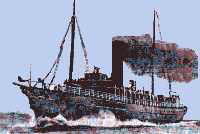
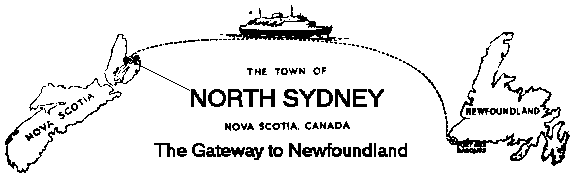
North Sydney was established as the terminus of
a ferry service between Newfoundland and Canada in 1898, a function now
maintained by CN Marine (now called Marine Atlantic), which is still one
of our town's major employers. The first North Sydney-Newfoundland ferry
was the SS BRUCE, shown at left.
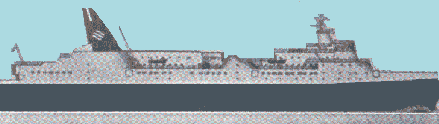
Presently, large ferries, like the SS CARIBOU II
shown to the right, are used to cross back and forth between Newfoundland
and North Sydney.
We also have the Northside Industrial Park which
is jointly operated by the towns of North Sydney and Sydney Mines.
The first industry to locate here was Magna International Ltd., which is
still in operation. The town recently lost its individuality
and has become part of the Cape Breton Regional Municipality. The
town's population is around 7,500 people but due to high unemployment and
an uncertain economy in our area, many of our young people have moved away
to find employment and a better future. Both of my sons and many
other relatives and friends have recently left our town. As with
most of the industrial area of Cape Breton, our town's future survival
is unknown and we can only hope for the best. After all, we are Cape
Bretoners and will always be Cape Bretoners no matter where we live.