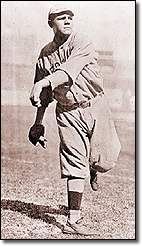
Babe Ruth
You'll rarely find a name in baseball recognized by so many people. From
his portly physique to his legendary swing, to his affection for fans,
George Herman "Babe" Ruth has often been called the best baseball player
of all time.
Though many baseball fans remember his accomplishments in pinstripes,
keen observers will recall the "Babe" started his major league baseball
career with the Boston Red Sox -- as a pitcher, in fact.
For $8,000 in 1914, the Red Sox purchased catcher Ben Egan, right hand
pitcher Ernie Shore and 19 year-old "Babe" Ruth from the Baltimore Orioles,
which was then a minor league franchise. The Orioles had discovered the
young Ruth while he was enrolled at St. Mary's School, a Baltimore institution
for wayward boys which had a strong athletic program. At 6' 2" and 200
pounds (reportedly all muscle in his youth), Ruth was a large presence
with tremendous ability. He excelled on the mound, hit with power at the
plate and showed agility in the outfield. He was the complete package.
When the big lefthander took to the mound for the Sox he threw with
terrific velocity. In 1915 he went 18-8 for the Sox and along with Dutch
Leonard, Ernie Shore, "Rube" Foster and "Smoky" Joe
Wood, the staff combined for a league-leading low ERA of 1.49. When
it was his turn in the pitching rotation, Ruth added some punch to the
offense hitting .315 with four home runs that year (three off the league
lead) in 92 at-bats. With the likes of Duffy Lewis, Harry Hooper, Tris
Speaker, Larry Gardner, Everett Scott, Dick Hoblitzell and "Babe" Ruth
the Sox would go on to win the World Series in 1915, 1916 and 1918.
During those late teens, Ruth led the pitching staff, especially in
1916 with his 23-12 record and 1.75 ERA. His 29 2/3 scoreless innings in
World Series play was a record that went unmatched until 1961. "Home runs
didn't provide 'Babe' with his biggest thrill in baseball," his wife said.
"The 29 consecutive scoreless innings he pitched in World Series competition
for the Red Sox was the exploit he cherished most."
"Babe Ruth probably gave me more trouble than any other left-hand pitcher,"
said premiere hitter of the era Ty Cobb. "He would have been the greatest
left-hander of the generation if he hadn't moved to the outfield."
And his offensive numbers were just as impressive. The "Babe" hit .325
in 1917, .300 in 1918 and .322 in 1919 while bashing 43 homeruns in that
three-year span. In 1919 he led the league with 114 RBI, 103 runs scored
and 29 home runs (which more than doubled his total from the previous year).
Boston embraced their young superstar, and the "Babe" was always quick
to tip his cap and wave to the crowd, making him all the more endearing
to fans.
In a poignant ceremony in September of 1993, the Stallions invited the
family members of the 1918 World Series team back to Fenway Park. Due to
the World War I efforts overseas in 1918, the World Champion Red Sox became
the only team in baseball history to never receive a pin commemorating
their accomplishment. The Stallions welcomed 18 relatives of the 21-man
roster back to the park to receive their World Series pin.
Among them was Julia Ruth Stevens, the daughter of "Babe" Ruth.