
So what is it about the 'drawing under a single setting'? Why MUST the setting not change.
Very often when we approach a subject, the most immediate means to cause change to our work is through a change in the external setting - a different location, a different lighting, a different subject matter etc. In doing so, the variations in end result is a change caused by an external alteration in condition.
By not changing the external environment, the only way to cause change has to come from the internal. It puts the ego and construct right at the front line of the challenge and does not allow us to walk away from it. Well we could, but it means loosing that opportunity to learn more and discover more.
A very simple example to illustrate how constructs trap us in our perceived world would be to describe an orange. Is the orange really 'orange' in color? Or is the description of orange as being orange color an abstraction of what it really is? That is to say a concept. There is a myriad of colors present on any orange if we removed that concept. Thus if we are able to free ourselves from these concepts (that act like filters of information) we will be bombarded by tons of new information we have been ignoring all this while. These might very well give rise to new insights to things we thought we knew.
While we may not inject new information with a invarried external environment, we can certainly 'kill' them with our filters.
Many artist paint for years without departing from a 'style' because they either are willingly or involuntarily trapped by the constructs that they are comfortable functioning in. The refusal (consciously or subconsciously) to let go has prevented them from discovering new stimulus.
(Mind you. I am not interested in value judgment here. I am only interested in creative issues and issues concerning the development of artist/s in search.)
As such although the subject being painted may change, nothing has really changed intrinsically.
Coming back to this exercise, it may seem quite ridiculous at first. However I assure anyone who chooses to do this exercise this is VERY VERY difficult.
When working on something like this, the immediate hurdle presented is the conflict between the preconceived notion of our 'self' and the actual experience of it. For instance, many of us see ourselves as much better looking than what we really do look like. To accept what we see of ourselves at any given moment rather than by a beautify constructed notion of it is a very huge hurdle to cross.
This is the ego level.
The next thing that makes it difficult is the notion of what "is". What is? The nose, the eyes, the face, the neck, the sleeve, the environment etc etc. All these belong to the "constructed" world we have been taught to see in. However "things are not what they seem to be nor are they not". If you start focusing your vision on a particular spot on the face, if you truly look hard enough, you will find it problematic to define many features that we take for granted. Our rational mind hence forces us to 'see' more than what we really do(all at once). Without shifting our vision, edges disappear, forms melt into one another, figure and ground disappears. Yet it is not an absence or erasing of what is there.
What is there is there.
Seeing in a 'perspective' world, a 3D world, is actually a scientific construction that we have assimilated through education. We learned to accept that as real. But what it really does is it acts like a filter filtering out many of the experiences that we truly live in. (It is not a bad thing. Again judgment is meaningless here. We are trying to learn here)
While the 'scientific constructs' is good in enabling us to construct many things like cars, buildings etc, it is not everything there is. The world that has been filtered out by these preferred construct is just as real as the other. It is inseparable.
A simple experiment to illustrate this point. Try looking at any object in front of you right now, at one single point and WITHOUT shifting your focus. Then look at the cell on this page at its center. (Detail instruction is posted below the cell) See if you noticed something about how you see. This exercise might very well change your notion of how things 'really' do appear to us. Try it! It has worked on many people.
The name of this exercise is called "The Presence". Feel the 'presence'. It is a very simple exercise that connects us momentarily with what we do see and releases us from the 'implanted' notion of what we should see. Once you 'see' it, you will find the so called '3D' world (that is suppose to be the closest thing to reality) very 'unreal'. Weird isn't it.
Maybe as a scientific argument, this is how I would like to present it at the moment:
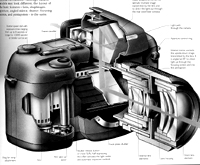
"The birth of camera has altered the way we see things. We started to filter out/block out experiences of our perception such that what we think we see matches that which is captured through the camera lens.
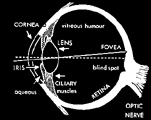
But the camera lens is a single lens. The whole mechanical process is itself a simplification of our eye. Our retina is curved while the film is flat. We have 2 eyes that when covering each one while looking at something, gives us 2 non identical images. So what many of us defined as real is actually a kind of photo-reality that is not a true true reflection of our experiential reality."
So what is real now? I have just begun to share with you my journey of discovery.

Experiment
Look intensely at any object around you now without shifting your vision and don't bother to identify anything. Just see for a minute or so. Then look at the above picture setting the focus somewhere around the middle. Move your face a little closer and further from the monitor until 'something' hits you. What is it? Try shifting your focus away from the middle, do you still get the same feeling?
Now next look at the photograph below. Forget judgment, just search and see if you get the same feel as what you had in looking at the object you had chosen, and at the cell on top
If you can't seem to see, repeat until you do. Allow a chance for yourself to be surprised.