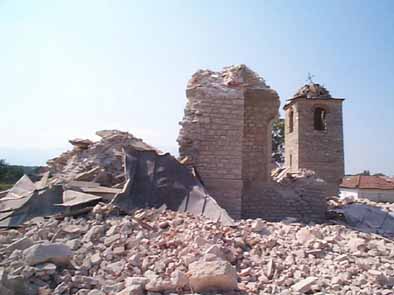
Serbian church destroyed from KLA terrorists, thanks to KFOR who protects all these places and catches all the criminals
THE MONTREAL GAZETTE, Sunday, February 27, 2000
MARK ABLEY
The Gazette
The Orthodox Church of St. Nicholas,
in the Kosovo village Banjska, was probably not an international
treasure.
As far as we know, it was just a modest house
of God in an area dotted
with the same.
But no one may ever be sure. On Jan. 30, 11 kilograms
of explosives
were detonated at the altar, leaving much of
the building in ruins.
The explosion forms part of a sad and continuing
pattern. Since a wary
peace took shape in Kosovo in June 1999,
nearly 80 of its Orthodox
churches and monasteries are known to have
suffered heavy damage or
destruction. The total may be higher, given
that a lot of churches are
located in remote areas where few, if any,
Serbs still live.
These attacks did not occur during the
North Atlantic Treaty Organization's bombing campaign
last spring. They have happened since the
return of Kosovo's Albanian
majority. Extremists,
usually assumed to be linked to the Kosovo
Liberation Army, have carried out a systematic
campaign of destruction
under the eyes of international peacekeepers.
The unanswered question is why this devastation
has caused so little outcry. British and French media have paid some attention
to the attacks; but the North American media have carried few reports.
Dozens of non-profit groups are now working in Kosovo; they have
said next to nothing. "The Western world is rather fed up with the Balkans,"
suggested Colin Kaiser, chief of the unit for southeast Europe and the
Arab states in
UNESCO's Division of Cultural Heritage.
"The wars, first in Croatia,
then in Bosnia and most recently in Kosovo, became
more and more intense in
terms of damage. But the cumulative effect has
been that the Western sensibility to it all has been dulled."
True enough. But beyond that, it also seems
true that after the wars
of the past decade, few Westerners dare to sympathize
with anything Serbian.
Last September, Bishop Artemije, the head of
the Orthodox diocese of Raska and Prizren, charged that while the first
aim of the Kosovo Albanians "is to expel all Serbs, the second is to eradicate
all traces and witnesses that could serve as evidence that the Serbs have
existed at all.
"But who and what are the witnesses? Churches,
monasteries and holy places. So they set out to
destroy the witnesses, to obliterate the
traces. In 21/2 months more than 70 monasteries and churches were burned
or demolished. Among them were the churches built by our illustrious and
holy ancestors in the 12th, 13th and 14th centuries. The churches and monasteries,
which survived 500 years of Turkish occupation, did not endure two months
in the presence of a 50,000-strong international 'peacekeeping' force."
Peacekeeping troops from the United Arab
Emirates, serving in the United Nations' multinational KFOR mission, had
been stationed near the Church of St. Nicholas. But in late January they
withdrew, leaving the church unprotected. It was soon blown to pieces.
The presence of the UN soldiers has slowed
the rate of destruction in
recent months, but foreign troops can provide
no guarantee of safety.
On Jan. 14, for instance, the Church of St. Elias,
in a village called
Cernica, was partly destroyed by explosives.
It stood just 70 metres from a checkpoint of U.S. soldiers. Almost everyone
would agree that the destruction of St. Elias's and St. Nicholas's churches
is regrettable. But what has so far escaped much notice, particularly in
North America, is that dozens of the earlier
victims were not just Serbian village churches,
but buildings of great
beauty and historical significance. Among
them:
- The Church of the Holy Virgin in Musutiste,
built in 1315. Frescoes
painted in the following years were among
the finest examples of medieval
wall-painting in the entire region. The
church was looted, burned and mined by explosives.
- The Church of St. Nicholas in Prizren,
which is said to date to 1348 or
earlier, and which contained medieval icons.
Five explosives went off, causing extensive damage.
- The Monastery of the Holy Trinity near
Musutiste, built from 1465 on. It
held a unique library of manuscripts as well
as a collection of recent
icons. The monastery was first plundered,
then burned and finally leveled with explosives.
- The Monastery of the Holy Archangels in
Gornje Nerodimjle, built in the
14th century, renewed and extended in 1700.
The monastery was looted
and burned; a great pine tree, said to date from
1336, was chopped down and burned; the cemetery was desecrated.
The stories go on and on. The pattern is
undeniable - and for once, no one
is even trying to claim that Yugoslavia's
notorious president, Slobodan Milosevic, is behind it.
So far, thanks to a 24-hour guard by foreign
soldiers, the greatest of all
treasures in the region - the monastic
churches of Gracanica and Decani -
have survived. Writers have waxed eloquent
about them for generations;
Rebecca West, for one, called Gracanica
"as religious a building as
Chartres Cathedral. The thought and feeling
behind it were as complex.
There is in these frescoes, as in the parent works of Byzantium, the height of accomplishment."
Some of the buildings were jewels of European
civilization. Now they are rubble.
Throughout the Balkans, politics and art, history
and myth, oppression
and religion are intertwined. The ruined Orthodox
buildings of Kosovo were
not only centres of worship and art; they were
political symbols.
Since the mid-1980s, writes Michael Sells,
professor of comparative
religion at Haverford College in Pennsylvania,
"Serb nationalists have manipulated concern
for the (Kosovo) shrines to motivate, justify
and implement 'ethnic
cleansing' and annihilation of centuries of non-Serb
artistic and religious monuments.
"In exploiting Serbian monasteries and
the heritage they represented
to foment hate and violence, they desecrated
a great Serbian heritage that deserves better."
It must also be said that if the KLA is behind
the devastation, it's
following a path already trod by Serbs themselves.
In Sarajevo, Banja Luka and other Bosnian cities, the
Serbs blew up historic mosques and Islamic shrines,
as well as burning the Oriental
Institute and the National Library.
Moreover, between March and June last year,
while NATO was bombing
Serbia and hundreds of thousands of Albanian-speaking
Kosovars were seeking foreign refuge, many buildings in Kosovo were subject
to deliberate Serbian attack.
The main targets, however, do not seem to have
been mosques. Serbian forces aimed most of
their destruction at Albanian houses and marketplaces.
Now the Serbs are reaping the whirlwind.
Since the Kosovars poured
back into their ravaged homeland, any buildings
where Serbs lived or prayed
have been vulnerable - even if they were homes
built in Ottoman style during the long centuries of Turkish rule.
Another of the recently damaged buildings is
the Kosovo Battle
Memorial, built on the famous battleground of
1389. That losing fight against
the invading Turks became a cornerstone of Serbian
memory and folk
history. It also became a useful symbol for Milosevic
when he wanted to stir up nationalist fervour in the 1980s.
In recent months, the Yugoslav government
has bitterly protested
against the desecration of Orthodox buildings
in Kosovo. But the protests have fallen on deaf ears.
"I don't know how many times we have said
this already," complained
Ljiljana Milojevic Borovcanin, first counselor
at the Yugoslav embassy in Ottawa. "We have
raised the issue at the United Nations and also
bilaterally, with the countries participating in KFOR."
Those countries include Canada. About 1,450 Canadian
troops are now in
Kosovo, serving mostly in the central and
northern areas alongside soldiers from Britain, Finland, Norway, Sweden
and the Czech Republic. The international community has a lot at stake
in the
peacekeepers' success. Under KFOR, Kosovo
has been divided into five sectors, each run by a NATO-led brigade. The
peacekeeping force is made up of 42,500 soldiers from 28 countries, in
addition to a further 7,500 troops based
in neighbouring countries.
For each soldier in the KFOR mission, only about
two Serbs remain in Kosovo.
Borovcanin says she has spoken to Canadian
officials about the continuing
destruction of Orthodox churches, "and
the response was always diplomatic. The Canadian
government says it regrets all the damage,
but at no time will it take any action.
"Yet it's the non-implementation of the
UN resolution that has enabled this barbarism to occur."
She was alluding to Security Council Resolution
1244. Under its terms,
the mandate of the KFOR troops involves "demilitarizing
the Kosovo
Liberation Army (KLA) and other armed Kosovo
Albanian groups - establishing a
secure environment in which refugees and displaced
persons can return home in
safety - (and) ensuring public safety and
order."
UNESCO has been in touch with KFOR leaders,
Kaiser told The Gazette.
"We provided them with lists of heritage
sites that were much longer than what
they could actually handle. We were told
that they have many responsibilities,
and can't possibly station soldiers in front
of every monastery."
Speaking from Pristina last week, KFOR
spokesman Lt.-Commander Philip Anido said that "KFOR and its soldiers have
static guards on the sites
that are active. Some of the churches are
guarded by moving patrols,
and it's up to the brigade commander to decide
on the level of sensitivity
and the level of risk."
About 800,000 Albanian refugees are thought
to have fled Kosovo before
and during the war last spring. Perhaps it's
not surprising that Canada –
a full participant in the NATO bombing campaign
- should be reluctant to
speak out publicly against the Kosovo Albanians
whom it spent so much time, effort and money in helping.
Canada even contributed $200,000 to help pay
for a cultural festival
in Kosovo last September. On hand along with
international stars like
Mikhail Baryshnikov, Meryl Streep and Elton John
was the Cape Breton choir Men
of the Deeps, flown in to sing coal-mining songs.
"Canada is helping rebuild Kosovo," Foreign
Affairs Minister Lloyd
Axworthy said at the time.
"That rebuilding effort must not only focus
on bricks and mortar; we must also help rebuild the human spirit."
But as elements of the KLA were quick to
realize, the best way to
crush the spirit of Kosovo's remaining Serbs
was to destroy significant
chunks of their bricks and mortar. The day after
the cultural festival ended,
the 14th-century church of Saints Cosma and Damian
in the village of Zociste
was razed. The church was noted for its frescoes
of Old Testament prophets.
On the same day, near the town of Vitina,
the remnants of the
14th-century monastery of the Holy
Archangel Gabriel were destroyed by explosives.
The monastery had already been looted and burned.
So much for the human spirit.
What is surprising, if not downright shocking,
is that the destruction of
churches and monasteries in Kosovo has
aroused so little attention
from international groups that are supposedly
dedicated to the preservation of cultural treasures.
To an outsider, it looks very much as though
the ancient buildings and
artworks are somehow tainted by their association
with present-day Serbia.
When it comes to the monasteries and churches
of Kosovo, silence has become an unofficial policy.
Consider the following:
- The World Monuments Fund (a private, non-profit
group based in New York and
funded extensively by American Express)
placed no Kosovo buildings on its recent list of
the
100 most endangered sites around the world.
- The fund has given money for architectural
restoration and preservation to 165 projects in 51
countries - not including Kosovo. Its Web
site includes no mention of Kosovo, and a request for an interview with
its president, Bonnie
Burnham, was turned down.
- If you believe the Web site of the International
Centre for the
Study of
the Preservation and Restoration of Cultural
Property, this awkwardly named group is a "catalyst for action." But it
has remained silentabout
the dangers to cultural property in Kosovo. An
E-mail asking for an explanation went unanswered.
- At UNESCO's headquarters in Paris last July,
a six-day official
meeting took place under the auspices of
the Convention Concerning the Protection of the World
Cultural and Natural Heritage Member nations
debated the threats to heritage sites in no fewer than
55 countries, including
Canada (a proposed open-pit mine near Jasper
National Park came under scrutiny); but Kosovo received only a brief general
mention.
UNESCO did sponsor two missions of inquiry to
Kosovo in July and November. Yet Colin Kaiser, who
led one of them, admitted that "UNESCO
is not tooled to work quickly
for emergencies." Part of the problem, he said,
is that proper documentation is not available for
Kosovo. The agency intends to resume work there
in co-operation with a Swedish
group called Cultural Heritage Without Borders.
"But we can't become involved in saying who did
what," Kaiser
emphasized. "UNESCO cannot take sides."
- Last April, at the height of the war
in Kosovo, a statement went out
from the International Committee of the
Blue Shield (a joint endeavour
that unites librarians, archivists, museum
curators and preservation officials). The statement expressed a generalized
"concern about all
damage to the cultural heritage of the
peoples of Yugoslavia." Once
the war was over, the Blue Shield Committee had
nothing more to say.
Last week, Manus Brinkman, the secretary-general
of the International
Council of Museums, told The Gazette that
"ICBS has not issued any new
appeals, because the first one is still
as valuable as ever."
Asked about the response to the April statement,
Brinkman said that "there have
been a lot of positive reactions and the
appeal invoked much discussion. Sadly
enough, there was no reaction from the parties
involved in the fighting in Kosovo,
neither from the official Serbian or Albanian
side, nor from NATO."
- Canada is one of many nations represented
on ICOMOS, the International
Council on Monuments and Sites, whose aim
is "the conservation of the world's historic
monuments and sites." The Web site of ICOMOS
Canada includes statements from 1997 onward. None mentions Kosovo.
The Canadian group's administrative secretary,
Victoria Angel, said
that ICOMOS Greece has tried to raise awareness
about the cultural monuments in
Kosovo. But Greece was not one of the NATO
members that bombed Yugoslavia;
and anyway, a little-known non-profit group
based in Athens can scarcely
be expected to kindle public attention
in other countries.
"North America is still stuck with the
message that there's a good guy
and a bad guy in Kosovo," said Dinu Bumbaru,
the head of Heritage Montreal
and a vice-president of ICOMOS Canada. "And what
the good guy does at the
end of the movie is fine with us."
Bumbaru noted that while a great deal of
information is available
about the Kosovo destruction, especially on the
Internet, "there's no
communications campaign. Frankly I just wonder
if, in the West, this
is of interest."
In 1992, following Yugoslavian attacks
on the magnificent Croatian
city Dubrovnik during a previous Balkan war,
Bumbaru led a UNESCO-sponsored
mission to assess the damage. International
funds were provided to
help Croatia, and Dubrovnik has largely been
rebuilt.
But Croatia was widely seen as a victim,
so, in the case of Dubrovnik, it
was politically easy for other countries
to do the right thing.
The Serbs, on the other hand, were widely
seen as aggressors. Now they're
outnumbered in Kosovo nearly 20 to 1; and in
Kaiser's words, "the problem is that
ultimately, the defence of anything depends upon
local people.
"Ideally, both Albanians and Serbs in Kosovo
will realize that the
loss of the monasteries and churches, like the
loss of the mosques and Ottoman
houses, will impoverish the whole area."
But that's a remote ideal. In the meantime,
there appears to be no political will outside Kosovo
to stand up for an Orthodox heritage so
fraught with beauty, so redolent of pain.
Reporter Mark Abley can be reached at (514) 987-2555 or by E-mail at
Tue, 2 May 2000 21:59:17 -0500
"T.V. Weber & Alida Weber"
<[email protected]>
Last November, Serbian Orthodox Bishop Artemije delivered the monograph
"CRUCIFIED KOSOVO" in person to Bill Clinton. This monograph contains
photos
of about 70 churches and monasteries destroyed after the arrival of
KFOR
in
Kosovo. Kosovo Serb representative Radmila Trajkovic remarked that
this
"monograph had totally infuriated American President [Clinton], who
had
asked Albanians after he had seen the photos: 'If America provides
the
money
for renovation of these churches, and surely it will, do you intend
to
destroy them again?'" (See message entitled "NEW: MONOGRAPH "CRUCIFIED
KOSOVO" ON THE INTERNET," at
http://www.egroups.com/message/decani/28020?&start=28012)
We are exceedingly skeptical about the genuineness of Bill Clinton's
concern
about the destruction of Orthodox Christian churches in Kosovo, since,
after
all, his own NATO bombers had destroyed Orthodox churches, cemeteries,
and
memorial complexes themselves during the bombing phase of the Kosovo
War.
Be that as it may, Clinton's question about whether Albanian terrorists
plan
to continue destroying churches is easy to answer. Attacks upon Serbian
Orthodox churches, as well as Serbian cemeteries, proceed apace. (See
“Albanians attack Serb churchgoers as UN mission visits” in the Toronto
Star,
http://www.thestar.com/editorial/updates/intlnews/200004290_UN-KOSOVO.html.
Also see “Desecrated Serbian cemetery in Ajvalija,” April 28, 2000,
http://www.serbia-info.com/news/2000-04/28/18641.html.)
And it isn't just a matter of destroying the churches; the attackers
want to
kill the worshippers as well. A recent story from the Serbia-Info
website,
available at
http://www.serbia-info.com/cgi-bin/printpage?filename=/news/2000-04/28/18635
.html, is entitled "Albanian terrorists blew up Serbian church in
Grncar"
(April 28,2000). The church in Grncar was blown up by a time bomb at
7:45
A.M. on Orthodox Good Friday. A Bible-reading service was planned to
be
held
in the church that morning, and the time bomb was set to go off then.
According to the story, the church was "crashed to the ground" and
parishoners were spared serious injury or death only because the
services
were delayed when the priest's car had broken down.
The Serbia-Info website does not go so far as to suggest that this car
breakdown might perhaps have been divine intervention; however, it
did
not
rule out the possibility, and we certainly do not.
T. V. Weber
&
Alida M. Weber, nee Jatich
===============================================
Albanian terrorists blew up Serbian
church in Grncar
April 28, 2000
One of hundred demolished churches in Kosovo
Kosovska Vitina, April 28th 2000 (Tanjug) - Albanian terrorists blew
up
"St. Petka" church by a time bomb in village Grncar in Kosovska Vitina
district, this morning around 7.45 a.m., on the day of Good Friday,
radio amateurs
from Kosmet reported.
The church, which is at the border of the village, was crashed to the
ground.
"St. Petka" church is in the region controlled by the American KFOR
troops,
whose main purpose should be protection of Serbs and their property.
Albanian terrorists set bomb during the night and arranged it to explode
around 8 a.m., at the time when on Good Friday, the day of Christ's
suffering, chapters from the Bible were read at the church.
This confirms that their intention was not only to demolish the church,
but
also to hurt Serbs, the believers, great number of which was expected
in
today's mass. Victims were avoided as the mass was late because the
priest's
car broke down.
The way in which the explosive was set up shows that it was done by
Albanian
terrorists from the orders of so-called "KLA", trained in NATO camps
in
Albania and Germany.
===============================================
The Voice of Kosovo and Metohia
Media and publishing center of Raska/Prizren Orthodox Diocese
URL: http://www.kosovo.com, mail: [email protected]
NEW: MONOGRAPH "CRUCIFIED KOSOVO" ON THE INTERNET
Internet edition of the book "Crucified Kosovo - Destroyed and
desecrated Serbian Orthodox churches in Kosovo and Metohia (1999-2000)"
was published on April 19th, 2000, at Kosovo.com, one of the central
world web-sites concerning Kosovo. URL:
http://www.kosovo.com/crucified/default.htm
The producers of this Internet edition are "Voice of Kosovo and
Metohija" [Media-publishing center of The Raska and Prizren Orthodox
Diocese] and Belgrade publishing house "TIA Janus" in the behalf of
Serb
National Forum of Kosovo and Metohija. Printed version appeared in two
Serbian-English editions, September and November 2000, and provoked
lot
of polemics in the global public opinion which could be seen also by
reaction of US President, Bill Clinton, during his visit to Kosovo
and
Metohia on November 24, 1999. (see appendix)
The "Crucified Kosovo" electronic edition has been expected for months,
because of numerous data and hundreds of photos from the ground
documenting systematic uprooting of Christianity achieved by Albanian
terrorists in the presence of KFOR.
CONTENTS AND AUTHORS
76 destroyed and desecrated temples are catalogued in the book. Their
history, significance, destiny caused by Albanian extremists are
presented by photos from the ground taken with huge risk during the
second half of 1999 by Serb clergy, like Bishop Atanasije Jevtic and
Father Sava Janjic, and our renown photographers and experts as well:
Ljubisa Folic, Milinko Stefanovic, Imre Sabo, Zivota Ciric, Goran
Veljkovic...
Texts of Serb Patriarch Pavle, Metropolitan Amfilohije, Bishop Artemije
and Father Sava Janjic are also included in the book. Ljubisa Folic,
professor of the University of Pristina and our recognized architect
wrote the preface about background and values of Kosovo inheritance,
and
destroyed churches as well. The author of concept and methodology is
Zoran Stefanovic, the editor-in-chief who cooordinated a numerous team
that professionally realized and produced this important monograph,
within the center "Voice of Kosovo and Metohija" and "TIA Janus"
company.
The same team is realizing web site Kosovo.com (http://www.kosovo.com)
with daily information and analyses of Kosovo crisis and events in
the
region.
THE WORLDWIDE DISTRIBUTION AND FUTURE TRANSLATIONS
"Crucified Kosovo" has been distributed all over the world in about
50.000 copies so far and is being just translated in French, German,
Italian, Russian, Greek and Albanian. In Yugoslavia it is distributed
in
Belgrade's "Trojerucica" bookstore and bookstore of Serb Orthodox Church
Patriarchate.
ROMANIAN EDITION
Romanian publisher "Scara" integrally published "Crucified Kosovo" on
December, 1999, in the book "Destroying of Orthodoxy: Yugoslavia
1991-2000" together with detailed book of Slobodan Mileusnic, director
of the Museum of Serb Orthodox Church, about the latest suffering of
Serb Church in former Yugoslavia. Translator into Romanian language
is
young theologian and editor from Bucharest, Ionut Gorgu.
THE MOVIE "CRUCIFIED KOSOVO"
In March 2000, the movie "Crucified Kosovo" appeared on the Internet,
testifying in two parts on destiny of Serb Christianity before and
after
the arrival on international forces. (http://www.decani.yunet.com,
http://www.spc.org.yu, http://www.kosovo.com).
APRIL-MAY 2000: NEW ELECTRONIC EDITIONS
Electronic edition of "Crucified Kosovo, in Serbian and other languages,
will also be published soon in the regional centers of Internet library
of Serb culture "Rastko Project" (http://www.rastko.org.yu),
Belgrade
and Timisoara.
APPENDIX: CLINTON AND "CRUCIFIED KOSOVO"
CLINTON INFURIATED BY "CRUCIFIED KOSOVO"
Srna - The Republic of Srpska News Agency, Belgrade, November 24, 1999.
Serb representatives from Kosovo and Metohija, Momcilo Trajkovic, Bishop
Artemije and Hieromonk Sava, insisted on destiny of 400 kidnapped and
vanished Serbs, during the meeting with Clinton, said Radmila Trajkovic,
a member of Serb National Forum (SNF) of Kosovo and Metohija. "Serb
representatives also insisted on stop killing Serbs and burning Serb
homes and properties as well as on returning of the Kosovo and Metohija
expelled Serbs ", added Radmila Trajkovic for Srna.
According to her, Bishop Artemije presented to Clinton the monograph
"CRUCIFIED KOSOVO" with photos of about 70 churches and monasteries
destroyed after the arrival of KFOR. Trajkovic pointed out that this
"monograph had totally infuriated American President, who had asked
Albanians after he had seen the photos: 'If America provides the money
for renovation of these churches, and surely it will, do you intend
to
destroy them again?', quoted Trajkovic and added that some participating
Albanians had qualified them as 'political churches'. She also added
that Clinton had firmly stated that burning and destroying of churches
had to be terminated.
ALBANIANS' SILENCE BEFORE CLINTON
Glas Javnosti Daily, Belgrade, November 24, 1999.
President of The Executive Council of The Serb National Forum, Momcilo
Trajkovic stated for Glas Javnosti Daily, after the meeting with
Clinton, that American President had listened carefully to Serbs'
representatives and had criticised Albanians.
"After he had listened our accusations on Albanians' account, he learned
about the letter of Bishop of The Raska and Prizren, Artemije, and
leafed through the monograph 'Crucified Kosovo', Clinton asked Albanian
representatives what should happened if he provided funds for renovation
of the destroyed Serb churches. 'Do you intend to destroy them too?'
Clinton had asked Albanians, to which Rugova responded that those were
the churches erected during Milosevic's reign. The Bishop then
documented that churches had been built in XI, XII, XIII and XIV
centuries. President Clinton had addressed Albanians again asking for
the answer on his former question, but they were silent. Then he added
they should have not talked what he had
expected to hear but what they meant", Trajkovic said.
Muslims in Kosovo Bomb Serb Orthodox Church on Good Friday
By: Mary Mostert, Analyst, Original Sources (www.originalsources.com)
ORIGINAL SOURCES, Monday, May 1, 2000
It was almost exactly 4 years ago, in June, 1996 that America was
"stirred to action" because of a rash of arson attacks on black churches
in the South. Although a least a couple of those churches turned out
to
be targeted by black people who were mad at the minister or the church
or had some other problem with its members, just the THOUGHT of minority
churches being burned to the ground, perhaps by the majority (whites)
in
the area was enough for bi-partisan House and Seant passed resolutions
condemning the church burnings.
Bill Clinton ordered the Justice Department to step up its investigation
and private groups raised funds to help rebuild churches victimized
by
the fires.
Applauding the quick action on the resolution, then House Speaker Newt
Gingrich (R-Ga.) said, "There is no place in America for hatred and
violence against fellow Americans."
Rep. J.C. Watts, a black Republican from Oklahoma, said at a news
conference, "It's important that we all work together. If you burn
a
church in Enid, Oklahoma, you are burning every church in America."
On June 11, the House Judiciary Committee voted unanimously to approve
the Church Arson Prevention act of 1996. The bill would give federal
law
enforcement agencies new powers to prosecute arsonists who set church
fires, lowering or eliminating threshold requirements for federal
involvement. Under the bill, federal authorities will be permitted
to
investigate any attack on a place of worship as a hate crime, even
where
there is minimal damage.
"The arson of a place of worship is repulsive to us as a society,"said
Rep. Henry Hyde (R-Ill.), co-sponsor of the bill and chairman of the
committee. "When a fire is motivated by racial hatred it is even more
reprehensible. In my view, there is no crime that should be more
vigilantly investigated and the perpetrators more vigorously prosecuted
than crimes of this type."
Clinton ordered increased federal efforts to investigate and bring an
end to the wave of church fires in the south, vowing "to do everything
in my power to get to the bottom of these church burnings as quickly
as
possible." More than 200 federal agents were working with local
authorities to investigate the fires.
Does that sound like that this nation really abhors those who would
burn
down the churches, or perhaps the homes, of a minority group and would
take some kind of immediate action to put an end to it?
Clinton said at the time, "It's hard to think of a more depraved act
of
violence than the destruction of a place of worship" and spoke of "vivid
and painful memories of black churches being burned in my own state
when
I was a child." However, Arkansas officials say there were no racially
motivated arson attacks on black churches in Arkansas during the civil
rights era - and leaders of three churches cited by the White House
said
that while they did have fires in their churches, none were arsons.
Even with his faulty memory, one would think that if any leader would
be
on top of the issue of the churches of a minority group being burned
and
the members of those churches harassed or killed it would be Bill
Clinton, wouldn't you? Well, he certainly doesn't seem to be.
Groups from the Jewish Anti-Defamation league to the National Council
of
Churches to Compassion International to the Southern Baptist Convention
to Habitat for Humanity marshaled their forces and their money to defend
a half dozen black Churches that burned in deference to America's
approximately 12% Black minority - or approximately 33 million blacks.
So, where are all the folks who, like Bill Clinton, believed torching
churches is a "depraved act of violence than the destruction of a place
of worship" during the past 10 months as 100 Serbian Orthodox Churches
were bombed and torched by Albanian Muslims in Kosovo? Some of those
churches were historic landmarks that were more than 500 years old.
The
agency that was supposed to be protecting "all people" of Kosovo
(according to the peace agreement and UN resolution 1244) is the United
Nations and NATO.
On Friday, April 28th, Serbian Orthodox Good Friday, a time bomb set
by
Albanian terrorists blew up "St Petka" Church in the Fillage of Grncar
in Dosovska Vitina district. exploded 30 minutes early -7:30 AM. It
had
been timed for 8:00 AM when the Albanian Muslim Terrorists expected
the
Church would be packed with Serbs.
The church, which is at the border of the village, crashed to the
ground. Because the Priest had car trouble, the worshippers, who would
have been hearing chapters from the Bible read on the day of Christ's
suffering, were not in the building.
"St. Petka" church is in the region controlled by the American KFOR
troops, whose main purpose should be protection of Serbs and their
property.
Albanian terrorists set bomb during the night and arranged it to explode
around 8 a.m., at the time when on Good Friday, the day of Christ's
suffering, chapters from the Bible were read at the church. "Victims
were avoided as the mass was late because the priest's car broke down,"
the report from Serbia-Info.com noted. "The way in which the explosive
was set up shows that it was done by Albanian terrorists from the orders
of so-called 'KLA', trained in NATO camps in Albania and Germany."
One hundred churches, belonging to the approximately350,000 Serbs
remaining in Kosovo in March 1999, have been destroyed. (See:January
17,
2000 - More than 80 Churches Destroyed in Kosovo
And, all we hear from Bill Clinton, the perpetrator of the policies
of
Kosovo, is that the Albanians are merely "retaliating" against the
Serbs. We hear nothing about the torching of a church, or planning
a
time bomb in a church during its busiest day of the year is total
silence - nothing about it being a "depraved act of violence" when
done
by his clients in the KLA.
Where's The Rev. Billy Graham these days? In 1996 he said he was
"grieved and saddened" by the church burnings. Graham said he had sent
a
"modest personal gift" to help rebuild a church in Charlotte, and would
help raise money to rebuild churches. Graham said, "We don't know yet
whether this is a conspiracy or a copy-cat crime, but the problem
between various ethnic groups is worldwide -- it is a problem of the
heart. As we have seen in Bosnia and Liberia, even among people of
the
same race, it seems that much of the world is affected by this terrible
disease, which should be called by its right name: sin."
So far, as the number of burned and bombed Churches in Kosovo reach
100
in less than 10 months, no one, not even The Rev. Billy Graham suggested
a campaign to rebuild those churches nor has there been an outcry
demanding even gun control for the KLA.
Why?
To comment: [email protected]
Gracanica, July 17 2000
Last night (July 16) around 23.30 the Serbian Orthodox Church of St.
Elias in Pomazatin, 12 km west from Pristina was completely destroyed
in
a powerful explosion The church of St Elias was originally built in
1937
near the river Drenica. At the beginning of the WW2 it was destroyed
by
Albanian Nazi troops called Balli Combetar. After the war the Serbs
rebuilt the church in 1965 and it served as a parish church since then.
Last year in summer, just after the deployment of KFOR in Kosovo the
KLA
memebers damaged the entrance of the church by a hand grenade. Despite
this damage the church could be easily repaired and the Diocese
requested from KFOR to secure the church from further destruction.
KFOR
only surrounded the church by barbed wire and from time to time patrols
would pass near by.
The church of St. Elias is only a few hundred meters from the nearest
British KFOR base. The attackers who are supposed again to be the
members of the former KLA brought large quantity of explosive and
informed the local population not to go out of their homes at the time
of explosion which was planned for 23.30.
Serbian Orthodox Church has condemned this latest barbarous attack and
has requested from KFOR and UN Mission to carry out the investigation.
There are very few reasons to believe that the perpertrators would
ever
be arrested because so far not a single attacker on nearly 90 destroyed
Serb churches has been identified or arrested.
Serbian Orthodox Diocese of Raska and Prizren
Information Service
--------------------------------
KFOR
Daily Press Release (on the same event)
Delivered by Major Scott A. Slaten
KFOR Spokesman
PRISTINA, Kosovo - Monday, 17 July, 2000
Serb Church Destroyed
A ruined Serb Church in the village of Pomatetin/ Pomazatin (5
kilometers west of Fushe Kosove/ Kosovo Polje) was completely destroyed
in
an explosion last night.
Explosives were detonated at approximately 11.30 p.m. and UNMIK police
reported that two suspects were seen running from the scene towards
Fushe
Kosove / Kosovo Polje. Initial reports from explosive experts state
that up
to 30 kilograms of dynamite were used in the attack.
The Church of the Holy Prophet Elijah has been out of use for the past
six years and was badly damaged during last year's conflict. As a result
it
was not one of the churches guarded by KFOR troops.
An investigation is ongoing in the destruction of the church. KFOR
MNB
Centre is committed to removing the weapons used for these types of
extremist activities from general use. As a result, a search operation
has
begun in the municipality this morning.
Weapons Search Targets Extremists
Troops from MNB Centre began a search operation this morning which
centers on the village of Miradi e Eperme / Gornje Dobrevo in the Kosovo
Polje municipality.
The mission of the operation is to search for illegal weapons in the
area and remove them from the hands of extremists. Four hundred KFOR
Norwegian soldiers make up the core of the units participating in the
operation. Additional manpower and expertise is being provided by search
teams from the 2nd Battalion the Royal Regiment of Fusiliers, the Swedish
Battalion and the Scots Dragoon Guards.
The village is located near the scene of a mine strike in early June
which killed three Serbs whose car drove over a mine which had been
planted
in the road. Although the village is in no way connected with last
night's
attack on the Serb Church, it is this type of extremism that the search
operation aims to prevent.
Incidents During the Past 24 Hours
Multinational Brigade North
Shots Reported
KFOR MNB North reported that shots were heard in the northern and
southern areas of Mitrovica for several hours last night. KFOR patrols
searched the areas. No reports of injuries or loss of life were reported
as
a result of the shootings.
Mass Held
KFOR soldiers secured the area around the southern Mitrovice/Mitrovica
Orthodox Church yesterday morning, in order to secure church goes attending
mass. There were no reported incidents of violence or serious incidents
during the transport escort and mass of the attendees.
FOR IMMEDIATE RELEASE
Tuesday, July 25, 2000
The total destruction of Serbian religious shrines continues unabated
under NATO occupation.
By allowing Albanian terrorists to destroy Serbian history, NATO is
also
destroying a part of European history. Even though many of the
monasteries and churches are on a UNESCO list of protected sites, NATO
troops stand by and allow their destruction.
UN and NATO agree the destruction of religious monuments is organized
and conducted by demolition experts. In each instance hundreds of
kilograms of dynamite were used to totally demolish the structure.
For a
partial list of before and after photographs of destroyed shrines please
visit http://www.balkanpeace.org and click on "2000 years of
Christianity" banner.
Many invading armies have passed through the Serbian lands of Kosovo
and
Metohija, often sacking villages and towns. The invaders did not destroy
Serb churches and monasteries. That is until now.
The destruction of Serb history, or "cultural genocide" as called by
some, is by extension an attempt to erase European history as well.
And
if Europe does not know where it has been, it is hard to know where
it
will be going.
Europe, the bastion of the Christian world, not only stood silent as
shrines of its history were destroyed, but took part in the desecration.
-------------------------------
The Centre for Peace in the Balkans is a non-profit corporation actively
engaged in the collection of information and materials related to the
region.
English Department
Wayne State University
51 W. Warren
Detroit, MI 48202
tel. (313) 577-7553
REUTERS AUG 19: "'The United Arab Emirates defence minister has offered
to build 50 mosques in Kosovo at his own expense'... 'PROJECT WOULD
BE CARRIED
OUT WITH THE HELP OF UAE TROOPS SERVING IN THE NATO-LED PEACEKEEPING
FORCE'"
SNC AUG 19: KFOR FROM UNITED ARAB EMIRATES DIRECTLY RESPONSIBLE FOR
DESTRUCTION OF ORTHODOX CHURCH IN VUCITRN
Coincidence?
Ask His Highness Sheikh Mohammed bin Rashid Al Maktoum, Dubai Crown
Prince and UAE Defence Minister at http://www.sheikhmohammed.co.ae/
Be polite, you may need stop-over in Dubai someday! Go to our ACTION PAGE for more details
------------------------------------------------------------------------
Dubai, 19 August (Reuters) - The United Arab Emirates' defense minister
has offered to build 50 mosques in Kosovo at his own expense, the
official WAM news agency reported on Saturday.
Sheikh Mohammed bin Rashid al-Maktoum's project would be carried out
with the help of UAE troops serving in the NATO-led peacekeeping force
in the
province, WAM added. It did not say how much the building work would
cost.
Kosovo's ethnic Albanian population is nominally Moslem, while the
minority Serbs belong mainly to the Orthodox Church.
International authorities took responsibility for Kosovo in June last
year after a NATO bombing campaign to drive out Serb forces. The UAE
has about
1,200 troops in Kosovo and another 250 soldiers operating nearby.
------------------------------------------------------------------------
KFOR
FROM UNITED ARAB EMIRATES DIRECTLY RESPONSIBLE FOR DESTRUCTION OF
ORTHODOX CHURCH IN VUCITRN
http://www.egroups.com/message/snc-km/41
Representatives of the Diocese of Raska and Prizren and the SNC
unanimously are of the opinion that yesterday's destruction of
the Serbian Orthodox Church in Vucitrn is the direct responsibility
of the KFOR forces from the United Arab Emirates.
From well-informed sources, the Diocese of Raska and Prizren has
learned that the church was "secured" by no less than 20 Arab troops
who permitted Albanian terrorists to carry out an attack on the Church.
During the previous destruction of the church of St. Nicholas in
[the Vucitrn village of] Banjska [on January 30, 2000],the Diocese
learned from well-informed sources that the attack was coordinated
with
Arab troops which withdrew at the decisive moment and permitted the
terrorists to destroy the church.
Despite the fact that KFOR accepted responsibility for the defense of
Orthodox churches in the Province, the commander of KFOR,
General [Juan] Ortuno, and the commander of the French multinational
brigade North did not find it necessary to advise Bishop Artemije of
this terrorist attack; instead, they allowed the Bishop to learn of
this
attack casually during the course of a personal conversation.
Such behavior is not only unprofessional and irresponsible but maximally
discourteous and harmful to the relationship of the Serb community
and
Church with KFOR as a whole.
Unfortunately, this is not the only instance of such behavior.
With a knife at its throat, the Church, which in these most difficult
times has found the strength to cooperate with those who have not captured
a
single perpetrator of these barbaric acts, is now forced to read about
the
destruction of its own shrines in the daily papers.
Taking all this into account, the Serbian Orthodox Church and the
Diocese of Raska and Prizren hold the responsible forces of KFOR equally
responsible for not performing the task with which they were entrusted.
Not a single Serb remained in Vucitrn whom they needed to protect;
only a church remained which is now destroyed.
The Diocese will consequently seek monetary COMPENSATION through the
highest bodies of the UN, the European Union and the governments of
the
Western countries for all its churches which have been destroyed during
the
post-war period.
The funds received will be kept for the renovation of the destroyed
churches when
the time is right.
KFOR and UNMIK, who have not resolved ONE case, not ONE single
case, to date of the destruction of a church are responsible for
carrying out, at least, monetary reparations to the Church.
The Information Service of the SNC
 MYASS!!!