
In 1600, Johannes Kepler worked on the vast amounts of data accumulated by
Tycho Brahe in Prague. A year later he left, after Tyco's death, with the
collection of observational data. The study of this data occupied the rest of
Kepler's life.
Kepler's main objective was to explain the motion of Mars
because the red planet has an irregular motion. It's irregular because of the
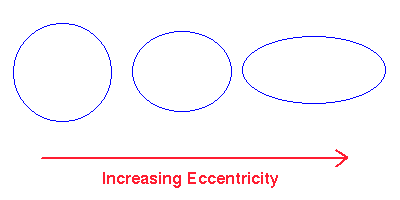
planet's closeness to Earth, and because it has an unusal eccentric orbit. Eccentricity is the amount of flattening of an
ellipse. It was believed, before, that the planets orbits consisted of cirlces,
when they are in fact ellipses. In 1604, Kepler finally considered the motion of
Mars as it would be seen from the sun.
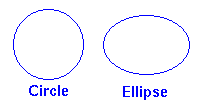
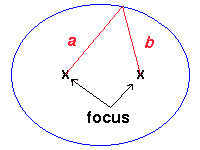
An ellipse is a curve that represents the
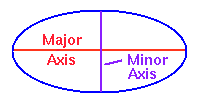
distance from two fixed points. Because its an oval, an ellipse has two axes,
major and minor. An ellipse's shape depends on the separation of the points.
Kepler found
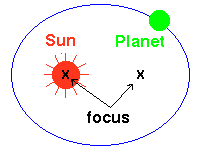
that the sun had to be located at one point of the ellipse.
As well, each
planet had a separate elliptical path and eccentricity. Even after Kepler's
discovery, it still wasn't until 1621 that he finished, after hardcore
mathematical calculations, his three laws of planetary orbits:
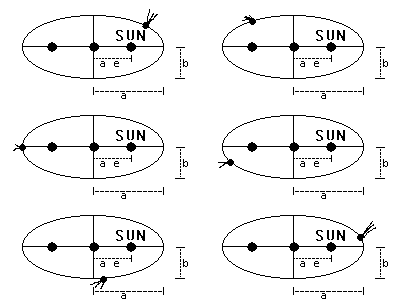
- Kepler's First Law:The sun is at one focus, while
the planet's orbit the sun in an ellipse.
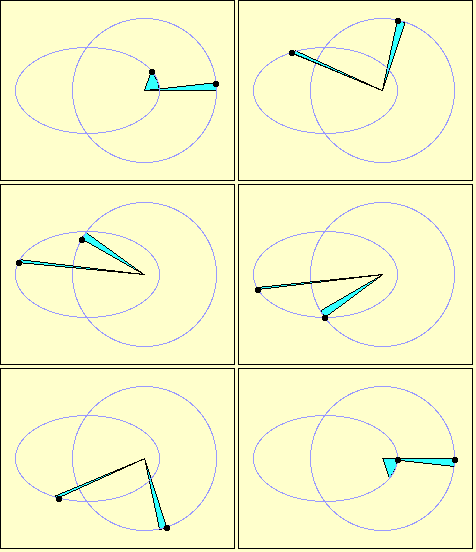
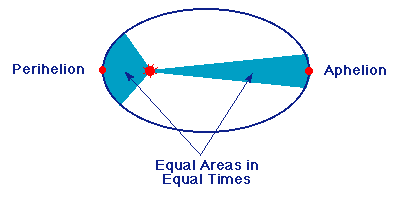
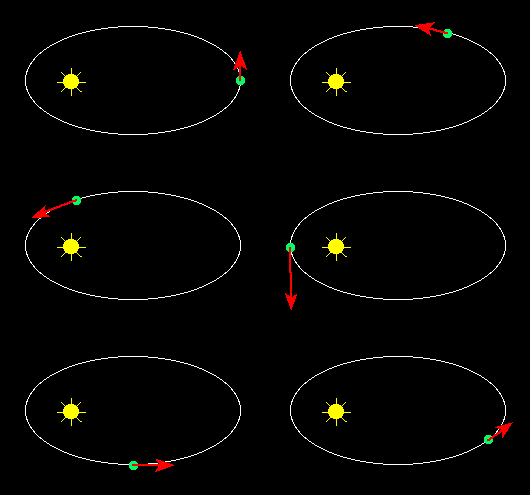
- Kepler's Second Law:Planets move faster when they
are nearer the sun. The imagined line from the sun to the planets sweeps out
an eual area in equal time.

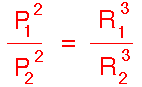
- Kepler's Third Law:The square of the orbit's period
is equal to the cube of half the major axis of the ellipse.
Kepler's third law is often called the harmonic law. He always hoped
and tried to find deep meaning in the cosmos, and Kepler assigned musical notes
to the planets based on his third law. He heard a music in the planets that is
reflected by the "beauty" that mathematicians and physicists see in Kepler's
third law.
A correct mathematical description of the planets' motions was
provided by Kepler's three laws, and has some predictive power. For example, if
a new planet were to be discovered in our solar system, we could not only
predict its orbital speed around the sun, but also predict the orbital period of
that planet.
But Kepler's laws don't provide the reason why there is
motion, yet his third law gives us a clue to this. If planets orbiting farther
away from the sun orbit more slowly, then the sun must influece their motion.
Sunlight also diminishes with distance, indicating some force coming from the
sun that moves the orbiting planets along. Therefore, this force decreases with
distance, making the planets orbit more slowly. At the time, Kepler had no
definition of intertial motion -- he didn't really know what it was and
therefore couldn't grasp gravitational law.
As a man, Kepler was unassuming and quiet. The greatness and fame he
achieved didn't seem destined for him and he wasn't held in high regard by
others in his day. But Kepler was a persistent man, mathematically gifted, and
intellectually honest. Kepler summarizes his achievements in his own
epitath:
I measured the heavens, now I measure the
shadows,
Skyward was the mind, the body rests in the
earth.
This site maintained by Adam
Johnsen.
�2000