
In 1887, two physicists created an experiment to measure the Earth with
respect to the so-called "preferred" reference frame that Maxwell's equations
seemd to suggest.
Albert Michelson and Edward Morley's experiment was
asking whether the transit time would be equal for the two roundtrips of the
light beams in their experiment (See below for a description of the
experiment).
They measured this time for the light beams by recombining
the beams when they arrived back at their starting point. The light waves would
then be superimposed, one on top of the other. If the light beams had different
travel times, then their phases would be out of line when recombined. Light
waves with different phases produces a pattern of light and dark when viewed by
an inferometer (See below).

Interference "fringes" showing no
change as the interferometer is rotated. (G. Joos, Lehrbuch der Theoretischen
Physik, Akademische Verlags., Leipzig, 1930)
George Fitzgerald
was the first physicist to accept the idea of the experiement, he
wrote:
"I have read with much interest Messrs. Michelson and Morley's
wonderfully delicate experiment....Their result seems opposed to other
experiments....I would suggest that almost the only hypothesis that can
reconcile this opposition si that the length of material bodies changes,
according as they are moving through absolute space or across it, by an amount
depending on the square of the ratio of their velocities to that of
light."
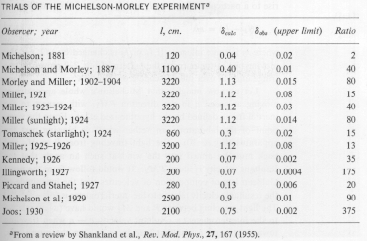
But when the experiment was completed, they observed no
difference in the light travel times. They tried the experiment many more times
and at different times of the year, but eventually conceded that light's speed
is the same for any direction. Even with their experimental limitations
recognized, the speed of light had to be equal in both directions. This result
was important because it meant that Newtonian physics were valid -- there was
nothing wrong its foundations. Physicists could trust Newton's laws and not
worry about there being a preferred reference frame that might make their
measurements and calculations, and therefore theories, invalid.
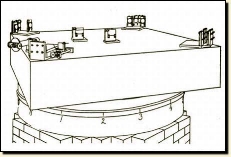
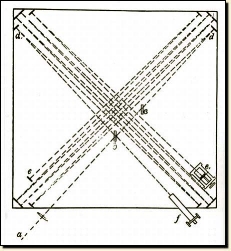
 The Michelson-Morley Inferometer was an experimental
setup in which a beam splitter split a light beam into two parts. One half moved
in one direction, struck a mirror, and then was reflected back to another
mirror. The other half of the beam did the same thing, but in a different
direction.
The Michelson-Morley Inferometer was an experimental
setup in which a beam splitter split a light beam into two parts. One half moved
in one direction, struck a mirror, and then was reflected back to another
mirror. The other half of the beam did the same thing, but in a different
direction.
The setup they used could be rotated. Two different arms
(which the light beam halves traveled) could be moved in the direction the
Earth's motion. So the apparatus had a light source, a beam splitter, and
several angled mirrors to reflect the light back.
The original apparatus
was mounted on a block of stone that floated in a mercury pool. They could
rotate the block to see changes relating to the Earth's motion in orbiting the
sun. One set of light beams was set to travel parallel to the direction of the
Earth through space, while another set of light beams was set to travel cross
this motion.
 James
Maxwell had a theory showing that electricity and magnetism were actually only
part of one electromagnetic force. He was then later able to show that
electromagnetic radiation was actually light itself. But his theory and
equations were dependant on the speed the light travels. But velocity is
relative, so his equations were not invariant -- they were relative.
James
Maxwell had a theory showing that electricity and magnetism were actually only
part of one electromagnetic force. He was then later able to show that
electromagnetic radiation was actually light itself. But his theory and
equations were dependant on the speed the light travels. But velocity is
relative, so his equations were not invariant -- they were relative.
Yet
the lack of invariance did not bother physicists of the time, at first that is.
The early reasoning was that light traveled through a medium, the luminiferous ether. They reasoned this because waves in matter
required a medium in which to propagate (move). But one should keep in mind that
this is not the same as Aristotle's ether. This luminiferous ether apparently
only existed to provide the expected medium for light; it had no mass and could
not be seen. It was wondered why the ether should exist for so special or
specific a function, becuase air does not exist solely for sound waves to move
through. But at the time, the view of waves was so set that no other alternative
was taken seriously.
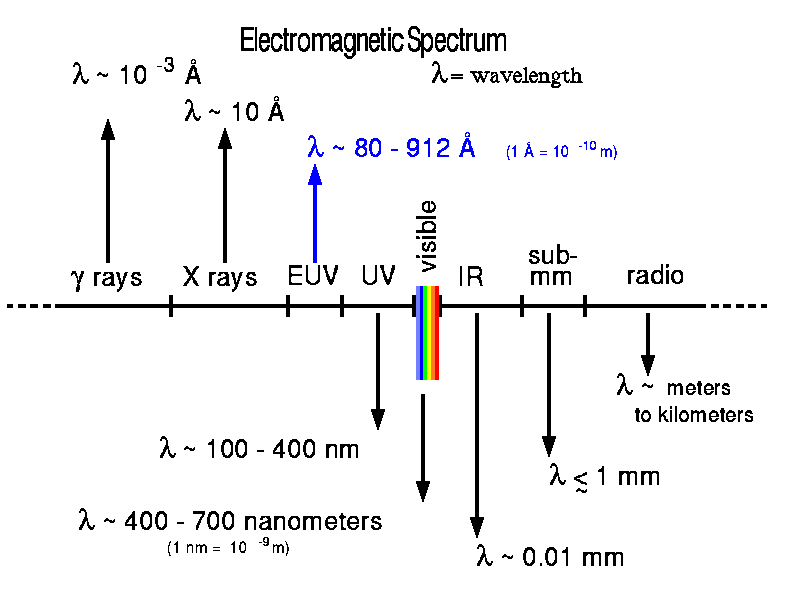
Electromagnetic waves,
traveling disturbances in the electromagnetic spectrum,
do not need to move through anything to propagate (see previous Page). Because
electromagnetic waves share the same nature, they differ only by wavelength.
Groups of frequencies, or bands, divide the spectrum.
Radio waves occur at low frequencies, and then moving to the higher frequencies
are microwaves, infrared radiation, visible light, ultraviolet
radiation, X-rays, and at the very shortest frequency, gamma radiation. But the only reason these waves have different
names is because of their separate discoveries before it was known they were of
the same nature. The band division has so signifigance. Visible light, that
which we can all see, is not fundametally different from any of the other
waves.
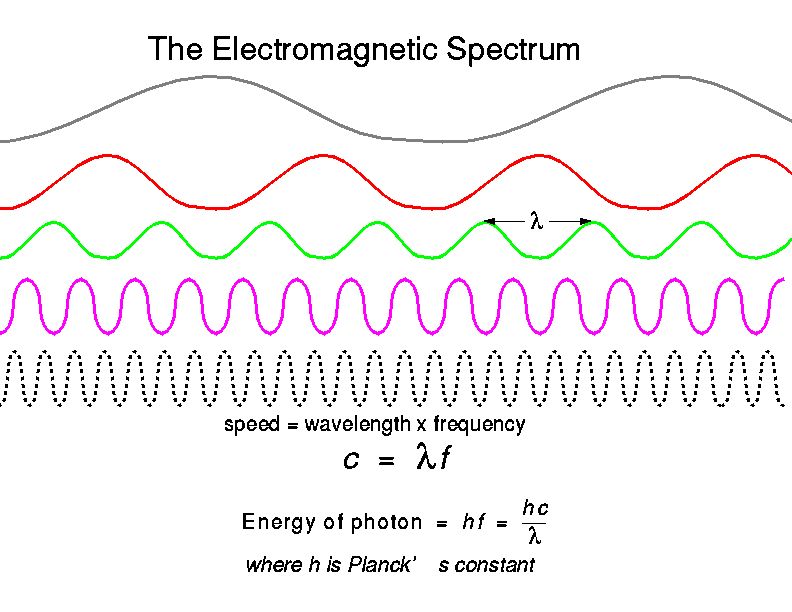
The speed
of the motion of waves in a vacuum is the speed of light. All electromagnetic
waves move at this speed, but only in a vacuum. When moving through a medium of
some sort, a group of electromagnetic waves will travel through the medium at
different speeds. This is called dispersion.
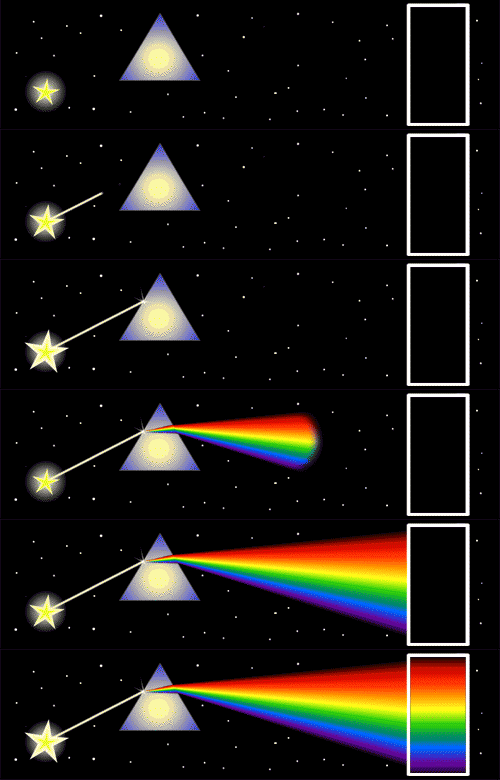
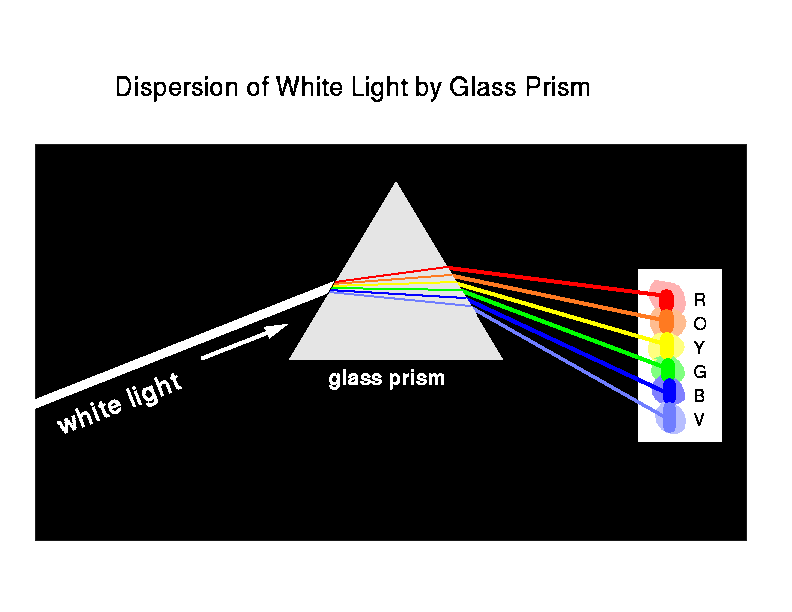 All
the wavelengths in the visible band of the electromagnetic spectrum compose
white light. When white light passes through a prism, the different wavelengths
move at slightly different speeds through the glass and make them refract
differently at the two surfaces they cross. The prism splits the white light
into its "colored" components.
All
the wavelengths in the visible band of the electromagnetic spectrum compose
white light. When white light passes through a prism, the different wavelengths
move at slightly different speeds through the glass and make them refract
differently at the two surfaces they cross. The prism splits the white light
into its "colored" components.
But...
Under Galilean
transformations, however, Newton's laws of an object's motion are invariant (please see the link if you need a recap of
invariance and transformations). All frames are equal and there is no specific
rest frame. The transformations are supposed to link observations in one frame
to how the observations should look in another frame. Yet, with the
transformations, the equations associated with electromagnetism are not
invariant. The speed of light in electromagnetism is not an invariant quantity /
measurement.
Maxwell, the creator of the electromagnetism equations,
thought there should be a specific frame where his equations would be correct,
corresponding to the idea of the specific rest frame. If so, then all
measurements in any other frame would be related to the rest frame because an
observer would have to recognize the relative motion between the rest frame and
whatever other frame the measurement are being taken from.
But, again,
the Michelson-Morley experiment could not detect or find evidence for motion
with respect to a specific rest frame. In the absence of this frame, the speed
of light didn't have a special frame. Two possibilites that physicists didn't
want to consider arose:
- Maxwell's equations were wrong, or even maybe the physics of light wasn't
the same for all inertial frames.
or
- Galileo's transformations were not right. But this possiblity would
suggest something was wrong with Newton's mechanics.
But the
problem still existed that Newtonian equations were just as successful at
explaining mechanics as Maxwell's equations were at explaining electromagnetism.
Explaining the Result
In 1889,
George F.FitzGerald made one of the first attempts to explain the
Michelson-Morley result. His theory was that an object moving through a frame
would shrink in the direction of its motion because of the ether. If an arm on
the inferometer was shortened in the direction parallel to the Earth's motion,
the travel distance for the light moving that direction would be shortened by
the amount needed to make up the change in the speed of the light's propagation.
If this was done, the trip time for both light beams would be equal, and
not produce the pattern of light and dark fringes. But
there was no theory explaining why objects would contract this way. One
hypothesis was that because intermolecular forces are electromagnetic in nature,
then maybe matter's structure was affected by motion.
But a lot of
scientists clung to a conservative view, that moving objects drag the ether
along with them -- near the Earth's surface then, no relative motion and drag
would be detected. Part of this theory was due to the knowledge that light
moving through a moving fluid was different than if the fluid was at rest. Some
of the fluid's velocity taken up by light. But if light is dragging the ether,
it should lose energy and slow down in orbit, ultimately falling into the sun.
Yet no effect like this was observed.
Ernest Mach had a braver proposal
for the Michelson-Morley result. He said that no ether-relative motion was seen
because the ether didn't exist. Because the ether was not detected after an
elaborate experiment to test its existence, he said, then the theory was proved
wrong.
With Fitzgerald's theory, there was not any known force that
could make a moving object shrink along its direction of movement. Hendrick
Lorentz believed the result of the Michelson-Morley experiment, but at the same
time he took Fitzgerald's suggestion of contraction seriously. Fitzgerald, Henri
Poincare, and Joseph Lamour reexamined electromagnetism and found something
peculiar. If Maxwell's equations were expressed by electric and magnetic fields
measured at rest, the equations took on a simple, pleasing mathmeatical form.
However, if the equations were expressed in terms of different fields
experienced by someone moving through them (the ether), then the equations took
on a more complicated appearance. The laws or equations could be made to appear
simple by imagning that all moving objects shrink by the amount Fitzgerald's
theory suggested. This thought woulde plain the Michelson-Morley result. But
this wasn't enough, because to make the equations simple, it would also have to
be imagined that time moves more slowly as well.
This site maintained by Adam
Johnsen.
@1999


