
|
BEGINNINGS OF BAKU |
|
|---|
|
|
BEGINNINGS OF BAKU |
|
|---|
There is nothing legendary about the "flaming rock" to be seen near the village of Mahomedly in the Apsheron steppe. A rocky slope covered with flaming torches of escaping methane, which have been burning, it is thought , allmost ever since the time of Alexander the Great, must have appeared like a miracle to the fire-worshiippers.
The name of Baku may be also connected with zoroastrianism if it si derived from the word "bak"-which in a number of ancient languages means "sun", "god", rather than from the word "wind" or "hill". The word, presumably, came to be used both as a name for the tribes or sects of fire-worshippers, bakans, who inhabited these parts, and as a name for the city.
|
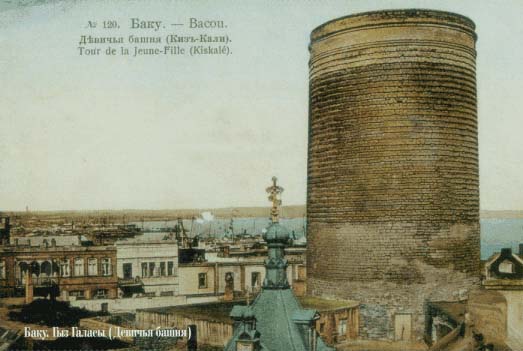
The exact age of Baku, undoubtedly a very ancient city, is difficult to detrmine. Numismatic and archaeological evidence goes back to the 5th century A.D. The first written record we have for the town was made by an Arab geographer in 930 A.D. The earliest excavations in the Icheri-Shekher (Old City) revealed a densely populated area with the remains of houses and other buildings, a lot of pottery and other finds dating form 5th to 8th century. The first reference to the flames near Baku comes in a description of the Scythian route and takes us back to the first centuries A.D. Some historians ascribe the foudation of Baku to Darius (c. 6th century B.C.) The English scholar F.Petrie identified Baku with "the mountain of the rising sun, Vakhau" in Egyptian Book of the Dead, and suggested that its namederived from baka meaning "dawn", Baku being situated on the Eastern slopes of the Caucasus... |
|---|
However that may be, it is certain that human settlements existed on Apsheron several thousand years prior to the Christian era. A dried-up oil lake has been discovered near Baku which 35-40 thousand years ago attracted animals by its deceptive gleam. Coming here to drink they got stuck and died to be well preserved together with plants and fruit. Abundant flora and fauna attracted juman nabitation. This is confirmed by the traces of charcoal. Finally, there is Kobustan with its primitive settlements and famous rock-carvings, some of them 10 thousand years old.

|

|
|---|