Baku Today
INDUSTRY
In the 1980s Azerbaijan became the biggest producer of grapes in the USSR-its grape begin equal to that of the other Caucasian republics and the Russian Federation put together; and a major producer of cotton, vegetables, tea, tobacco, citrus fruit, saffron, olives, pomegranates, nuts, etc. Agricultural growth simulated the food and canning industry. A champagne factory was built in Baku.
Azerbaijan was a major Soviet manufacturer of ail products, steel pipes, non-ferrous metals, Synthetic rubber, electric engines, automobile tryes, mineral fertilizers, building materials, electrothermic equipment, china and earthenware, carpets, textiles, wool, cotton and natural silk. It accounted for 70 per cent of Soviet oil-producing equipment, and most of the air-conditioners made in the country; about 360 items were exported to 80 countries. Despite efforts at decentralization, to foster industry in the other cities of Azerbaijan, almost half of the above mentioned goods were made in Baku.
Baku today is known not only for its oil and petrochemical industry, but also for its electrical, mechanical and radio engineering, electronics, tale-communications, and machine tools industries. New industries speeding up the technological revolution account for over one third of its industrial structure, but this in not to say that the extraction industry is decreasing in importance:oil extraction is four times that of 1950, gas production also in the increase. The latest subsea technology is used, including cable drilling.
The scale of open-sea oil exploration and extraction in the Caspian made it necessary to set up a yard for building deep-sea platforms. These platforms which are delivered to site by dowcoal dump-barges are the size of a football pitch. Still newer methods for oil extraction are being researched.
A long-term development plan for Greater Baku has been drawn up to the year 2000. Baku combines three characteristics making for dynamic growth-a capital city, ti has an advanced industry plus rich natural resources. In the near future Greater Baku will absorb towns within a 70-mile radius of the city. Trees will be planted over 15 per vent of the area of Grater Baku.
HOUSING
The inner city is also being replanned: new buildings include hotels such as the Moskva and Karabakh, Gulistan restaurant, a new cultural center, the Youth Center, an attractive marriage registrar's office, a new market, Sherg Bazary, new department stores, schools, shops, hospitals, etc. A ring road and motorways have been constructed to ease the traffic. The water supply is improved daw to the construction of a new pipeline from the Kura river. Housing Construction is constantly growing-every fifth citizen has recently moved to a new house.
EDUCATION
Baku has become an important educational and research center: virtually all of Azerbaijan's university-level educational establishments and research institutions are to be found in the capital. Graduates from dozens of countries have received a higher education in Baku.
Baku is sometimes referred to as an"oil academy" for its achievements in fundamental research in that fields and some technical breakthroughs, such as tribune drilling, cementation of oil-wells, obtaining synthetic rubber from natural gas. Visitors form all over the world come here for advice and consultations. Baku experts have contributed to oil exploration in the whole world, as well as to the theory and practice of the petrochemical industry.
CULTURE
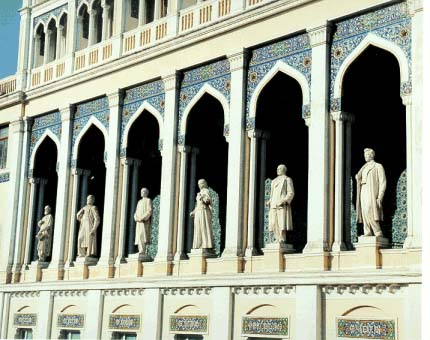
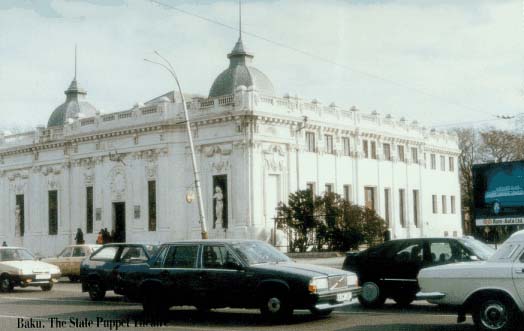
With over 180 libraries, 30 museums, more than 100 clubs and 6 theaters, Baku has a rich and varied cultural life. Among the best cultural facilities are: the Azizbeckov Drama Theater, the Vurgun Russian Drama Theater which performs in Russian, the Akhundov Opera and Ballet Theatre, whose ballet company won the gold medal at the 6th Festival of Dance in Paris in 1969, the Magomayev Philarmonic Society. The State Symphony Orchestra, The State Dance Ensemble, the State Theater of Song- won popularity different countries.
|
|
|
POETRY & MUSIC
Poetry reigned suprime in Azerbaijan art as late as the 19th century. The classical beitas were set to mugam music, manuscripts of poetry were illuminated by miniatures, carpets and other objects of applied art carried motifs from Nizami and Fisuli. Though today poetry shares its popularity with the other arts, the Day of Poetry still arouses great enthusiasm.
MOVIE
The national Azerbaijan-Film studios produces feature films, popular-science films and documentaries many of which have won acclaim in many countries. Here the best Russian and Foreign films are dubbed into Azerbaijani.
|
HEALTH
Great importance is attached to the health service. The urological clinic, provided with the latest equipment, conducts important research and admits patients from Azerbaijan, as well as from neighboring regions. Baku has over 90 hospitals, and 40 sanatoria, pensions and rest homes, where cost of accommodation and treatment is either fully or partially covered by the trade unions.
All medical care is free.
TRANSPORT
Baku is a major transport junction. Azerbaijan has about 750 miles of railway. Suburban trains carry about 150,000 commuters a day. There are flights from Baku's Bina airport to more that 70 cities in different countries. Ships of the Caspian Fleet call at 125 ports in 30 foreign countries. The Baku-Krasnovodsk ferry service cuts from three to three thousand miles off the journey form European part of Russia to Central Asia.

