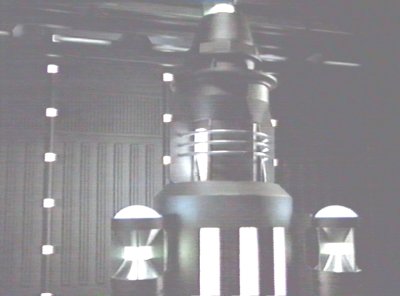
The main computer core is situated on decks 10, 11 and 12.
The main computer processor's specifications are as follows:
Simultaneous access to 47 million data channels, transliminal
processing at 575 trillion calculations per nanosecond, and operational
temperature margins from 10 degrees Kelvin to 1790 degrees Kelvin.
Processing is vastly speeded up by the use of bio-neural gel packs, a
feature which was first introduced to Starfleet's Intrepid-class ships.
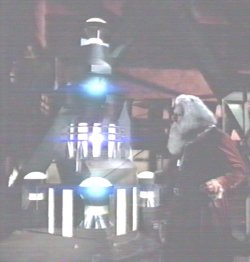
The main computer processor as installed by Tau on his
planet. [#79 Concerning Flight]
[#79 Concerning Flight]
On Stardate 51386 an alien called Tau stole it and other
items from Voyager, using a high-energy transport beam designed to locate
and remove objects of technological value. An alien informed Chakotay that
Tau had stolen the device and it had made Tau a rich man. Janeway, aided
by the holocharacter Leonardo da Vinci, located the stolen computer
processor and it was beamed back to Voyager.
The auxiliary computer core runs through decks 6 and 7.
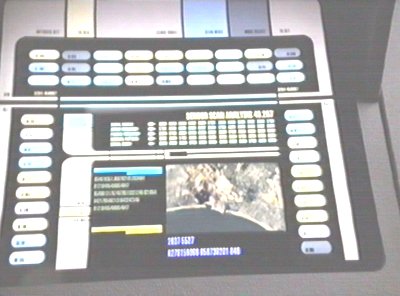
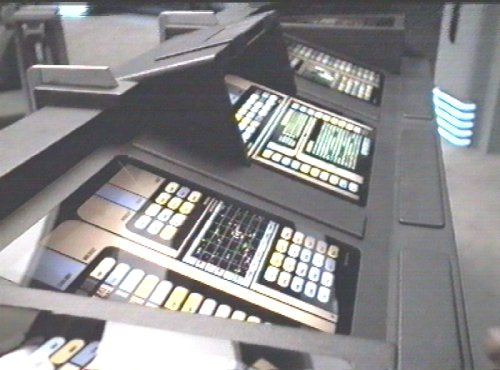
The computer operating system is known as LCARS (acronym for
Library Computer Access and Retrieval System). The distinctive character of its
monitor displays and control interfaces can be found throughout the ship, in
shuttlecraft etc.
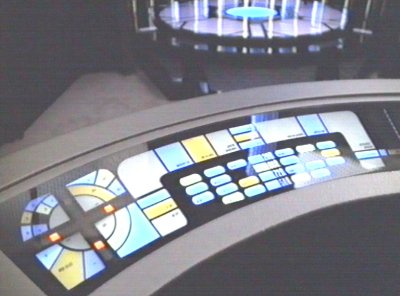
Part
of Ops controls, the middle part under the "hood" [Blink of an
Eye]
Ops
controls [Pathfinder]
Part
of the transporter control console. [Counterpoint]
The Interior Ship's
Tour (Detailed) contains some pictures of various LCARS displays etc., and
will eventually contain more detailed information including pictures and text of
specific computer consoles. So far there is a small selection plus a page on the Tactical/Security
station.
The computer functions utilising bio-neural circuitry, an
advanced system featuring on Intrepid-class ships.
Lt. Stadi tells Tom Paris in [Caretaker]: "The gel packs on Voyager
contain bioneural cells that organize information more efficiently and
speed up response time."
from [Learning Curve]
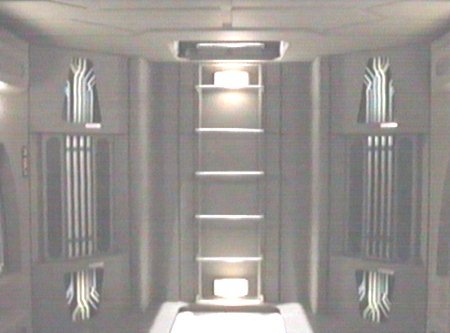
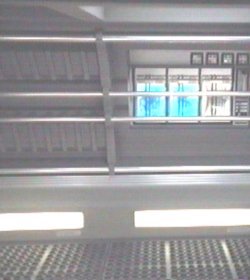
Part of the Jefferies tube system. On the left,
just out of picture, low-level doors to the left lead to the crawlway that
accesses bio-neural gel-pack sequence 6-theta-9 [#93
One]
bio-neural
gel-pack sequence 6-theta-9....
....and
the part of the crawlway giving access to them.
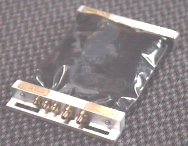
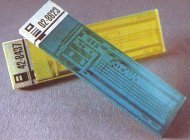
isolinear chips Picture:
Encyclopaedia
There are two computer cores. One is located near the
centre of the primary hull, the other in the engineering hull. Data is
kept on small isolinear optical chips.
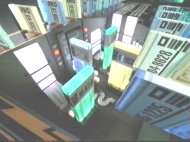
isolinear chips Picture: 'DS9'
episode [One Little Ship]
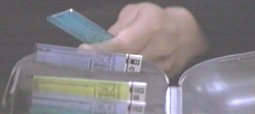
[#10 Prime Factors]
In [#10 Prime Factors], certain crewmembers downloaded the
ship's entire database of stories onto these isolinear datachips which
were kept all together in a small case.
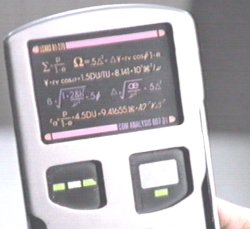
portable computer [Caretaker]
Bethel also has the usual portable computer, and PADDs
(acronym for "personal access display device").
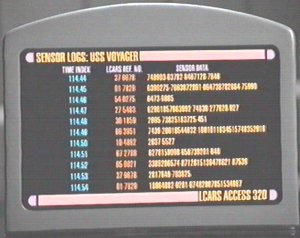
sensor logs display on The Captain's personal computer [Dark Frontier]
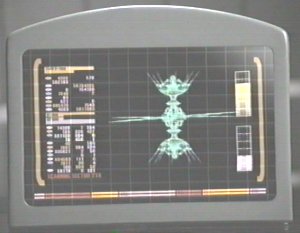
display of the Hirogen communications relay network [Hunters]
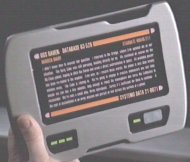
Above: One type of PADD, shown displaying text
and a picture.
All Starfleet PADDS are now fabricated from micromilled duranium and operate
on sarium-krellide power cells. They employ dynamic resolution switching created
by a nanopixel molecular matrix. They are light and easily portable. There are
various sizes. All PADDS contain subspace transceiver assemblies (STA) for data
transmissions to larger core computers. Isolinear memory storage capacity ranges
from 15.3 kiloquads to 97.5 kiloquads although the exact capacity of Voyager's
PADDS is unknown (not stated in sources).
DIAGNOSTICS
Every so often the command is given to conduct a diagnostic of certain ship's
systems, for instance "carry out a Level 1 diagnostic". The procedure aboard
Federation starships utilises pre-programmed engineering analysis software
programs, available for use when actual or potential malfunctions are
experienced. The diagnostic programs carry out an automated determination of
systems performance, and at the same time identify any malfunctions. Key systems
have a number of such diagnostic programs available, ranging from Level 5, which
is the fastest and most automated, to Level 1 which is the most thorough but the
slowest as it necessitates the most manual labour. Which level of diagnostic
utilised depends on a number of factors, particularly how critical the situation
is and on the amount of time available to carry out the procedure.
In detail the diagnostic levels are as follows, and are standard on all
Federation Starfleet vessels:
Level 1 Diagnostic This refers to the
most comprehensive type of system diagnostic, which is normally conducted on
ship's systems. Extensive automated diagnostic routines are performed, but a
Level 1 diagnostic requires a team of crew members to physically verify
operation of system mechanisms and to system readings, rather than depending on
the automated programs, thereby guarding against possible malfunctions in
self-testing hardware and software. Level 1 diagnostics on major systems can
take several hours, and in many cases the subject system must be taken off-line
for all tests to be performed.
Level 2 Diagnostic Level 2 Diagnostic.
This refers to a comprehensive system diagnostic protocol which, like a Level 1,
involves extensive automated routines, but requires crew verification of fewer
operational elements. This yields a somewhat less reliable system analysis, but
is a procedure that can be conducted in less than half the time of the more
complex tests.
Level 3 Diagnostic Level 3 Diagnostic.
This protocol is similar to Level 1 and 2 diagnostics but involves crew
verification of only key mechanics and systems readings. Level 3 diagnostics are
intended to be performed in ten minutes or less.
Level 4 Diagnostic This automated
procedure is intended for use whenever trouble is suspected with a given system.
This protocol is similar to Level 5, but involves more sophisticated batteries
of automated diagnostics. For most systems, Level 4 diagnostics can be performed
in under 30 seconds.
Level 5 Diagnostic This automated
procedure is intended for routine use to verify system performance. Level 5
diagnostics, which usually require less than 2.5 seconds, are typically
performed on most systems on at least a daily basis, and are also performed
during crisis situations when time and system resources are carefully managed.
Sources: Encyclopaedia, and STTNG Technical Manual.


 DIAGNOSTICS